
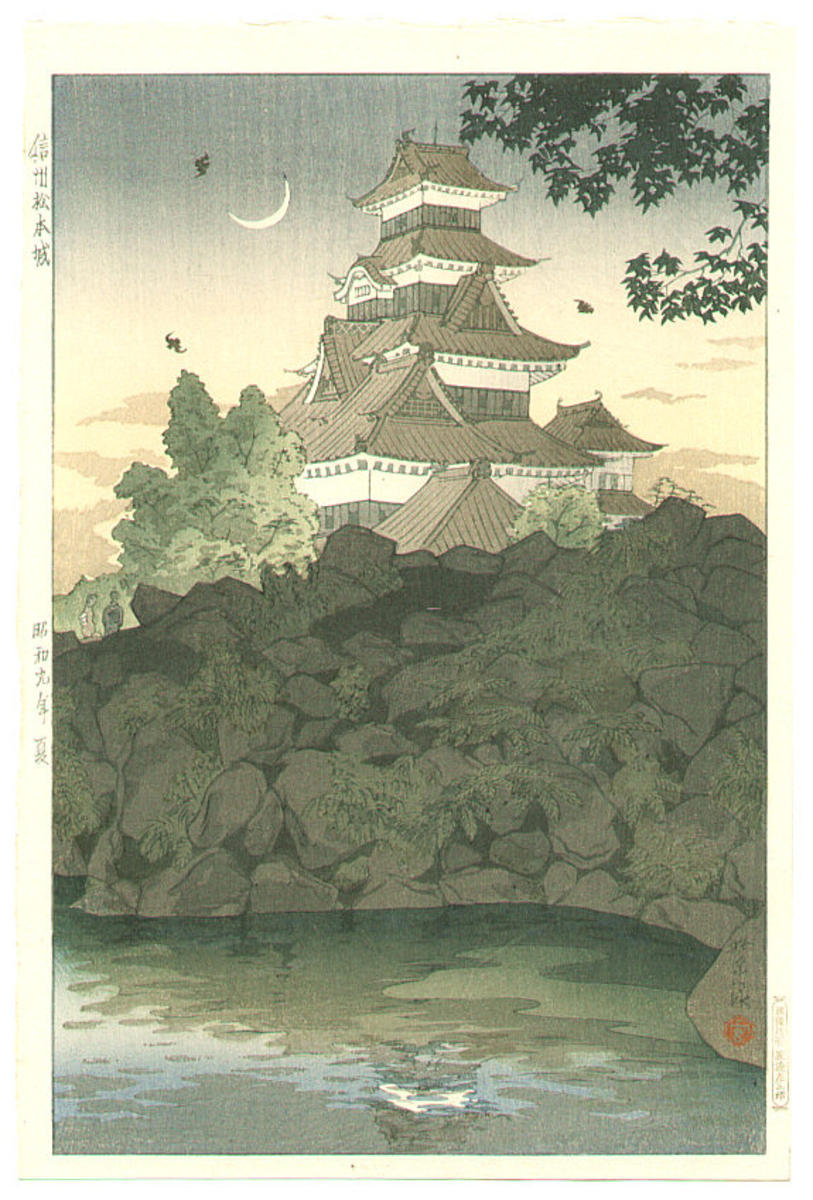
Matsumoto Castle
- Medium:
- Mokuhanga (Japanese woodblock)
- Image courtesy of
- Saru Gallery
Description
Matsumoto-jo, the early-Edo donjon in Nagano Prefecture nicknamed Karasu-jo, the crow castle, for its black-lacquered exterior, is among the most recognizable surviving castle keeps in Japan. Kasamatsu's print almost certainly arranges the structure with its surrounding moat, allowing the keep and its red Tsukimi-yagura turret to double in the still water—a compositional formula that exploits the keyblock's strong silhouette against a tonal sky and lets the printer carry symmetry through the design. The black tower presents a specific technical demand: ink must be laid down with enough density to read as lacquered architecture without flooding into the surrounding washi, requiring careful baren control and likely multiple impressions of the dark block. Castle subjects entered the shin-hanga vocabulary somewhat later than temple and shrine views, and Kasamatsu produced several across his career—Himeji and Nagoya as well as Matsumoto. The print connects to the broader meisho-e tradition of provincial famous places carried forward by the Watanabe and post-Watanabe workshops through the mid-twentieth century.
More Prints by Shiro Kasamatsu

More Castles Prints


Featured in Collections
Curated cross-cuts that include this print.
Frequently Asked Questions
Matsumoto Castle was created by Shiro Kasamatsu (笠松紫浪).
Matsumoto Castle depicts castles.