
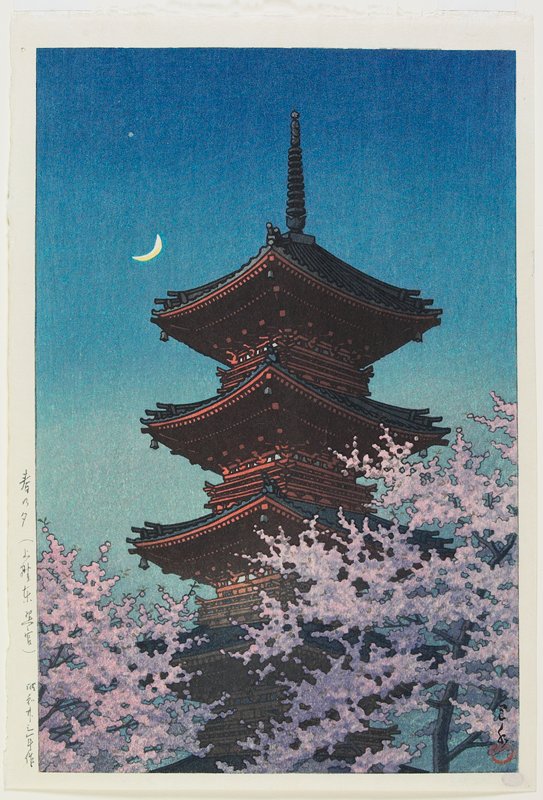
Spring evening in Ueno Park, Tokyo
- Medium:
- Mokuhanga (Japanese woodblock)
- Image courtesy of
- Saru Gallery
Description
Ueno Park has been the principal hanami site in Tokyo since the Edo period, when Tokugawa Iemitsu had cherries planted at Kan'ei-ji. Kasamatsu's print combines two of his characteristic registers — the spring blossom subject and the evening scene — by depicting the park after dark, when paper lanterns are lit beneath the cherry trees. The composition foregrounds a path, a tea-house, or a row of lanterns receding under the canopy, with blossoms printed in soft pinks against a deeper ground. Bokashi is used both for the night sky and for the diffuse glow under the lanterns. Spring evenings at Ueno had been a print subject through Hiroshige and Kiyochika; Kasamatsu's twentieth-century version retains the meisho-e framing but draws on shin-hanga interest in artificial light. Kasamatsu was born in nearby Asakusa in 1898 and would have known the park from childhood.
More Prints by Shiro Kasamatsu
More Spring Prints

Featured in Collections
Curated cross-cuts that include this print.
Frequently Asked Questions
Spring evening in Ueno Park, Tokyo was created by Shiro Kasamatsu (笠松紫浪).
Spring evening in Ueno Park, Tokyo depicts spring, night scenes, and gardens.