
Shuzenji Hotsprings
- Date:
- 1937
- Medium:
- Color woodblock print
- Source:
- Art Institute of Chicago
Description
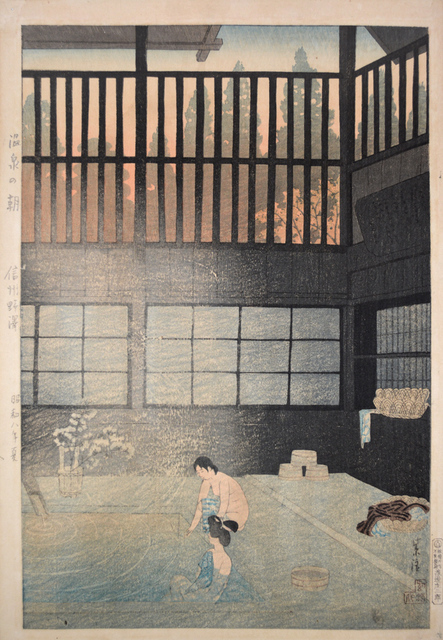
Shiro Kasamatsu produced Shuzenji Hotsprings in 1937, a mature shin-hanga landscape from one of the most productive periods of his collaboration with the publisher Watanabe Shozaburo. Shuzenji, on the Izu Peninsula in Shizuoka Prefecture, is among the oldest hot-spring towns in Japan, traditionally associated with the wandering monk Kukai and a long history of literary pilgrimage. Kasamatsu turns this storied valley into a quiet study of water, mountain, and built form rather than a tourist scene. Wooden inns, tile roofs, and stone embankments cluster along the Katsura River, while wooded slopes rise behind them in carefully graded blocks of green and slate. The image is held by Kasamatsu's characteristic colour register: soft mineral blues for distance, muted ochres for timber buildings, and a controlled use of white reservation for steam and water. The print exemplifies how Kasamatsu adapted the shin-hanga workflow, in which artist, carver, and printer worked under the publisher's direction, to subjects drawn from regional rather than metropolitan Japan. Watanabe's workshop pushed for technically refined editions aimed at both domestic and overseas collectors, and Shuzenji Hotsprings shows the polish that came out of that system: precise registration, gradient bokashi printing in the sky, and disciplined keyblock outlines that never overwhelm the colour. As a record of an inland onsen town in the late 1930s, the work also has documentary value, capturing a way of life and a built environment that was already being altered by tourism, modernisation, and the approach of war. The print is held in the Art Institute of Chicago's collection of Japanese prints.
More Prints by Shiro Kasamatsu
More Spring Prints

Featured in Collections
Curated cross-cuts that include this print.
Frequently Asked Questions
Shuzenji Hotsprings was created by Shiro Kasamatsu (笠松紫浪) in 1937.
Shuzenji Hotsprings depicts spring.