
Mt. Fuji and A Lake
- Source:
- ukiyo-e.org
Description
Mt. Fuji and A Lake, held in the Honolulu Museum of Art, is one of the many Fuji views Takahashi Shotei contributed to the chuban landscape catalogue assembled by his publisher Watanabe Shozaburo. Working under his art name Hiroaki, Shotei treats the mountain not as a singular icon but as a quiet element within a wider lake scene, framing the peak with low pine-shrouded shores and a foreground of still water that mirrors the sky. The image draws on a long Japanese tradition of placing Fuji within Hakone or Kawaguchi-ko vistas, but Shotei stages the view in the soft tonal register that came to define the shin-hanga revival: a high pale band of bokashi above the summit, a layered grey-blue distance, and reflections rendered with carefully wiped pigment. As one of Watanabe Shozaburo's most prolific designers, Shotei produced Fuji subjects in many sizes and times of day, and the Honolulu sheet sits within that larger group as a calm midday or early afternoon variant. The chuban landscape format gives the design a portable scale well suited to the early twentieth-century export market that Watanabe cultivated abroad, while still allowing the printer to demonstrate the workshop's gradient skies and reflective water effects. The Honolulu Museum of Art's impression is one of the surviving examples that allow viewers to trace Shotei's Fuji compositions across his career, especially valuable because the 1923 Great Kanto earthquake destroyed many of the publisher's original blocks. The print remains a clear example of how shin-hanga repackaged the classic Fuji motif for a new generation of collectors at home and overseas.
More Prints by Takahashi Shotei

More Mount Fuji Prints
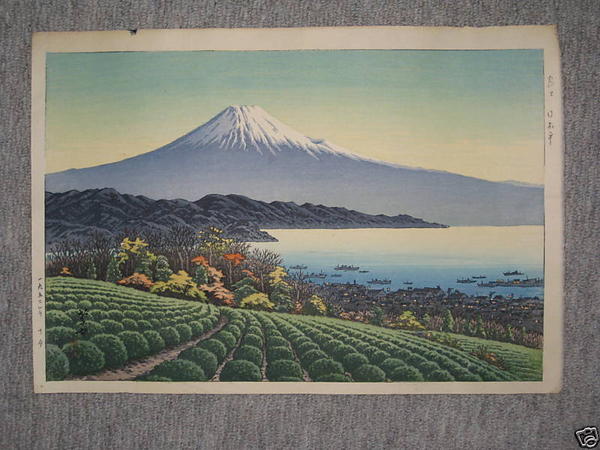
Fuji from tea farm
Woodblock print

Akasaka, Fujikawa, Okazaki, Chiryu, and Narumi, from the series "Famous Places on the Fifty-three Stations of the Tokaido, Five Stations (Tokaido gojusan eki goshuku meisho)"
c. 1830/35
Color woodblock print; oban
![Mount Fuji on a Moonlit Night, Kawai Bridge (Tsukiyo no Fuji [Kawaibashi]), from the series "Selection of Views of the Tokaido (Tokaido fukei senshu)" by Kawase Hasui](https://www.artic.edu/iiif/2/d0960668-1e73-339a-b182-fb995a54bff0/full/843,/0/default.jpg)
Mount Fuji on a Moonlit Night, Kawai Bridge (Tsukiyo no Fuji [Kawaibashi]), from the series "Selection of Views of the Tokaido (Tokaido fukei senshu)"
1947
Color woodblock print; oban

Mt. Fuji in Rain (Ame no Fuji)
n.d.
Color woodblock print
Featured in Collections
Curated cross-cuts that include this print.
Frequently Asked Questions
Mt. Fuji and A Lake was created by Takahashi Shotei (高橋松亭).
Mt. Fuji and A Lake depicts mount fuji.