
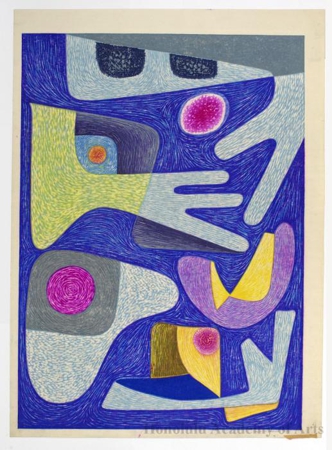
Semi-abstract Nude
- Medium:
- Mokuhanga (Japanese woodblock)
- Image courtesy of
- Saru Gallery
Description
Semi-abstract Nude reflects the abstract turn that many sosaku-hanga artists took during the postwar decades, when the creative-print movement absorbed influences from European modernism and the Japanese avant-garde. The figure is reduced to essential contours and volumes rather than rendered anatomically, a treatment well suited to the woodblock's natural inclination toward bold, planar form. Shinagawa would have drawn, carved, and printed the work himself in keeping with his lifelong adherence to jiga, jikoku, jizuri. Color is typically applied in a small number of registered impressions, with the grain of the cherry or katsura block sometimes incorporated into the surface texture. The nude as subject sits apart from his more frequent rural landscapes, demonstrating the breadth of subject matter he engaged with over a career spanning more than seven decades. It aligns him with contemporaries such as Tetsuro Sawada and Yoshitoshi Mori, who similarly explored the human figure in abstract terms.
More Prints by Takumi Shinagawa


![Music in Spring (Shunfu [Haru no fu]), Shôwa period, mid 20th century by Takumi Shinagawa](https://data.ukiyo-e.org/harvard/images/HUAM-CARP06220.jpg)
More Nude Prints

Tsuta Hot Springs in Mutsu Province (Mutsu Tsuta onsen), from the series "Souvenirs of Travel, First Series (Tabi miyage dai isshu)"
Mutsu Tsuta onsen
1919
Color woodblock print; oban

Namari Spa, Iwate Prefecture (Iwate ken Namari onsen)
1943
Color woodblock print

Autumn at the Arayu Hot Spring, Shiobara
Autumn 1920
Woodblock print, ink and color on paper

Arifuku Spa, Iwami, from the series "Souvenirs of Travel, Third Series" (Tabi miyage dai sanshu, Iwami Arifuku onsen)
1924
Color woodblock print
Featured in Collections
Curated cross-cuts that include this print.
Frequently Asked Questions
Semi-abstract Nude was created by Takumi Shinagawa (品川工).
Semi-abstract Nude depicts nude and abstract.