
Nagoya Castle
- Medium:
- Mokuhanga (Japanese woodblock)
- Image courtesy of
- Saru Gallery
Description
Nagoya Castle, originally constructed in 1612 by Tokugawa Ieyasu and topped by its golden shachihoko (tiger-fish ornaments), was destroyed by American bombing in 1945 and reconstructed in concrete in 1959. A Tokuriki print of the castle could depict either the pre-war wooden donjon or the post-war reconstruction, both recognisable by the five-tiered roofline and gilded finials. The composition would likely place the keep against a sky rendered in bokashi, with the surrounding moat, white-walled storehouses, and pine trees of the castle grounds in the lower register. Castles were a recurring subject in Tokuriki's meisho-e output, joining temples, shrines, and seasonal landscapes as anchors of regional identity. The reconstruction of major monuments after the war became a recurring theme in mid-century Japanese printmaking, registering both loss and the re-establishment of national landmarks. Tokuriki's architectural prints handle these subjects descriptively rather than commemoratively, focusing on the visual structure of the building.
More Prints by Tomikichiro Tokuriki
Heian Shrine in the Spring
Woodblock print
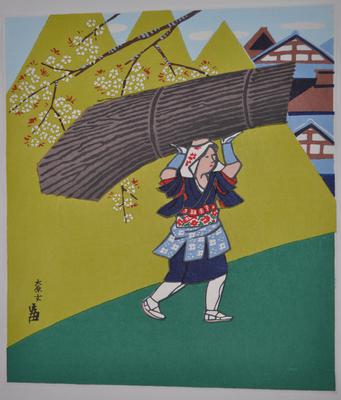
An Oharame Girl Carrying Firewood on Her Head
20th century
Woodblock print, ink and color on paper

April (Arashiyama Park, a Famous Scenic Resort)
四月 (嵐山)
second half 20th century
Woodblock print, ink and color on paper

June (Rainy Scene of the Sen-ke, Japanese Tea Ceremony Founder's House)
六月 (千家雨景)
second half 20th century
Woodblock print, ink and color on paper
More Castles Prints


Featured in Collections
Curated cross-cuts that include this print.
Frequently Asked Questions
Nagoya Castle was created by Tomikichiro Tokuriki (徳力富吉郎).
Nagoya Castle depicts castles.