
Snowy Night in Kyoto
- Medium:
- Mokuhanga (Japanese woodblock)
- Image courtesy of
- Saru Gallery
Description
This nocturne presents a snow-covered Kyoto street or temple precinct under night conditions, a combination that called on the printmaker's full tonal range. Snow scenes in mokuhanga rely on the unprinted washi ground to register accumulated snow on roofs, walls, and ground, with the surrounding darkness built up through deeply inked black blocks and bokashi gradation to convey a sky lit only by reflected snowlight. Punctuating warm lights — perhaps from a lantern, a lit window, or the glow at a temple gate — would be registered in small areas of yellow or orange to anchor the composition. Tokuriki produced numerous Kyoto views across the four seasons, and his winter and night subjects allowed for compositional restraint that contrasts with his more saturated summer temple scenes. The print continues a long meisho-e tradition of Kyoto night and snow imagery, reaching back through Hiroshige and forward through shin-hanga masters such as Hasui, while Tokuriki's handling reflects his sosaku-hanga sensibility favoring mood and place over narrative incident.
More Prints by Tomikichiro Tokuriki
Heian Shrine in the Spring
Woodblock print
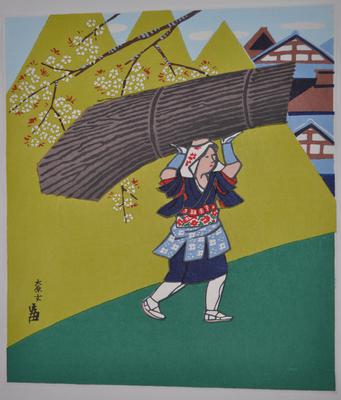
An Oharame Girl Carrying Firewood on Her Head
20th century
Woodblock print, ink and color on paper

April (Arashiyama Park, a Famous Scenic Resort)
四月 (嵐山)
second half 20th century
Woodblock print, ink and color on paper

June (Rainy Scene of the Sen-ke, Japanese Tea Ceremony Founder's House)
六月 (千家雨景)
second half 20th century
Woodblock print, ink and color on paper
More Night Scenes Prints
Evening in East Africa
Woodblock print

Evening Shower at Teradomari (Teradomari no yau), from the series "Souvenirs of Travel, Second Series (Tabi miyage dai nishu)"
Teradomari no yau
1921
Color woodblock print; oban
![Mount Fuji on a Moonlit Night, Kawai Bridge (Tsukiyo no Fuji [Kawaibashi]), from the series "Selection of Views of the Tokaido (Tokaido fukei senshu)" by Kawase Hasui](https://www.artic.edu/iiif/2/d0960668-1e73-339a-b182-fb995a54bff0/full/843,/0/default.jpg)
Mount Fuji on a Moonlit Night, Kawai Bridge (Tsukiyo no Fuji [Kawaibashi]), from the series "Selection of Views of the Tokaido (Tokaido fukei senshu)"
1947
Color woodblock print; oban

Evening Moon at Nakanoshima, Sapporo (Sapporo Nakanoshima no yuzuki), from the series "Collection of Views of Japan, Eastern Japan Edition (Nihon fukei shu higashi Nihon hen)"
March 1933
Color woodblock print; oban
Featured in Collections
Curated cross-cuts that include this print.
Frequently Asked Questions
Snowy Night in Kyoto was created by Tomikichiro Tokuriki (徳力富吉郎).
Snowy Night in Kyoto depicts night scenes.