
Sumida River
- Medium:
- Mokuhanga (Japanese woodblock)
- Image courtesy of
- Saru Gallery
Description
A second Sumida River composition, this print presents an alternate view of the Tokyo waterway that has structured woodblock representations of the city since the late eighteenth century. Tokuriki most likely selected a different bridge, embankment, or seasonal moment than his companion Sumidagawa print, varying viewpoint or weather to create a related but distinct image — a working method common among prolific Showa-era printmakers who built series around recurring subjects. Technical handling would rely on registered nishiki-e color blocks for the river's reflective surface and bokashi gradations to suggest distance, mist, or evening light. The Sumida had been a meisho-e fixture through Hokusai's and Hiroshige's series and remained a productive subject for twentieth-century artists documenting Tokyo's persistence amid rapid change. Tokuriki's contribution, drawn from a corpus of an estimated five thousand prints across a seventy-year career, places this work within his broader survey of Japan's celebrated waterways and urban landscapes, distinct from his more familiar Kyoto temple subjects.
More Prints by Tomikichiro Tokuriki
Heian Shrine in the Spring
Woodblock print
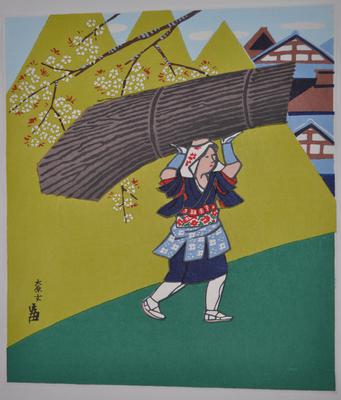
An Oharame Girl Carrying Firewood on Her Head
20th century
Woodblock print, ink and color on paper

April (Arashiyama Park, a Famous Scenic Resort)
四月 (嵐山)
second half 20th century
Woodblock print, ink and color on paper

June (Rainy Scene of the Sen-ke, Japanese Tea Ceremony Founder's House)
六月 (千家雨景)
second half 20th century
Woodblock print, ink and color on paper
More Rivers & Lakes Prints

Lake Chuzenji, Nikko (Nikko Chuzenjiko)
Nikko Chuzenjiko
1930
Color woodblock print; oban

Lake Kugushi in Wakasa Province (Wakasa Kugushiko), from the series Souvenirs of Travel I (Tabi miyage dai isshu)"
Wakasa Kugushiko
1920
Color woodblock print; oban

Gosai Canal in Niigata (Niigata Gosaibori), from the series "Souvenirs of Travel, Second Series (Tabi miyage dai nishu)"
Niigata Gosaibori
1921
Color woodblock print; oban

The Hori River at Obama (Obama Horikawa), from the series "Souvenirs of Travel, First Series (Tabi miyage dai isshu)"
Obama Horikawa
1920
Color woodblock print; oban
Featured in Collections
Curated cross-cuts that include this print.
Frequently Asked Questions
Sumida River was created by Tomikichiro Tokuriki (徳力富吉郎).
Sumida River depicts rivers & lakes.