
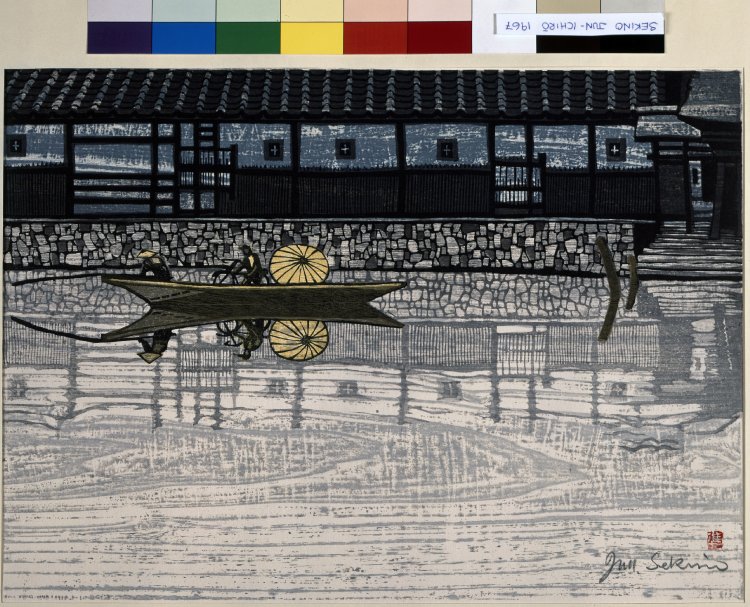
Viewing Nakayama from the front of the 4th station
- Medium:
- Mokuhanga (Japanese woodblock)
- Image courtesy of
- Saru Gallery
Description
The title locates this print at a yon-gome (4th station) waypoint, the traditional resting points along Japan's pilgrimage and climbing routes, with Nakayama visible across an intervening valley. The Transportation tag suggests the foreground likely incorporates a path, station shelter, or travelers, framing the distant peak as the destination of an unfolding journey. Tokuriki frequently treated mountain views with this layered recession — near foliage in dense color, middle ground softened, and the distant ridgeline rendered in flat color planes typical of mid-century mokuhanga. The stylized treatment of clouds and atmosphere would draw on the bokashi gradation technique, where pigment is brushed onto the block in a graded wash before printing. Such station-view compositions belong to the meisho-e lineage Tokuriki carried forward from the Edo masters, updated through his sosaku-hanga sensibility — the artist's own hand controlling the cutting and printing rather than relying on a publisher's atelier.
More Prints by Tomikichiro Tokuriki
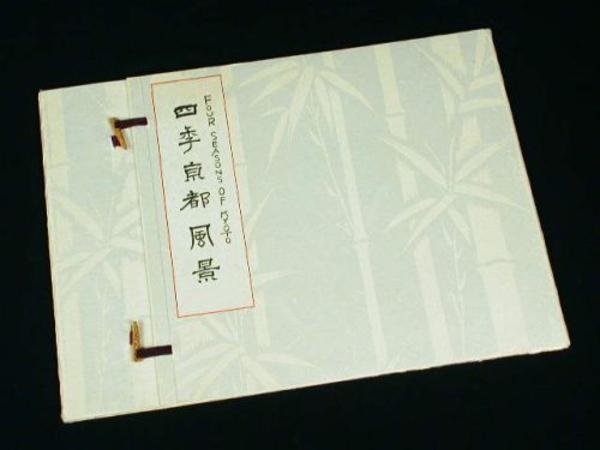
Heian Shrine in the Spring
Woodblock print
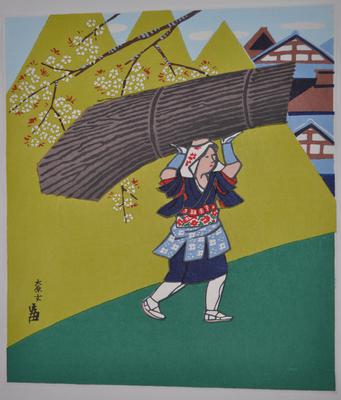
An Oharame Girl Carrying Firewood on Her Head
20th century
Woodblock print, ink and color on paper

April (Arashiyama Park, a Famous Scenic Resort)
四月 (嵐山)
second half 20th century
Woodblock print, ink and color on paper

June (Rainy Scene of the Sen-ke, Japanese Tea Ceremony Founder's House)
六月 (千家雨景)
second half 20th century
Woodblock print, ink and color on paper
More Transportation Prints
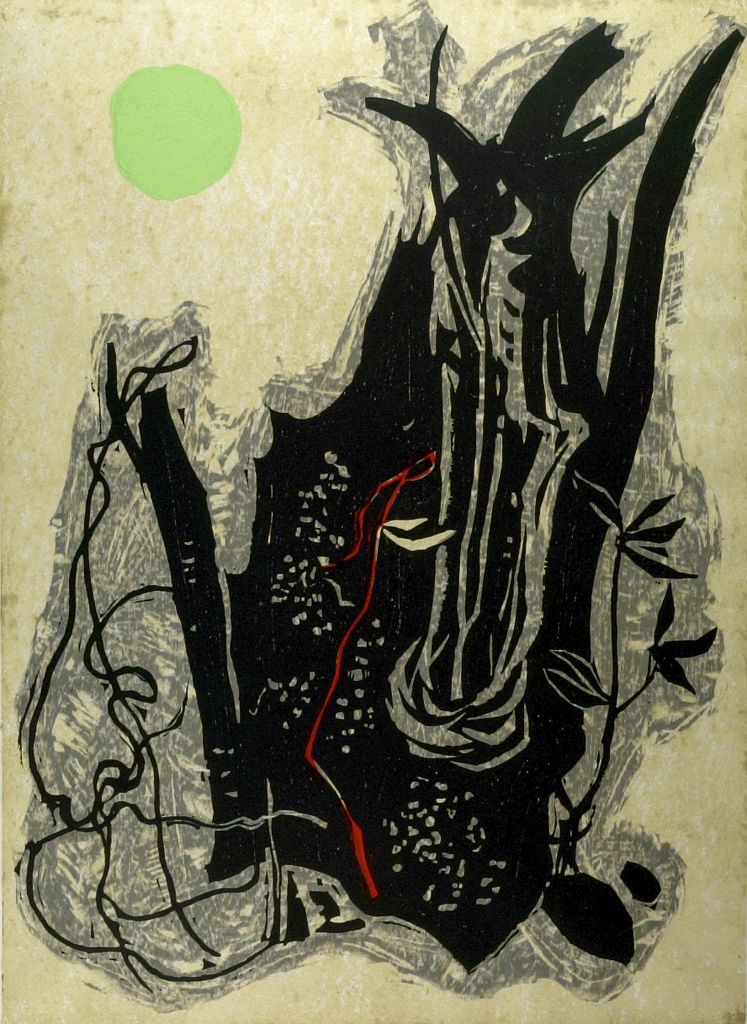
Old Tree and Path of the Sun, Shôwa period, dated 1961
Woodblock print
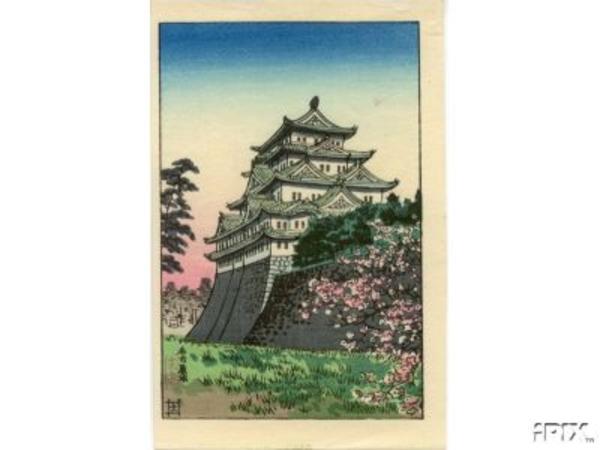
Nagoya Castle
Woodblock print
Battle at Jinzhoucheng on the Road to Port Arthur
1894 (Meiji 27)
Woodblock print (nishiki-e); ink and color on paper
Mitsuke / Tokaido gojusan tsugi ('Fifty-three Stations of the Tokaido Road)
Woodblock print
Featured in Collections
Curated cross-cuts that include this print.
Frequently Asked Questions
Viewing Nakayama from the front of the 4th station was created by Tomikichiro Tokuriki (徳力富吉郎).
Viewing Nakayama from the front of the 4th station depicts transportation.