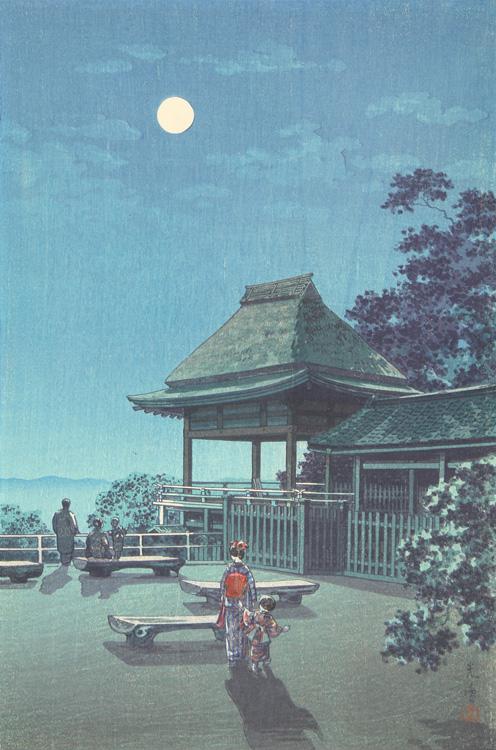
Autumn Moon at Ishiyamadera
- Medium:
- Woodblock print
- Format:
- Oban
- Publisher:
- Doi Sadaichi
- Edition:
- Published by Watanabe Shozaburo
- Source:
- Chazen Museum of Art
Description
Ishiyamadera on the southern shore of Lake Biwa has been associated with moongazing since the Heian period, when the temple's hilltop position over the water made it ideal for viewing the autumn moon. Koitsu renders the scene with the luminous bokashi that defines his finest night work — the moon's glow diffusing through mist above the darkened lake surface, the temple buildings silhouetted against the pale sky. The print draws on the same classical imagery as his 1933 Ishiyama view but treats the scene with greater atmospheric abstraction.
More Prints by Tsuchiya Koitsu
![Five-storied Pagoda at Nikkō [bright sky] by Tsuchiya Koitsu](https://1.api.artsmia.org/800/80121.jpg)

More Moonlight Prints
![Mount Fuji on a Moonlit Night, Kawai Bridge (Tsukiyo no Fuji [Kawaibashi]), from the series "Selection of Views of the Tokaido (Tokaido fukei senshu)" by Kawase Hasui](https://www.artic.edu/iiif/2/d0960668-1e73-339a-b182-fb995a54bff0/full/843,/0/default.jpg)
Mount Fuji on a Moonlit Night, Kawai Bridge (Tsukiyo no Fuji [Kawaibashi]), from the series "Selection of Views of the Tokaido (Tokaido fukei senshu)"
1947
Color woodblock print; oban

Evening Moon at Nakanoshima, Sapporo (Sapporo Nakanoshima no yuzuki), from the series "Collection of Views of Japan, Eastern Japan Edition (Nihon fukei shu higashi Nihon hen)"
March 1933
Color woodblock print; oban

Matsushima in Moonlight (Tsuki no Matsushima)
1919
Color woodblock print

Kiyozumi Garden in Moonlight
January 1938
Woodblock print, ink and color on paper
Featured in Collections
Curated cross-cuts that include this print.
Frequently Asked Questions
Autumn Moon at Ishiyamadera was created by Tsuchiya Koitsu (土屋光逸).
Autumn Moon at Ishiyamadera uses Bokashi, on woodblock print.
Autumn Moon at Ishiyamadera was published by Doi Sadaichi.
Autumn Moon at Ishiyamadera depicts moonlight, night scenes, and autumn foliage.