
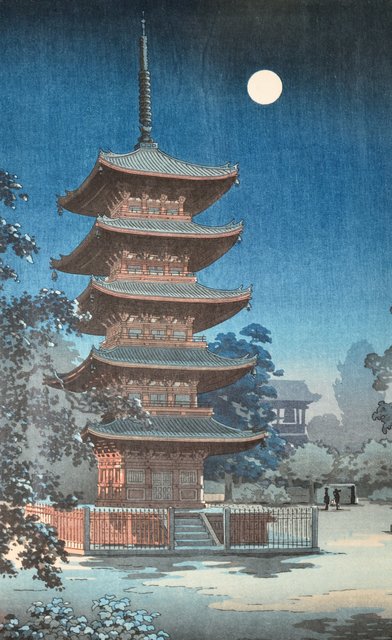
Kofukuji Temple, Nara
- Date:
- 1937
- Medium:
- Color woodblock print
- Format:
- Oban
- Dimensions:
- 39.3 × 25.7 cm
- Publisher:
- Doi Sadaichi
- Edition:
- Published by Watanabe Shozaburo
- Source:
- Art Institute of Chicago
Description
The Kofukuji pagoda at Nara is one of Japan's oldest surviving wooden structures, its five-tiered silhouette rising above the deer-grazed grounds of Nara Park. Koitsu renders the 1937 scene with an autumnal color palette, the pagoda's ancient wood glowing amber against a sky rendered in careful bokashi gradation. Nara's position as Japan's eighth-century capital lends the image an additional historical gravity — this temple complex once rivaled any in Asia.
More Prints by Tsuchiya Koitsu


More Temples & Shrines Prints
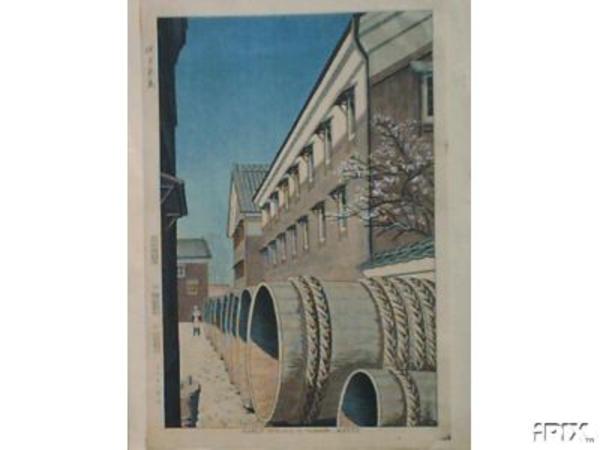
Fushimi Inari Temple
伏見稲荷
Woodblock print

The Compound of the Tenman Shrine at Kameido in the Snow (Kameido Tenmangu keidai no yuki), from the series "Famous Places in the Eastern Capital (Toto meisho)"
c. 1832/38
Color woodblock print; oban
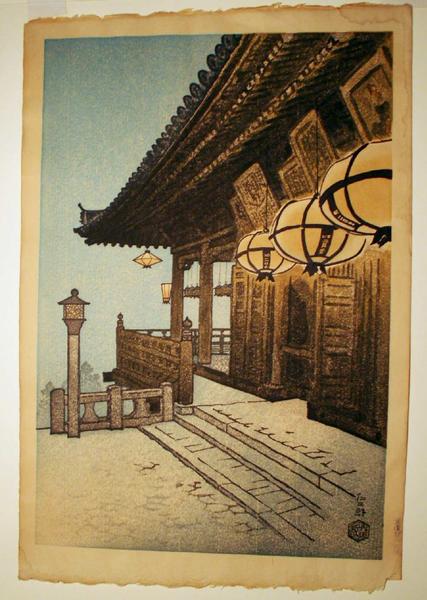
Temple with lanterns
Woodblock print

A Section of the Byodo Temple at Uji (Uji Byodoin no ichibu), from the series "Souvenirs of Travel, Second Series (Tabi miyage dai nishu)"
Uji Byodoin no ichibu
1921
Color woodblock print; oban
Featured in Collections
Curated cross-cuts that include this print.
Frequently Asked Questions
Kofukuji Temple, Nara was created by Tsuchiya Koitsu (土屋光逸) in 1937.
Kofukuji Temple, Nara uses Bokashi, on color woodblock print.
Kofukuji Temple, Nara was published by Doi Sadaichi (1937).
Kofukuji Temple, Nara depicts temples & shrines, set at Nara.
Kofukuji Temple, Nara measures 39.3 × 25.7 cm (Oban format).