
Tairao Kiyomori sees skulls in his snow-covered garden in Fukuhara
- Medium:
- Mokuhanga (Japanese woodblock)
- Image courtesy of
- Saru Gallery
Description
The print depicts the episode from the "Heike Monogatari" in which Taira no Kiyomori, the dying patriarch of the Taira clan, sees in his snow-covered garden at Fukuhara a vision of countless skulls — a ghostly portent of his clan's coming destruction and karmic recompense for his seizure of power. Yoshitoshi was drawn throughout his career to scenes of supernatural apparition, and this winter subject combines two strands he treated frequently: ghost imagery (yūrei-ga) and historical-warrior narrative. Compositionally, snow scenes in ukiyo-e reserve broad areas of unprinted washi to read as accumulated snow, with sparing use of black sumi line and faint gomazuri (sesame-seed printing) for falling flakes; against this restrained ground, the swarming skulls appear as a dense, unsettling pattern half-merged with stones and shrubs. The Fukuhara garden — Kiyomori's short-lived alternate capital — reinforces the moral arc: the warlord confronting the consequences of his hubris. Among Yoshitoshi's many treatments of Taira-Minamoto conflict this print exemplifies his late-career preference for psychological-supernatural staging over open battle, an approach that helped reshape musha-e for a Meiji audience.
More Prints by Tsukioka Yoshitoshi
More Snow Scenes Prints
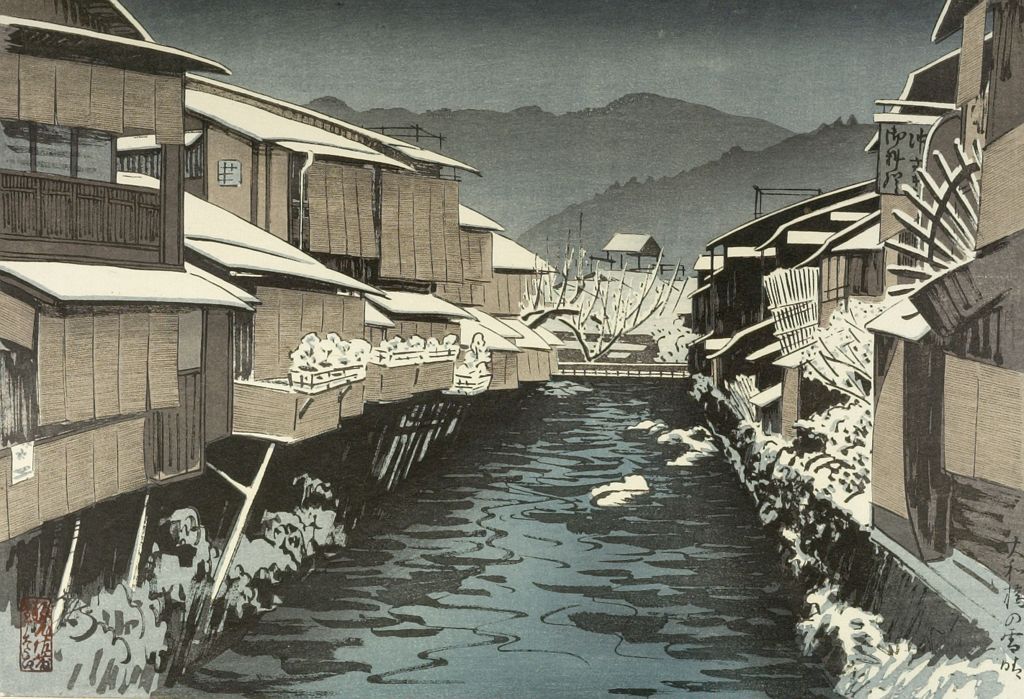
Fair Weather After Snow at Yamato Bridge, Kyoto (Yamato bashi no yukibare), Taishô period, dated 1924
Woodblock print

The Compound of the Tenman Shrine at Kameido in the Snow (Kameido Tenmangu keidai no yuki), from the series "Famous Places in the Eastern Capital (Toto meisho)"
c. 1832/38
Color woodblock print; oban

Miyajima in Snow (Yuki no Miyajima)
Yuki no Miyajima
1929
Color woodblock print; oban
Evening Snow at Shiha Park, Tokyo
1932
Woodblock print
Frequently Asked Questions
Tairao Kiyomori sees skulls in his snow-covered garden in Fukuhara was created by Tsukioka Yoshitoshi (月岡芳年).
Tairao Kiyomori sees skulls in his snow-covered garden in Fukuhara depicts snow scenes and gardens.