
Fukagawa Susaki and Jūmantsubo
- Date:
- 1857, intercalary 5th month
- Medium:
- Woodblock print (nishiki-e), ink and color on paper
- Source:
- Art Institute of Chicago
Description
Fukagawa Susaki and Jumantsubo, dated 1857, is one of the late, most dramatic sheets from Utagawa Hiroshige's series One Hundred Famous Views of Edo (Meisho Edo hyakkei), published by Uoya Eikichi from 1856 to 1858. Jumantsubo, literally one hundred thousand tsubo, was a vast tract of reclaimed land at the eastern edge of Edo behind Susaki, sparsely settled and used for salt production and farming. Hiroshige's composition looks down on the flat marshland from a high, impossible viewpoint as an eagle soars in the foreground; below stretch the snow-dusted reclamation, a small wooden tub or pail set on the salt fields, and the distant outline of mountains beyond Edo Bay. As an Edo ukiyo-e landscape print, the sheet is celebrated for its bold compositional choices: the eagle dominates one third of the image, while the human scale of the salt workings shrinks to small marks against the snow. The Art Institute of Chicago's impression preserves the careful bokashi shading in sky and water, the rich blacks of the bird's plumage, and the controlled white of the snow that early issues of the series are valued for. The print was widely admired in nineteenth-century Europe and was studied by Vincent van Gogh among others, and it remains one of the most reproduced images in Hiroshige's late career as a landscape master.
More Prints by Utagawa Hiroshige


More Landscapes Prints

Lake Kugushi in Wakasa Province (Wakasa Kugushiko), from the series Souvenirs of Travel I (Tabi miyage dai isshu)"
Wakasa Kugushiko
1920
Color woodblock print; oban
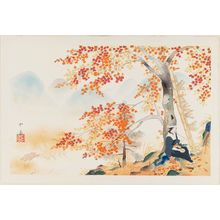
Autumn Maple Leaves at Takao, from the album Eight Views of Kyoto (Kyôto hakkei)
Woodblock print

The Beach at Kaiganji in Sanuki Province (Sanuki Kaiganji no hama), from the series "Collection of Views of Japan II, Kansai Edition (Nihon fukei shu II Kansai hen)"
1934
Color woodblock print; oban

Tea Kettle, section of a sheet from the series "Mirror of Stone Rubbings of Views of the Provinces" (Kohon meihitsu ishizuri kagami)
n.d.
Woodblock print; ishizuri-e, section of harimaze sheet
Featured in Collections
Curated cross-cuts that include this print.
Frequently Asked Questions
Fukagawa Susaki and Jūmantsubo was created by Utagawa Hiroshige (歌川広重) in 1857, intercalary 5th month.
Fukagawa Susaki and Jūmantsubo depicts landscapes.