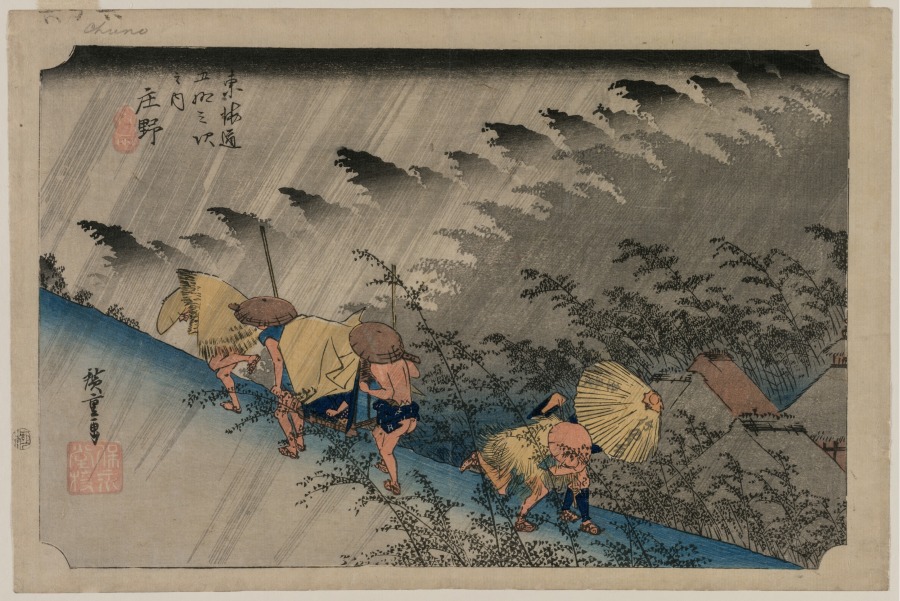
Kawasaki, from the 53 Stations of the Tokaido
- Date:
- 19th century
- Source:
- Harvard Art Museums
Description
Kawasaki, from the 53 Stations of the Tokaido, returns Utagawa Hiroshige to the highway he made his own across multiple successive series. Kawasaki was the second post-station out of Nihonbashi, marking the point where travelers heading west crossed the Rokugo River from Edo into Musashi by ferry. Hiroshige's compositions of the station typically center on this crossing: flat-bottomed boats poled along the broad river, travelers and porters waiting in clusters on the near bank, and in the distance the soft outline of Mount Fuji rising above the riverside fields. The Harvard Art Museums sheet documents one of Hiroshige's revisits to the subject, a design notable for its quiet handling of water and atmosphere. Bokashi gradations in indigo move the eye from foreground reeds to mid-water boats to distant mountain ridge, while small figures placed along the banks anchor the scale. The print exemplifies how Hiroshige used the Tokaido as a recurring laboratory for the Edo ukiyo-e landscape print: each new series let him refine his treatment of well-known stations and explore variations of weather, time of day, and human activity. For collectors and scholars, the Kawasaki designs offer a particularly clear way of comparing Hiroshige's evolving compositional thinking, since the basic subject of the river crossing remains constant while the pictorial solution shifts from edition to edition.
More Prints by Utagawa Hiroshige


More Landscapes Prints

Lake Kugushi in Wakasa Province (Wakasa Kugushiko), from the series Souvenirs of Travel I (Tabi miyage dai isshu)"
Wakasa Kugushiko
1920
Color woodblock print; oban
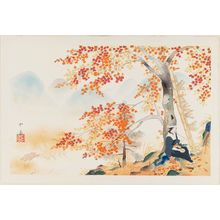
Autumn Maple Leaves at Takao, from the album Eight Views of Kyoto (Kyôto hakkei)
Woodblock print

The Beach at Kaiganji in Sanuki Province (Sanuki Kaiganji no hama), from the series "Collection of Views of Japan II, Kansai Edition (Nihon fukei shu II Kansai hen)"
1934
Color woodblock print; oban

Tea Kettle, section of a sheet from the series "Mirror of Stone Rubbings of Views of the Provinces" (Kohon meihitsu ishizuri kagami)
n.d.
Woodblock print; ishizuri-e, section of harimaze sheet
Featured in Collections
Curated cross-cuts that include this print.
Frequently Asked Questions
Kawasaki, from the 53 Stations of the Tokaido was created by Utagawa Hiroshige (歌川広重) in 19th century.
Kawasaki, from the 53 Stations of the Tokaido depicts landscapes.