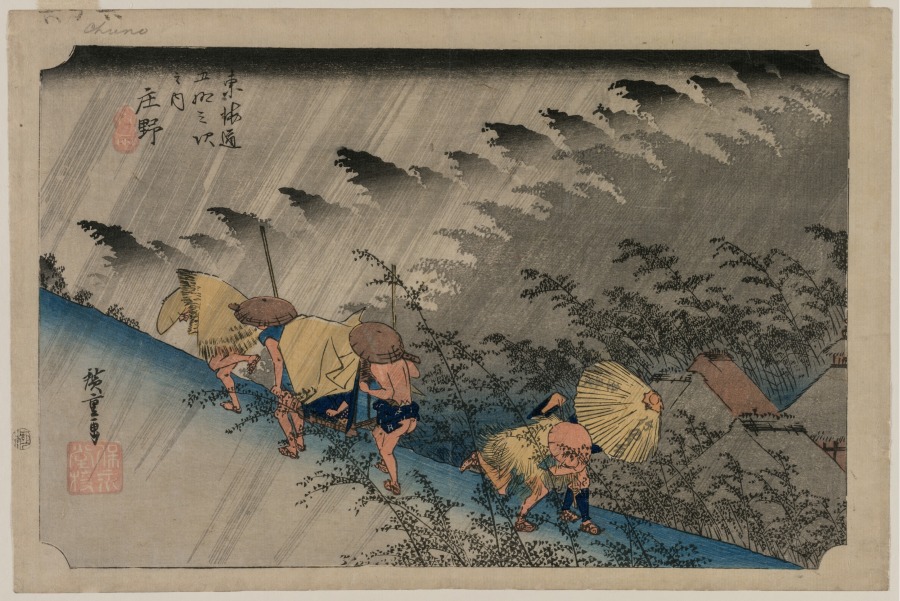
Okazaki, from the series Cut-out Pictures of Fifty-three Stations (Gojūsan tsugi harimaze)
- Date:
- 20th century
- Medium:
- Woodblock print; ink and color on paper
- Source:
- Harvard Art Museums
Description
Cut-out Pictures of Fifty-three Stations (Gojusan tsugi harimaze) is one of Utagawa Hiroshige's most inventive responses to the runaway success of his earlier Tokaido series. Each sheet in the set assembles several small landscape compositions on a single page, designed so that collectors could either keep them intact or scissor them apart and paste them into albums and screens, hence the term harimaze, meaning paste-mixed. This Okazaki sheet draws together vignettes associated with that Tokaido station, including the long Yahagi Bridge over the Yahagi River for which Okazaki was celebrated. The compositions are simplified and tightened to read clearly at small scale, with strong silhouettes and a limited but vivid palette typical of Edo ukiyo-e printing in the 1850s. Functioning at once as a landscape print, a memento of travel, and a kind of paper game, the sheet illustrates how Hiroshige and his publishers continually repackaged the Tokaido subject to keep it commercially fresh. The impression preserved at the Harvard Art Museums retains the crisp keyblock printing on which the harimaze format depends, since dull lines would obscure the cut edges.
More Prints by Utagawa Hiroshige


More Landscapes Prints

Lake Kugushi in Wakasa Province (Wakasa Kugushiko), from the series Souvenirs of Travel I (Tabi miyage dai isshu)"
Wakasa Kugushiko
1920
Color woodblock print; oban
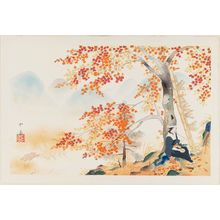
Autumn Maple Leaves at Takao, from the album Eight Views of Kyoto (Kyôto hakkei)
Woodblock print

The Beach at Kaiganji in Sanuki Province (Sanuki Kaiganji no hama), from the series "Collection of Views of Japan II, Kansai Edition (Nihon fukei shu II Kansai hen)"
1934
Color woodblock print; oban

Tea Kettle, section of a sheet from the series "Mirror of Stone Rubbings of Views of the Provinces" (Kohon meihitsu ishizuri kagami)
n.d.
Woodblock print; ishizuri-e, section of harimaze sheet
Featured in Collections
Curated cross-cuts that include this print.
Frequently Asked Questions
Okazaki, from the series Cut-out Pictures of Fifty-three Stations (Gojūsan tsugi harimaze) was created by Utagawa Hiroshige (歌川広重) in 20th century.
Okazaki, from the series Cut-out Pictures of Fifty-three Stations (Gojūsan tsugi harimaze) depicts landscapes.