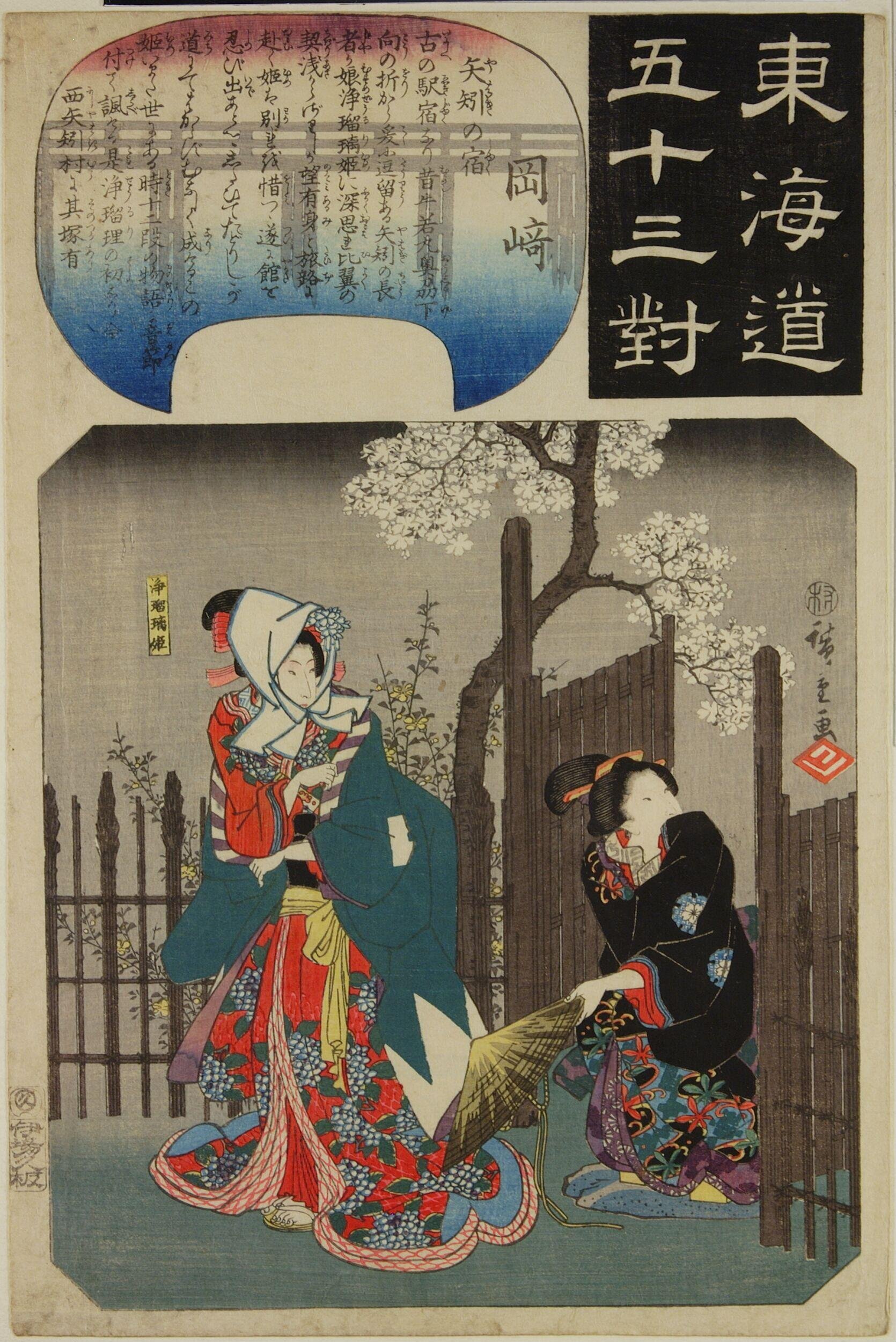
Okazaki: Yahagi Station (Yahagi no shuku)
- Medium:
- Source:
- Victoria and Albert Museum
Description
Okazaki: Yahagi Station (Yahagi no shuku) is a landscape print by Utagawa Hiroshige (1797 to 1858), treating one of the most distinctive stations on the Tokaido road. Okazaki was the thirty-eighth station along the route, sited in what is now Aichi Prefecture, and its defining visual feature was the Yahagi bridge over the Yahagi River. The Yahagi-bashi was traditionally cited as the longest wooden bridge in Japan, stretching across the river's broad shallows, and travelers approaching Okazaki could not miss it as they made their way along the road. The bridge appears prominently in nearly every Hiroshige treatment of Okazaki across his several Tokaido series, including the famous Hoeido Tokaido of the early 1830s, where the procession of travelers crossing the long span of the bridge frames a view back toward Okazaki Castle and the river bend. The current print depicts Okazaki by way of the Yahagi station, foregrounding the bridge and the river crossing as the defining experience of that stretch of the road. As a landscape print within the Edo ukiyo-e tradition, the work participates in Hiroshige's broader inventory of the Tokaido stations, each treated as a distinct visual problem with its own topography and human incident. The impression is held in the collection of the Victoria and Albert Museum, London, where it joins the museum's substantial holdings of Hiroshige's various Tokaido cycles, allowing comparative study of how he returned to the same fifty-three stations across multiple series in different formats and palettes.
More Prints by Utagawa Hiroshige


More Landscapes Prints

Lake Kugushi in Wakasa Province (Wakasa Kugushiko), from the series Souvenirs of Travel I (Tabi miyage dai isshu)"
Wakasa Kugushiko
1920
Color woodblock print; oban
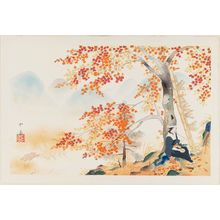
Autumn Maple Leaves at Takao, from the album Eight Views of Kyoto (Kyôto hakkei)
Woodblock print

The Beach at Kaiganji in Sanuki Province (Sanuki Kaiganji no hama), from the series "Collection of Views of Japan II, Kansai Edition (Nihon fukei shu II Kansai hen)"
1934
Color woodblock print; oban

Tea Kettle, section of a sheet from the series "Mirror of Stone Rubbings of Views of the Provinces" (Kohon meihitsu ishizuri kagami)
n.d.
Woodblock print; ishizuri-e, section of harimaze sheet
Featured in Collections
Curated cross-cuts that include this print.
Frequently Asked Questions
Okazaki: Yahagi Station (Yahagi no shuku) was created by Utagawa Hiroshige (歌川広重).
Okazaki: Yahagi Station (Yahagi no shuku) depicts landscapes.