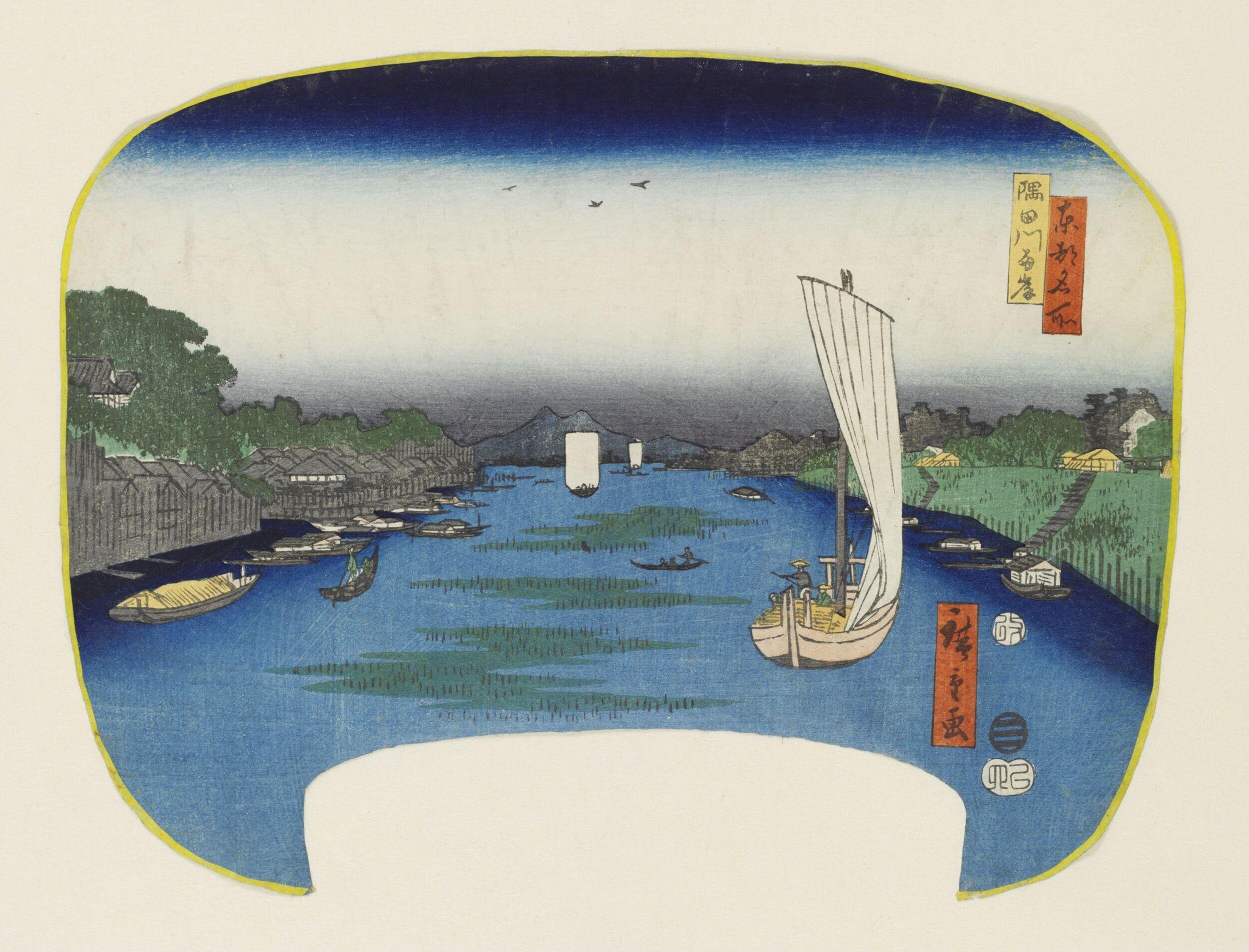
The Banks of the Sumida River
- Date:
- 1857
- Medium:
- Source:
- Victoria and Albert Museum
Description
The Banks of the Sumida River is an 1857 landscape print by Utagawa Hiroshige (1797 to 1858), one of his late views of the Edo waterfront produced in the year before his death. The Sumida River was the principal artery of Edo, dividing the eastern districts of Honjo and Fukagawa from the central city and serving as both transportation route and recreational space. Its banks supported teahouses, theaters, shrines, and the great spectacle of cherry-blossom viewing at Mukojima each spring. Hiroshige had drawn on Sumida subjects throughout his career and returned to them with renewed intensity in the late 1850s, when he assembled the One Hundred Famous Views of Edo. The Banks of the Sumida River participates in this larger project, fixing a familiar stretch of the river with the attention to weather, season, and human incident that defines his late style. The composition treats the river as a horizontal field of water punctuated by passing boats and bordered by tree-lined embankments, with figures at the water's edge or aboard small craft providing scale and narrative interest. As a landscape print, this work demonstrates Hiroshige's commitment to the meisho-e tradition at the close of his life. The Edo ukiyo-e print, by the end of the Tokugawa period, had become a sophisticated medium for civic self-representation, and Hiroshige stood at the center of that achievement. The impression is held in the Victoria and Albert Museum, London, which preserves a significant Hiroshige collection that includes other Sumida views from the same late period.
More Prints by Utagawa Hiroshige


More Landscapes Prints

Lake Kugushi in Wakasa Province (Wakasa Kugushiko), from the series Souvenirs of Travel I (Tabi miyage dai isshu)"
Wakasa Kugushiko
1920
Color woodblock print; oban
Autumn Maple Leaves at Takao, from the album Eight Views of Kyoto (Kyôto hakkei)
Woodblock print

The Beach at Kaiganji in Sanuki Province (Sanuki Kaiganji no hama), from the series "Collection of Views of Japan II, Kansai Edition (Nihon fukei shu II Kansai hen)"
1934
Color woodblock print; oban

Tea Kettle, section of a sheet from the series "Mirror of Stone Rubbings of Views of the Provinces" (Kohon meihitsu ishizuri kagami)
n.d.
Woodblock print; ishizuri-e, section of harimaze sheet
Featured in Collections
Curated cross-cuts that include this print.
Frequently Asked Questions
The Banks of the Sumida River was created by Utagawa Hiroshige (歌川広重) in 1857.
The Banks of the Sumida River depicts landscapes.