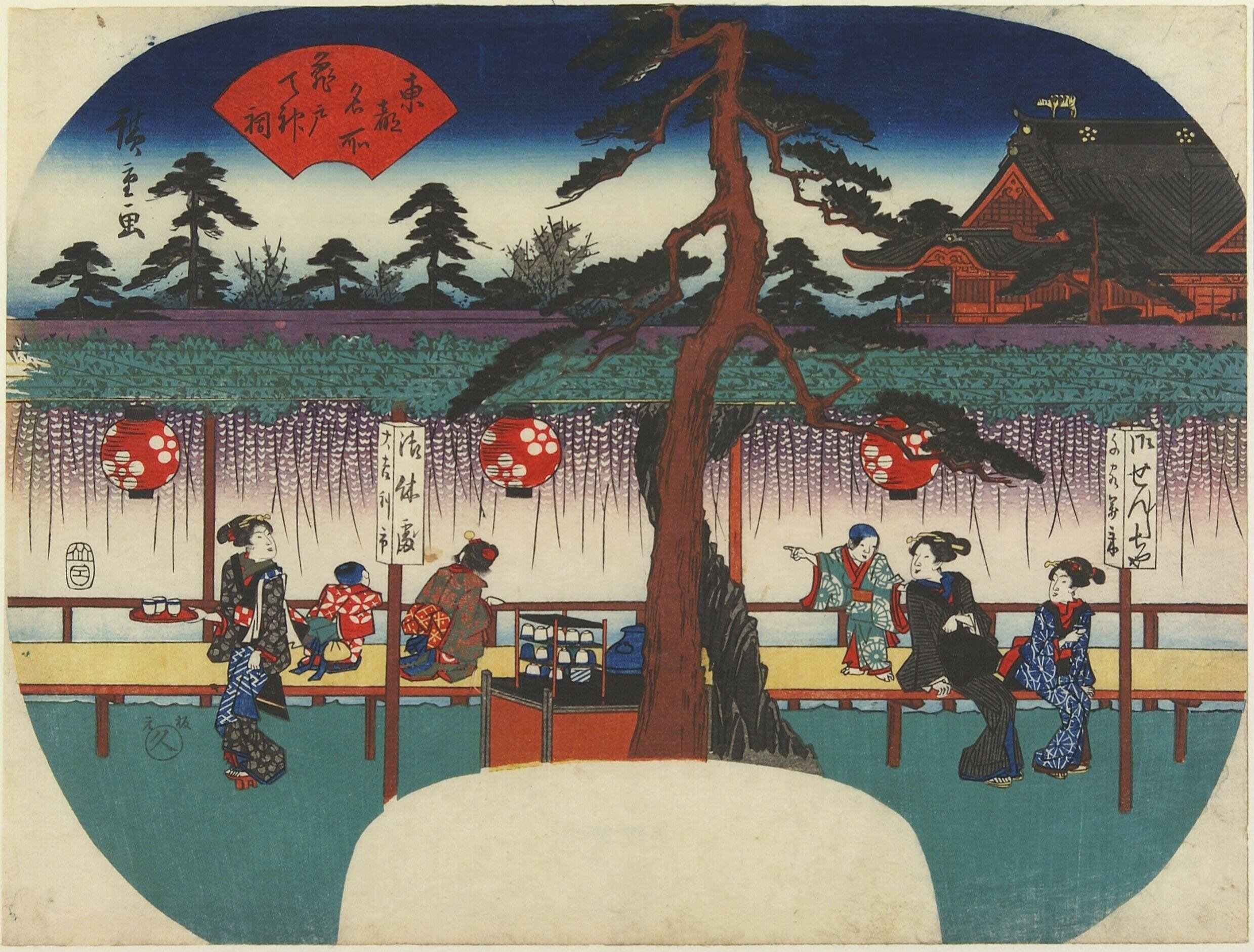
The Kameido Tenjin Shrine
- Date:
- 1843-1847
- Medium:
- Source:
- Victoria and Albert Museum
Description
The Kameido Tenjin Shrine, an 1843 print by Utagawa Hiroshige now held in the Victoria and Albert Museum, depicts one of Edo's most celebrated suburban sanctuaries, dedicated to Sugawara no Michizane, the scholar-poet revered as the deity Tenjin. Kameido was famous above all for its drum bridge arching over a pond of carp and for the spectacular wisteria trellises whose hanging blossoms drew vast crowds each spring. Hiroshige composes the scene as an Edo ukiyo-e landscape print of the kind that defines so much of his mature work: foreground bridge or trellis, mid-ground pond, and distant shrine architecture frame the place, while elegantly dressed visitors move through its precincts. The work belongs to a phase in which he produced numerous views of Edo's named gardens, shrines, and seasonal sites, anticipating the encyclopedic ambition of his later One Hundred Famous Views of Edo. The colour palette balances saturated indigos and greens with restrained accents, evoking the cool atmosphere of pondside paths and shaded walkways. Kameido Tenjin remained one of Hiroshige's repeated subjects, returning to him in different formats and series, and the V&A sheet stands as an excellent example of his treatment of the shrine's distinctive topography. For collectors of nineteenth-century Japanese woodblock prints, the image is both a historical record of an important religious-and-recreational site and a model of how the Utagawa school turned everyday urban geography into enduring picture-making.
More Prints by Utagawa Hiroshige


More Landscapes Prints

Lake Kugushi in Wakasa Province (Wakasa Kugushiko), from the series Souvenirs of Travel I (Tabi miyage dai isshu)"
Wakasa Kugushiko
1920
Color woodblock print; oban
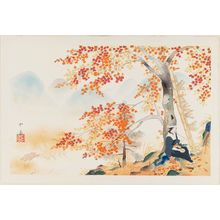
Autumn Maple Leaves at Takao, from the album Eight Views of Kyoto (Kyôto hakkei)
Woodblock print

The Beach at Kaiganji in Sanuki Province (Sanuki Kaiganji no hama), from the series "Collection of Views of Japan II, Kansai Edition (Nihon fukei shu II Kansai hen)"
1934
Color woodblock print; oban

Tea Kettle, section of a sheet from the series "Mirror of Stone Rubbings of Views of the Provinces" (Kohon meihitsu ishizuri kagami)
n.d.
Woodblock print; ishizuri-e, section of harimaze sheet
Featured in Collections
Curated cross-cuts that include this print.
Frequently Asked Questions
The Kameido Tenjin Shrine was created by Utagawa Hiroshige (歌川広重) in 1843-1847.
The Kameido Tenjin Shrine depicts landscapes.