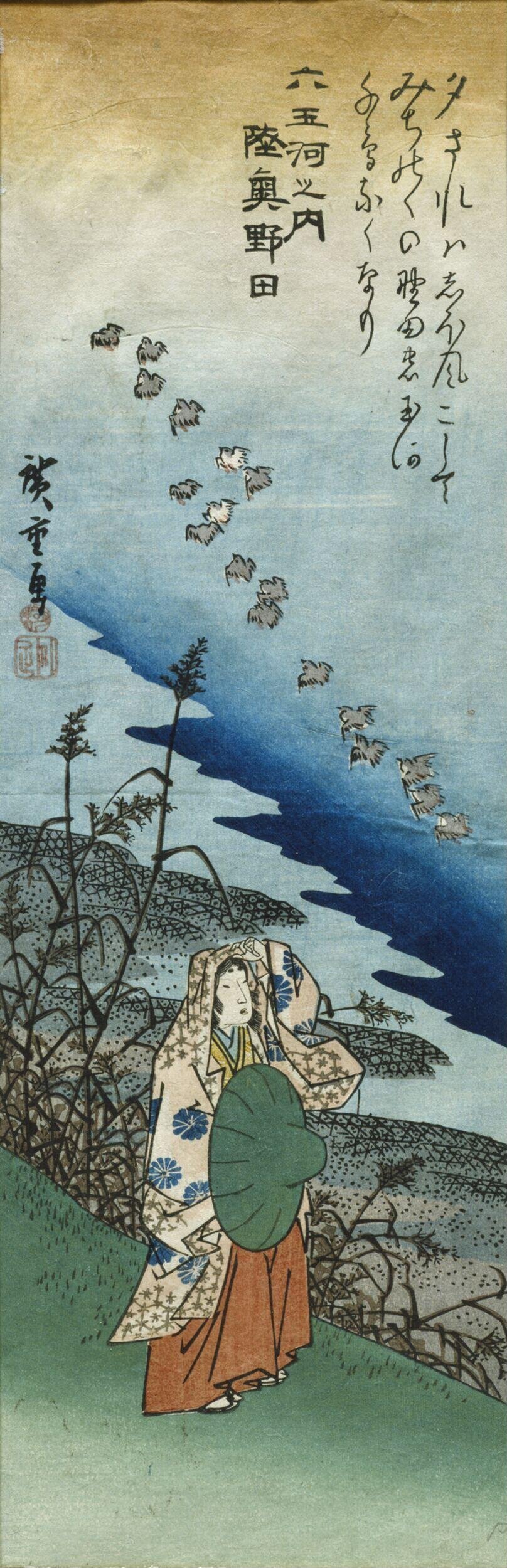
The Noda Jewel River in Mutsu Province (Mutsu Noda)
- Date:
- circa 1835
- Medium:
- Source:
- Victoria and Albert Museum
Description
The Noda Jewel River in Mutsu Province (Mutsu Noda), dated 1835 and held by the Victoria and Albert Museum, is an Edo ukiyo-e landscape print by Utagawa Hiroshige from his designs based on the six tama-gawa, or jewel rivers, a classical poetic theme. The jewel rivers were six famous streams scattered across the provinces, each linked to a particular waka poem and seasonal association; the Noda Jewel River, in Mutsu Province in the north-east, was traditionally paired with the haunting cry of plovers at dusk. Hiroshige's Utagawa Hiroshige landscape print on this subject converts the poetic conceit into an atmospheric scene of riverside marshland, with low water, a dark band of trees, and the implied presence of birds in flight. By the 1830s, when this print appeared, the artist was firmly established as a leading designer of meisho-e and Edo ukiyo-e, and the tama-gawa subjects allowed him to extend that idiom to remote, partially imagined geographies. The Victoria and Albert Museum impression shows the muted, blue-dominated palette that Hiroshige favoured for melancholic riverine subjects, with bokashi shading suggesting twilight or early evening. The landscape print encapsulates his ability to fuse classical literary culture with the visual conventions of woodblock printing, presenting a place that most Edo viewers would never visit but could nevertheless feel through the combined force of poetry, season and image.
More Prints by Utagawa Hiroshige


More Landscapes Prints

Lake Kugushi in Wakasa Province (Wakasa Kugushiko), from the series Souvenirs of Travel I (Tabi miyage dai isshu)"
Wakasa Kugushiko
1920
Color woodblock print; oban
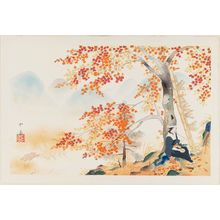
Autumn Maple Leaves at Takao, from the album Eight Views of Kyoto (Kyôto hakkei)
Woodblock print

The Beach at Kaiganji in Sanuki Province (Sanuki Kaiganji no hama), from the series "Collection of Views of Japan II, Kansai Edition (Nihon fukei shu II Kansai hen)"
1934
Color woodblock print; oban

Tea Kettle, section of a sheet from the series "Mirror of Stone Rubbings of Views of the Provinces" (Kohon meihitsu ishizuri kagami)
n.d.
Woodblock print; ishizuri-e, section of harimaze sheet
Featured in Collections
Curated cross-cuts that include this print.
Frequently Asked Questions
The Noda Jewel River in Mutsu Province (Mutsu Noda) was created by Utagawa Hiroshige (歌川広重) in circa 1835.
The Noda Jewel River in Mutsu Province (Mutsu Noda) depicts landscapes.