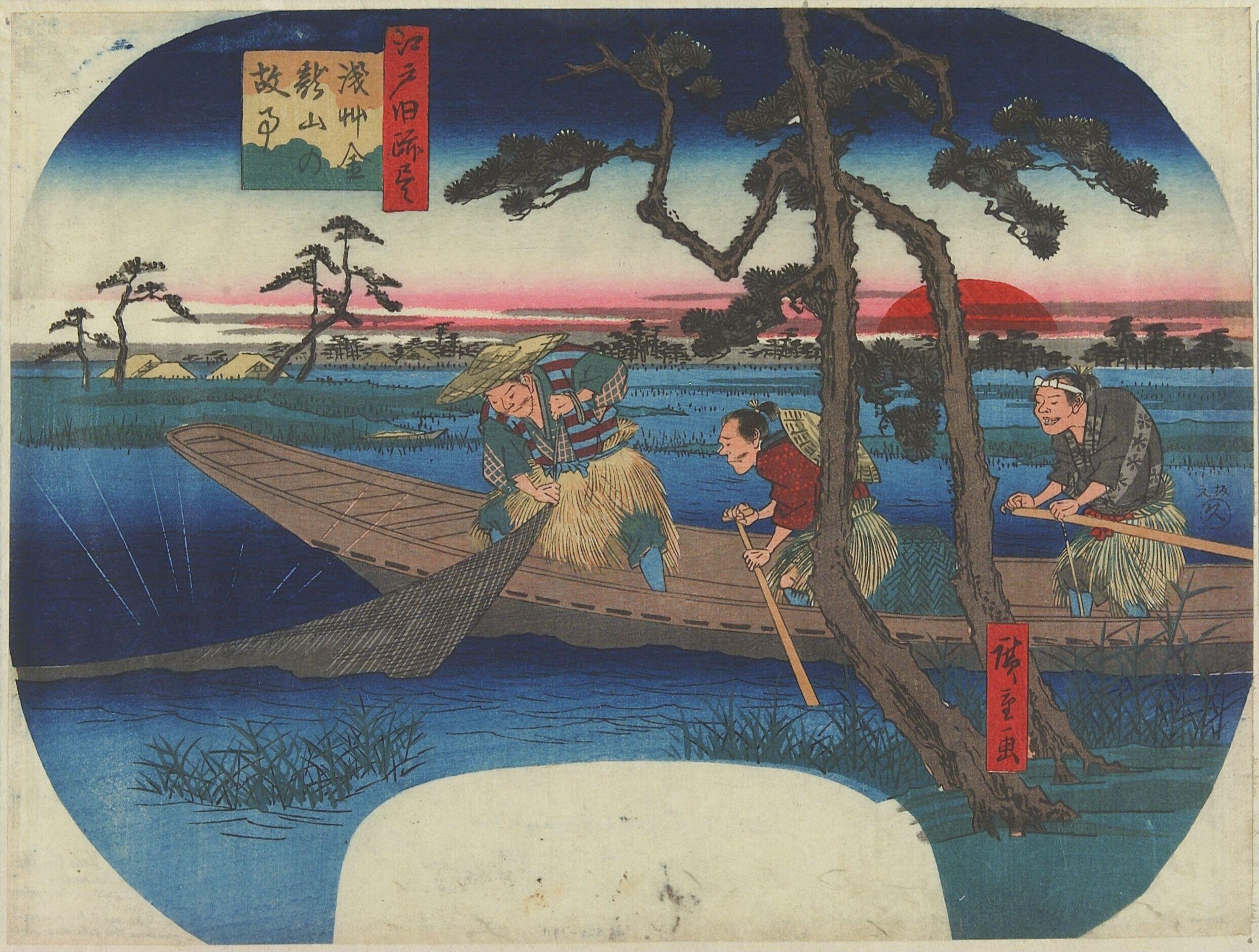
The Origins of the Kinryuzan Temple at Asakusa
- Date:
- ca. 1845-1846
- Medium:
- Source:
- Victoria and Albert Museum
Description
Issued in 1845, this landscape print by Utagawa Hiroshige takes as its subject the founding legend of Kinryuzan Sensoji, the great Asakusa temple complex that has been the most popular Buddhist pilgrimage site in Edo since the seventeenth century. According to tradition, in the year 628 two fisher brothers, Hinokuma Hamanari and Takenari, drew a small golden image of the bodhisattva Kannon from the waters of the Sumida River, and the temple grew up around that miraculous catch. Hiroshige treats the legend with the muted dignity appropriate to a religious subject, presenting the brothers at the moment of discovery against a softly washed riverbank with reeds, fishing nets, and a still pre-urban skyline. The print is one of a number of works in which Hiroshige documented the religious and historical undercurrents of Edo ukiyo-e sites rather than their contemporary crowds, supplying his audience with the layered backstory of places they walked through every day. The careful registration, the rust-and-blue palette, and the slightly archaic figure style all locate the work within the artist's mid-career production. The Victoria and Albert Museum preserves the impression as part of its substantial holdings of Hiroshige's Asakusa subjects.
More Prints by Utagawa Hiroshige


More Landscapes Prints

Lake Kugushi in Wakasa Province (Wakasa Kugushiko), from the series Souvenirs of Travel I (Tabi miyage dai isshu)"
Wakasa Kugushiko
1920
Color woodblock print; oban
Autumn Maple Leaves at Takao, from the album Eight Views of Kyoto (Kyôto hakkei)
Woodblock print

The Beach at Kaiganji in Sanuki Province (Sanuki Kaiganji no hama), from the series "Collection of Views of Japan II, Kansai Edition (Nihon fukei shu II Kansai hen)"
1934
Color woodblock print; oban

Tea Kettle, section of a sheet from the series "Mirror of Stone Rubbings of Views of the Provinces" (Kohon meihitsu ishizuri kagami)
n.d.
Woodblock print; ishizuri-e, section of harimaze sheet
Featured in Collections
Curated cross-cuts that include this print.
Frequently Asked Questions
The Origins of the Kinryuzan Temple at Asakusa was created by Utagawa Hiroshige (歌川広重) in ca. 1845-1846.
The Origins of the Kinryuzan Temple at Asakusa depicts landscapes.