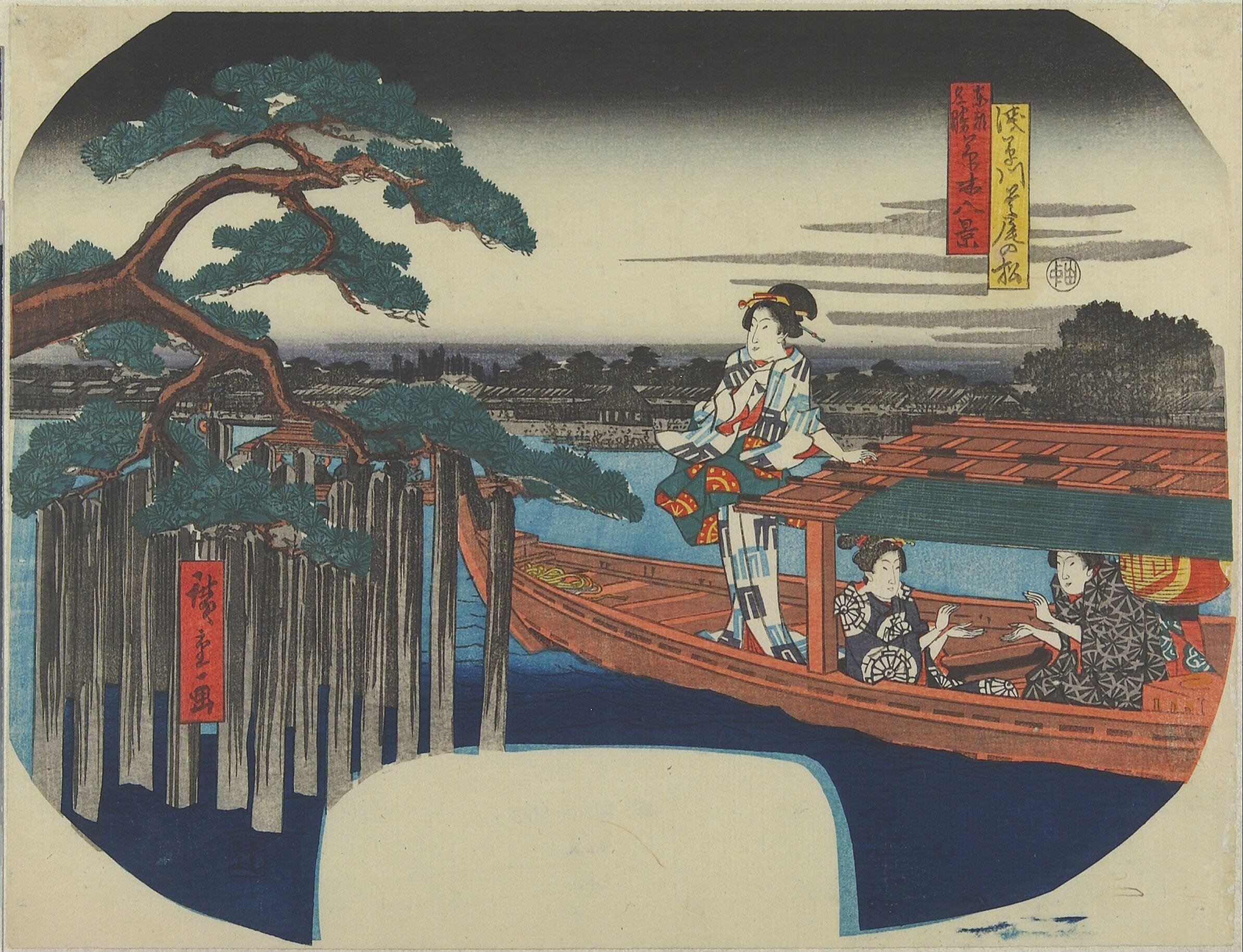
The Shubi Pine Tree on the Asakusa River
- Date:
- 1843-1847
- Medium:
- Source:
- Victoria and Albert Museum
Description
The Shubi Pine Tree on the Asakusa River, an 1843 print by Utagawa Hiroshige now in the Victoria and Albert Museum, focuses on one of the most storied trees in Edo's urban landscape. The Shubi-no-matsu stood on the bank of the Okawa, the stretch of the Sumida River near Asakusa, and was celebrated in poetry, prose, and the popular imagination as a meeting place for lovers and a landmark for boatmen. Hiroshige's composition makes the pine its emotional and visual centre, its twisted trunk and broad branches dominating the foreground while the river curves away into the distance behind. Small figures along the bank or in passing boats animate the scene without distracting from the tree itself. This treatment exemplifies Hiroshige's mature Edo ukiyo-e landscape print idiom, in which a single famous feature becomes a portal into the wider geography and lore of the city. Bokashi gradation softens the sky and water, while keyblock lines render the texture of the pine's bark and needles with the precision typical of high-quality Edo publishing. The Shubi pine fits within Hiroshige's wider Sumida cycle, recurring throughout his career and culminating in the One Hundred Famous Views of Edo. The V&A example demonstrates how a beloved tree could carry the weight of urban memory and seasonal feeling, and how the medium of the woodblock print served as the primary means by which Edoites preserved and shared their attachment to such places.
More Prints by Utagawa Hiroshige


More Landscapes Prints

Lake Kugushi in Wakasa Province (Wakasa Kugushiko), from the series Souvenirs of Travel I (Tabi miyage dai isshu)"
Wakasa Kugushiko
1920
Color woodblock print; oban
Autumn Maple Leaves at Takao, from the album Eight Views of Kyoto (Kyôto hakkei)
Woodblock print

The Beach at Kaiganji in Sanuki Province (Sanuki Kaiganji no hama), from the series "Collection of Views of Japan II, Kansai Edition (Nihon fukei shu II Kansai hen)"
1934
Color woodblock print; oban

Tea Kettle, section of a sheet from the series "Mirror of Stone Rubbings of Views of the Provinces" (Kohon meihitsu ishizuri kagami)
n.d.
Woodblock print; ishizuri-e, section of harimaze sheet
Featured in Collections
Curated cross-cuts that include this print.
Frequently Asked Questions
The Shubi Pine Tree on the Asakusa River was created by Utagawa Hiroshige (歌川広重) in 1843-1847.
The Shubi Pine Tree on the Asakusa River depicts landscapes.