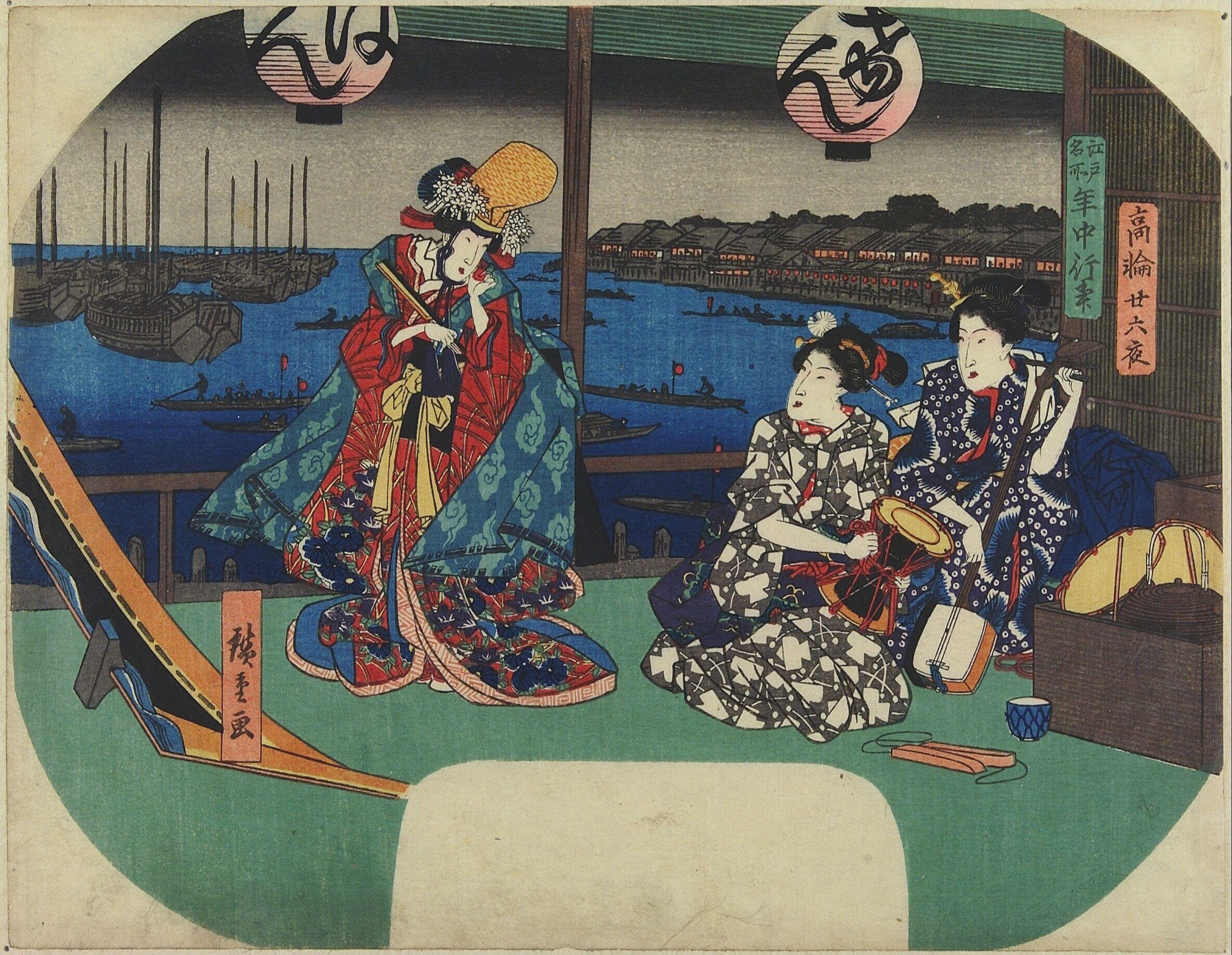
The Twenty-sixth Night at Takanawa
- Date:
- ca. 1840-1842
- Medium:
- Source:
- Victoria and Albert Museum
Description
The Twenty-sixth Night at Takanawa, dated 1840 and held by the Victoria and Albert Museum, is an Edo ukiyo-e landscape print by Utagawa Hiroshige depicting a popular nocturnal festival held along Edo Bay. On the twenty-sixth night of the seventh month, crowds gathered at coastal sites such as Takanawa to await the late-rising moon, which appeared with three points of light according to a Pure Land tradition associated with Amida Buddha. Takanawa, on the southern fringe of Edo where the Tokaido met the bay, was one of the favoured viewing spots. In this Utagawa Hiroshige landscape print the artist arranges a darkened expanse of sea and sky punctuated by lantern light, tea-stalls and figures awaiting the auspicious moment. The composition uses deep blues and blacks in the manner characteristic of late Edo ukiyo-e nocturnal scenes, with reflected lanterns on the water adding accents of warm tone against the cool dominant palette. Hiroshige's restraint allows the social atmosphere of the event to register without overwhelming the landscape itself; the bay remains the principal subject, with the festival functioning as a seasonal occasion that gives it meaning. The Victoria and Albert Museum impression preserves the careful colour separation and atmospheric bokashi that the design requires. As a record of an urban religious-festive practice rendered in the landscape print idiom, it shows Hiroshige's interest in the ways ordinary Edoites experienced their city's coastline as a place of communal contemplation.
More Prints by Utagawa Hiroshige


More Landscapes Prints

Lake Kugushi in Wakasa Province (Wakasa Kugushiko), from the series Souvenirs of Travel I (Tabi miyage dai isshu)"
Wakasa Kugushiko
1920
Color woodblock print; oban
Autumn Maple Leaves at Takao, from the album Eight Views of Kyoto (Kyôto hakkei)
Woodblock print

The Beach at Kaiganji in Sanuki Province (Sanuki Kaiganji no hama), from the series "Collection of Views of Japan II, Kansai Edition (Nihon fukei shu II Kansai hen)"
1934
Color woodblock print; oban

Tea Kettle, section of a sheet from the series "Mirror of Stone Rubbings of Views of the Provinces" (Kohon meihitsu ishizuri kagami)
n.d.
Woodblock print; ishizuri-e, section of harimaze sheet
Featured in Collections
Curated cross-cuts that include this print.
Frequently Asked Questions
The Twenty-sixth Night at Takanawa was created by Utagawa Hiroshige (歌川広重) in ca. 1840-1842.
The Twenty-sixth Night at Takanawa depicts landscapes.