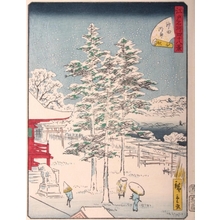
THIRTY-SIX VIEWS OF YEDO, "SEKIYA NO SATO"
- Date:
- 19th century
- Medium:
- Ink on paper
- Source:
- Harvard Art Museums
Description
The Sekiya no Sato sheet from a "Thirty-Six Views of Yedo" series, held at the Harvard Art Museums, is among the more rustic compositions in Utagawa Hiroshige's late Edo ukiyo-e production. Sekiya was a riverside hamlet at the bend of the Sumida north of Edo, near present-day Higashi-Mukōjima, and had long been associated in poetry with crossings, ferries, and the autumnal mood of an open landscape just outside the city. Hiroshige takes a low vantage, placing thatched roofs, a winding path, and a few willow trees in the foreground; beyond them the Sumida River opens into the middle distance, with small boats and a far bank suggested in cool washes. The palette is dominated by greens, blue-greys, and soft sandy yellows, and the printer's bokashi gradations in the sky and water produce the slightly humid, hushed atmosphere typical of riverside Edo. Human activity is reduced to a handful of figures—farmers, perhaps a traveler on the path—so that the scene reads less as an urban view than as a glimpse of rural life on the city's periphery. As one of thirty-six views of Edo, the print enacts the series convention that the shogunal capital contained, alongside its great commercial districts, pockets of village geography that could be presented as proper landscape print subjects in their own right; this Sekiya sheet typifies that quieter, more pastoral side of Hiroshige's vision of Edo.
More Prints by Utagawa Hiroshige


More Landscapes Prints

Lake Kugushi in Wakasa Province (Wakasa Kugushiko), from the series Souvenirs of Travel I (Tabi miyage dai isshu)"
Wakasa Kugushiko
1920
Color woodblock print; oban
Autumn Maple Leaves at Takao, from the album Eight Views of Kyoto (Kyôto hakkei)
Woodblock print

The Beach at Kaiganji in Sanuki Province (Sanuki Kaiganji no hama), from the series "Collection of Views of Japan II, Kansai Edition (Nihon fukei shu II Kansai hen)"
1934
Color woodblock print; oban

Tea Kettle, section of a sheet from the series "Mirror of Stone Rubbings of Views of the Provinces" (Kohon meihitsu ishizuri kagami)
n.d.
Woodblock print; ishizuri-e, section of harimaze sheet
Featured in Collections
Curated cross-cuts that include this print.
Frequently Asked Questions
THIRTY-SIX VIEWS OF YEDO, "SEKIYA NO SATO" was created by Utagawa Hiroshige (歌川広重) in 19th century.
THIRTY-SIX VIEWS OF YEDO, "SEKIYA NO SATO" depicts landscapes.