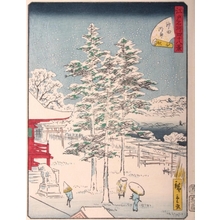
THIRTY-SIX VIEWS OF YEDO "YANAGISHIMA MIYOKEN"
- Date:
- 19th century
- Medium:
- Ink on paper
- Source:
- Harvard Art Museums
Description
Thirty-six Views of Yedo, Yanagishima Miyoken, in the Harvard Art Museums, is a sheet from one of the late series associated with the Utagawa Hiroshige name that takes the city's bridges, temples, and waterways one by one. Yanagishima, the Willow Island on the east bank of the Sumida, was famous in the late Edo period for the Hosshoji temple complex and its image of Myoken, the Buddhist personification of the North Star. Worshippers crossed a bridge to the temple precincts for night-and-day visits, especially on Myoken festival days. Hiroshige treats the site as he treated other east-bank locations: a low horizon, a band of river, a pierced silhouette of bridge and temple roofs, and a wide expanse of sky in which bokashi gradients indicate weather and time. The Edo ukiyo-e landscape print idiom is again applied to a site whose religious meaning was inseparable from its physical character on the Sumida bank. Sheets from this series circulated alongside Hiroshige's Hyakkei and his earlier meisho prints; collectively they made the experience of crossing into Yanagishima available to anyone who could afford a single print, and they preserve a topography that has been substantially altered since the Meiji period.
More Prints by Utagawa Hiroshige


More Landscapes Prints

Lake Kugushi in Wakasa Province (Wakasa Kugushiko), from the series Souvenirs of Travel I (Tabi miyage dai isshu)"
Wakasa Kugushiko
1920
Color woodblock print; oban
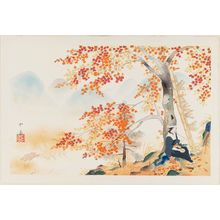
Autumn Maple Leaves at Takao, from the album Eight Views of Kyoto (Kyôto hakkei)
Woodblock print

The Beach at Kaiganji in Sanuki Province (Sanuki Kaiganji no hama), from the series "Collection of Views of Japan II, Kansai Edition (Nihon fukei shu II Kansai hen)"
1934
Color woodblock print; oban

Tea Kettle, section of a sheet from the series "Mirror of Stone Rubbings of Views of the Provinces" (Kohon meihitsu ishizuri kagami)
n.d.
Woodblock print; ishizuri-e, section of harimaze sheet
Featured in Collections
Curated cross-cuts that include this print.
Frequently Asked Questions
THIRTY-SIX VIEWS OF YEDO "YANAGISHIMA MIYOKEN" was created by Utagawa Hiroshige (歌川広重) in 19th century.
THIRTY-SIX VIEWS OF YEDO "YANAGISHIMA MIYOKEN" depicts landscapes.