Two Fish
- Date:
- 19th century
- Medium:
- Paper
- Source:
- Harvard Art Museums
Description
Two Fish by Utagawa Hiroshige is a small-format still-life print belonging to the fish series that he and other artists produced for poetry circles in the 1830s and 1840s. Within Edo ukiyo-e, these fish prints occupy a particular niche: they were often distributed through kyoka and haikai groups, accompanied by verses, and exchanged among amateur poets who used the prints as illustrated platforms for their writing. Hiroshige, better known for the landscape print and for kacho-e, brought the same observational precision to scaled and finned subjects, capturing the silvery shimmer of skin, the wet curve of a tail, and the angle of a gill plate with carved and printed surfaces that retain a startling naturalism. In compositions of two fish, he balances the animals against simple props -- a sprig of plant, a kelp band, or just empty paper -- so that the design feels both elegant and abundant, the way a still life on a banquet table might. The Harvard Art Museums impression preserves the delicate color work necessary to such a subject: subtle bokashi gradations across the body, careful registration so that translucent fins keep their delicate edge. As a quieter expression of the Edo ukiyo-e tradition, Two Fish reminds modern viewers that Hiroshige's range extended well beyond his great landscape print series, and that his eye for organic form animated his depictions of the natural world at every scale.
More Prints by Utagawa Hiroshige


More Landscapes Prints

Lake Kugushi in Wakasa Province (Wakasa Kugushiko), from the series Souvenirs of Travel I (Tabi miyage dai isshu)"
Wakasa Kugushiko
1920
Color woodblock print; oban
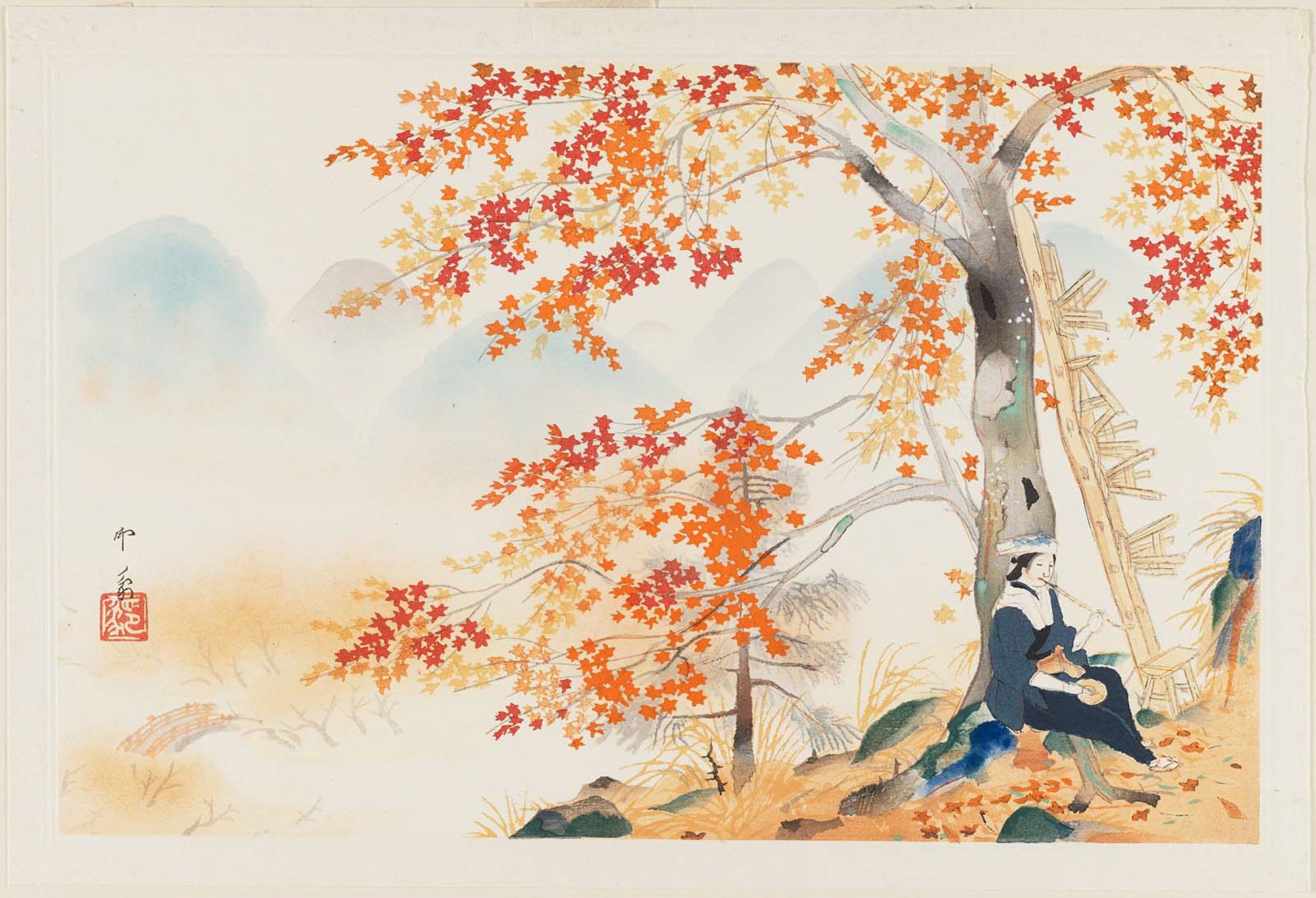
Autumn Maple Leaves at Takao, from the album Eight Views of Kyoto (Kyôto hakkei)
Woodblock print

The Beach at Kaiganji in Sanuki Province (Sanuki Kaiganji no hama), from the series "Collection of Views of Japan II, Kansai Edition (Nihon fukei shu II Kansai hen)"
1934
Color woodblock print; oban

Tea Kettle, section of a sheet from the series "Mirror of Stone Rubbings of Views of the Provinces" (Kohon meihitsu ishizuri kagami)
n.d.
Woodblock print; ishizuri-e, section of harimaze sheet
Featured in Collections
Curated cross-cuts that include this print.
Frequently Asked Questions
Two Fish was created by Utagawa Hiroshige (歌川広重) in 19th century.
Two Fish depicts landscapes and fish.