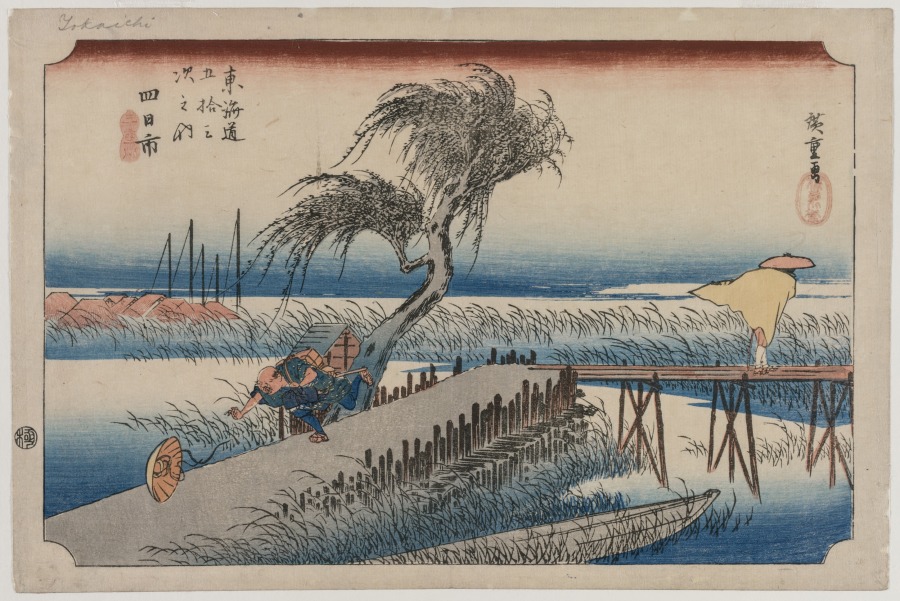
Yokkaichi: View of the Mie River, from the series The Fifty-Three Stations of the Tōkaidō
- Date:
- c. 1833–34
- Medium:
- Color woodblock print
- Source:
- Cleveland Museum of Art
Description
Yokkaichi was the forty-third post station on the Tokaido, an important port on Ise Bay where pilgrims often turned south toward the great shrines at Ise. In this 1838 landscape print from one of Utagawa Hiroshige's many Tokaido series, the artist takes the Mie River, which flows past Yokkaichi, as his primary subject. The composition is built around a windy day along the river: a traveler clutches his hat as it threatens to blow off the bank, while in the distance a few buildings of the post town and a small bridge mark the human presence in an otherwise wide, open landscape. The Cleveland Museum of Art's impression preserves the cool palette and crisp linework that distinguish early printings of Hiroshige's mid-1830s and 1830s Tokaido sheets. As an Edo ukiyo-e landscape print, the Yokkaichi sheet is one of his most economical compositions: a few reeds bent in the wind, a curving river, and a single figure caught in the gust together suggest both the climate and the rhythm of travel along the highway. The print also exemplifies how Hiroshige used unobtrusive narrative incident, in this case the threatened straw hat, to give a recognizable, slightly humorous human anchor to an otherwise atmospheric study of weather and place.
More Prints by Utagawa Hiroshige


More Landscapes Prints

Lake Kugushi in Wakasa Province (Wakasa Kugushiko), from the series Souvenirs of Travel I (Tabi miyage dai isshu)"
Wakasa Kugushiko
1920
Color woodblock print; oban
Autumn Maple Leaves at Takao, from the album Eight Views of Kyoto (Kyôto hakkei)
Woodblock print

The Beach at Kaiganji in Sanuki Province (Sanuki Kaiganji no hama), from the series "Collection of Views of Japan II, Kansai Edition (Nihon fukei shu II Kansai hen)"
1934
Color woodblock print; oban

Tea Kettle, section of a sheet from the series "Mirror of Stone Rubbings of Views of the Provinces" (Kohon meihitsu ishizuri kagami)
n.d.
Woodblock print; ishizuri-e, section of harimaze sheet
Featured in Collections
Curated cross-cuts that include this print.
Frequently Asked Questions
Yokkaichi: View of the Mie River, from the series The Fifty-Three Stations of the Tōkaidō was created by Utagawa Hiroshige (歌川広重) in c. 1833–34.
Yokkaichi: View of the Mie River, from the series The Fifty-Three Stations of the Tōkaidō depicts landscapes.