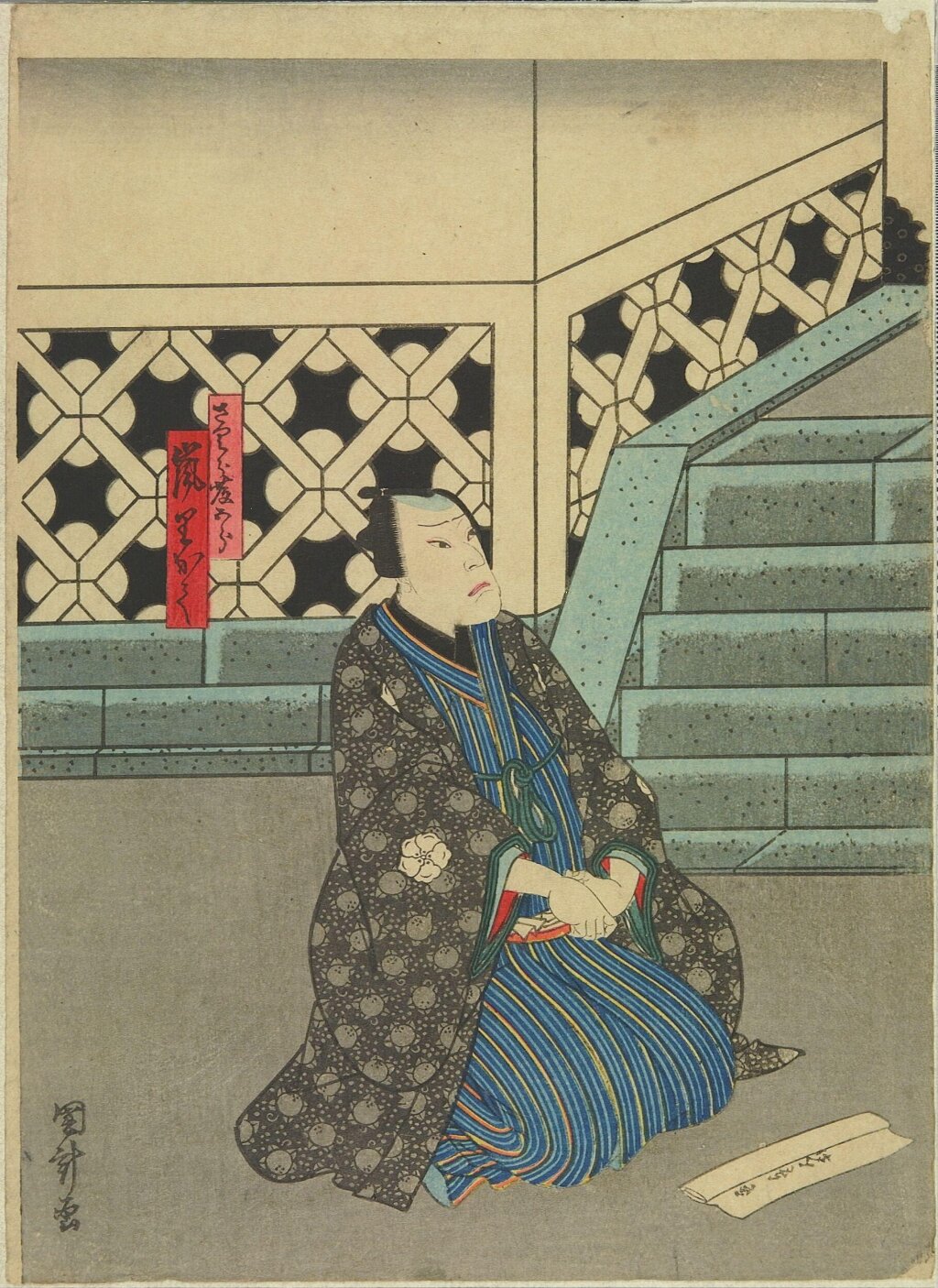
Actor Arashi Rikaku II as Sakura Tōgorō
- Date:
- 1856
- Medium:
- Color woodblock print
- Source:
- Victoria and Albert Museum
Description
A single male kabuki actor kneels on a stone-paved ground before a stone staircase and a lattice-patterned wall with a black background, a red cartouche bearing vertical text set into the lattice at left. He wears a grey kimono patterned with dark roundels and a white floral crest over a blue robe striped in yellow, red, and white, his hands clasped before him and his head turned to the side with a stern expression; a closed scroll or folded paper lies on the ground beside him. This 1856 color woodblock print by Utagawa Kunikazu depicts the actor Arashi Rikaku II in the role of Sakura Tōgorō.
More Prints by Utagawa Kunikazu
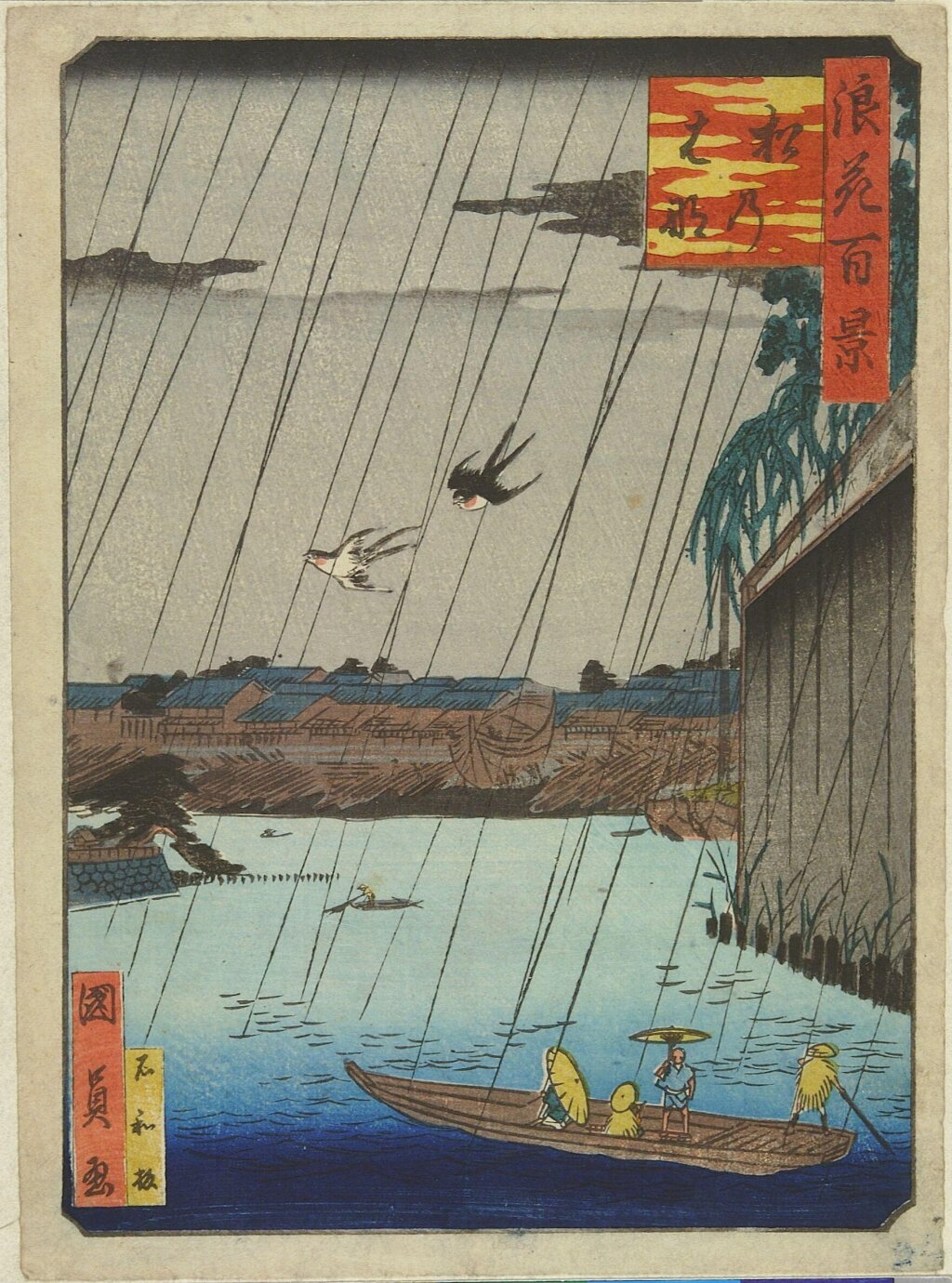
Pine Tree Point (Matsu-no-hana)
松の鼻
1860
Color woodblock print
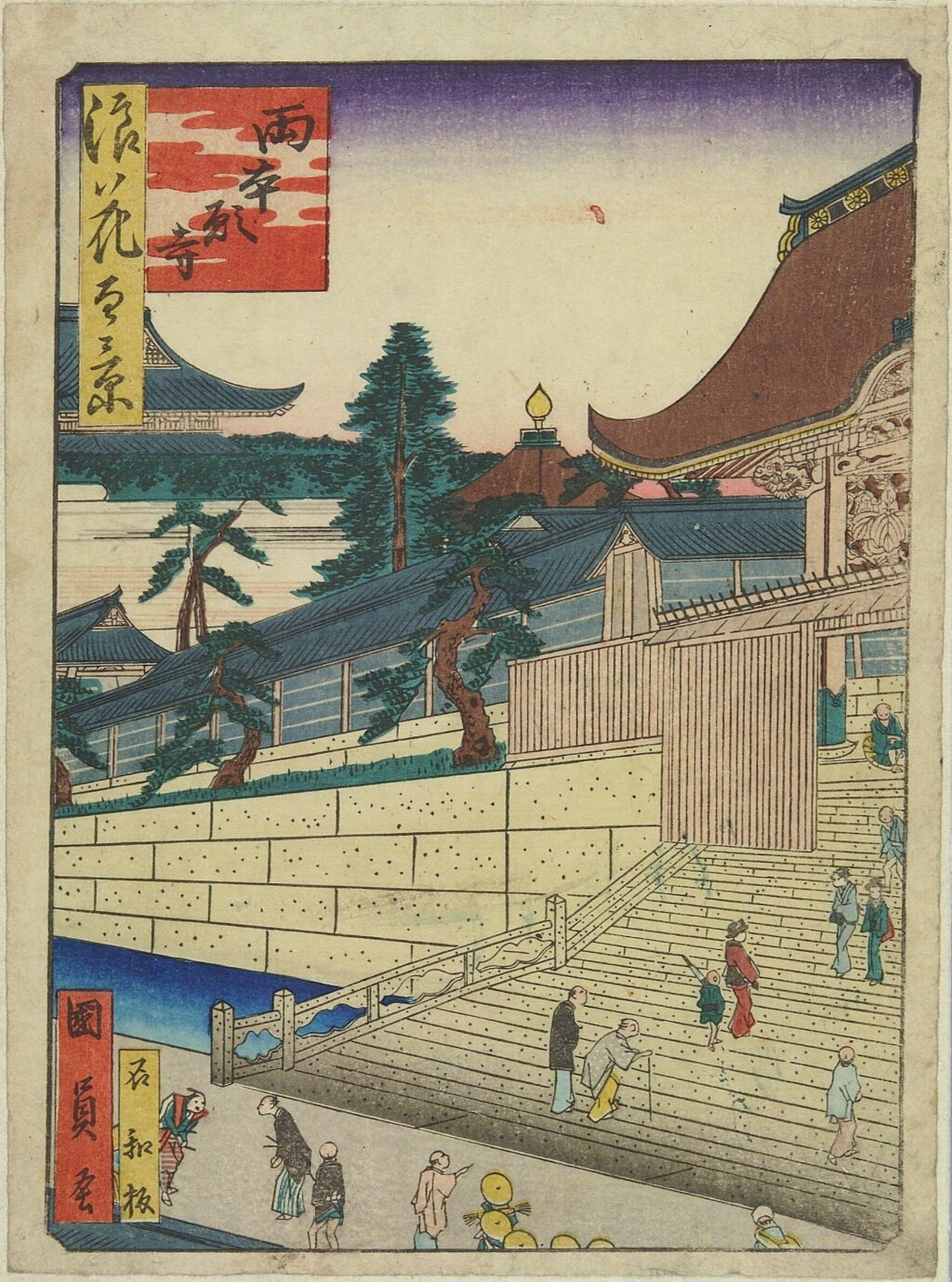
The Two Hongan-ji Temples (Ryō Hongan-ji)
両本願寺
1860
Color woodblock print

Dai Nihon rokujū yo kyō no uchi (One of the Sixty-odd Provinces of Great Japan)
大日本六十余州之内
c. 1862
Color woodblock print
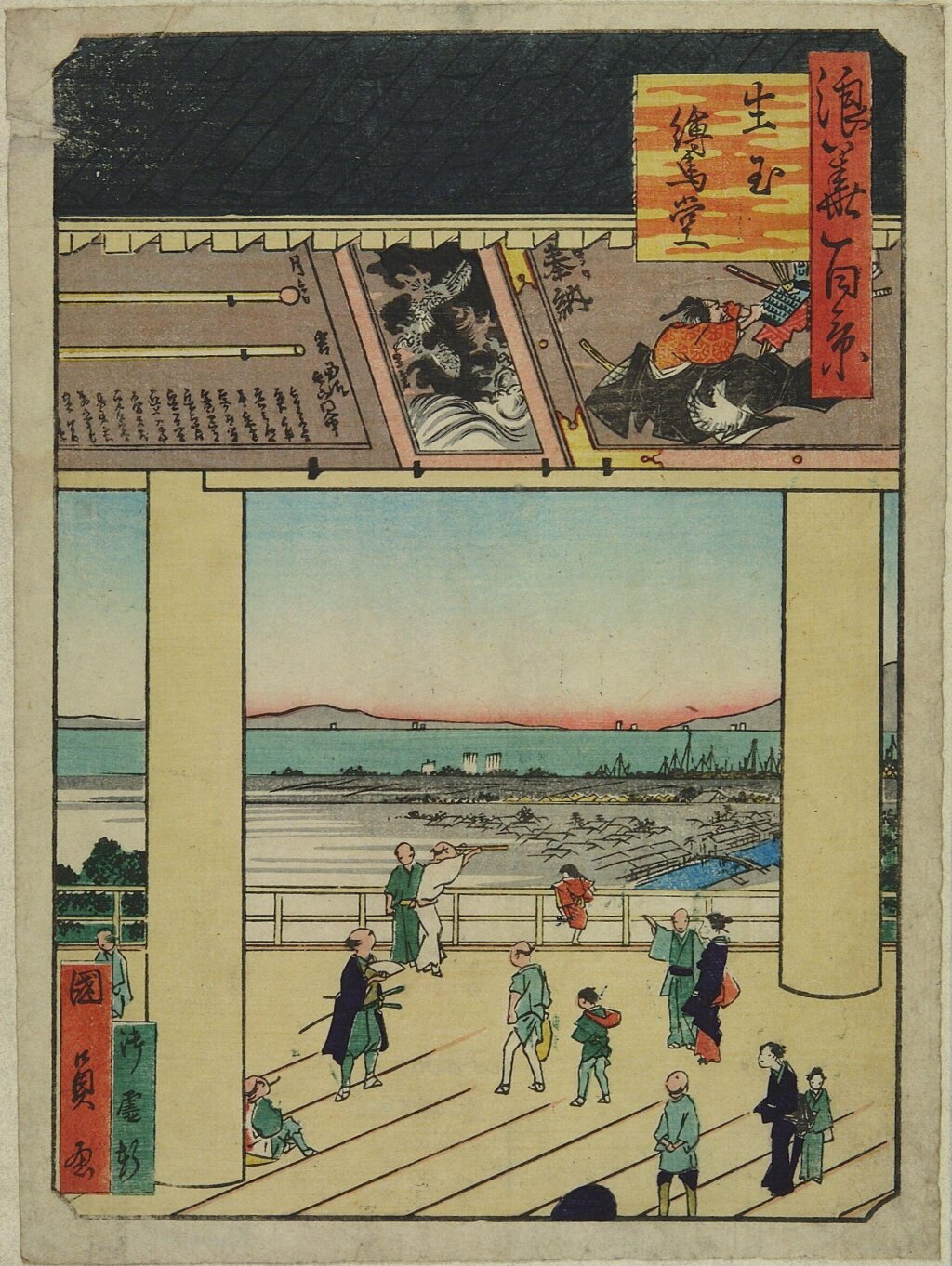
Votive-Picture Hall of the Shrine at Ikutama (Ikutama Ema-dō)
生玉絵馬堂
1860
Color woodblock print
More Landscapes Prints

Lake Kugushi in Wakasa Province (Wakasa Kugushiko), from the series Souvenirs of Travel I (Tabi miyage dai isshu)"
Wakasa Kugushiko
1920
Color woodblock print; oban
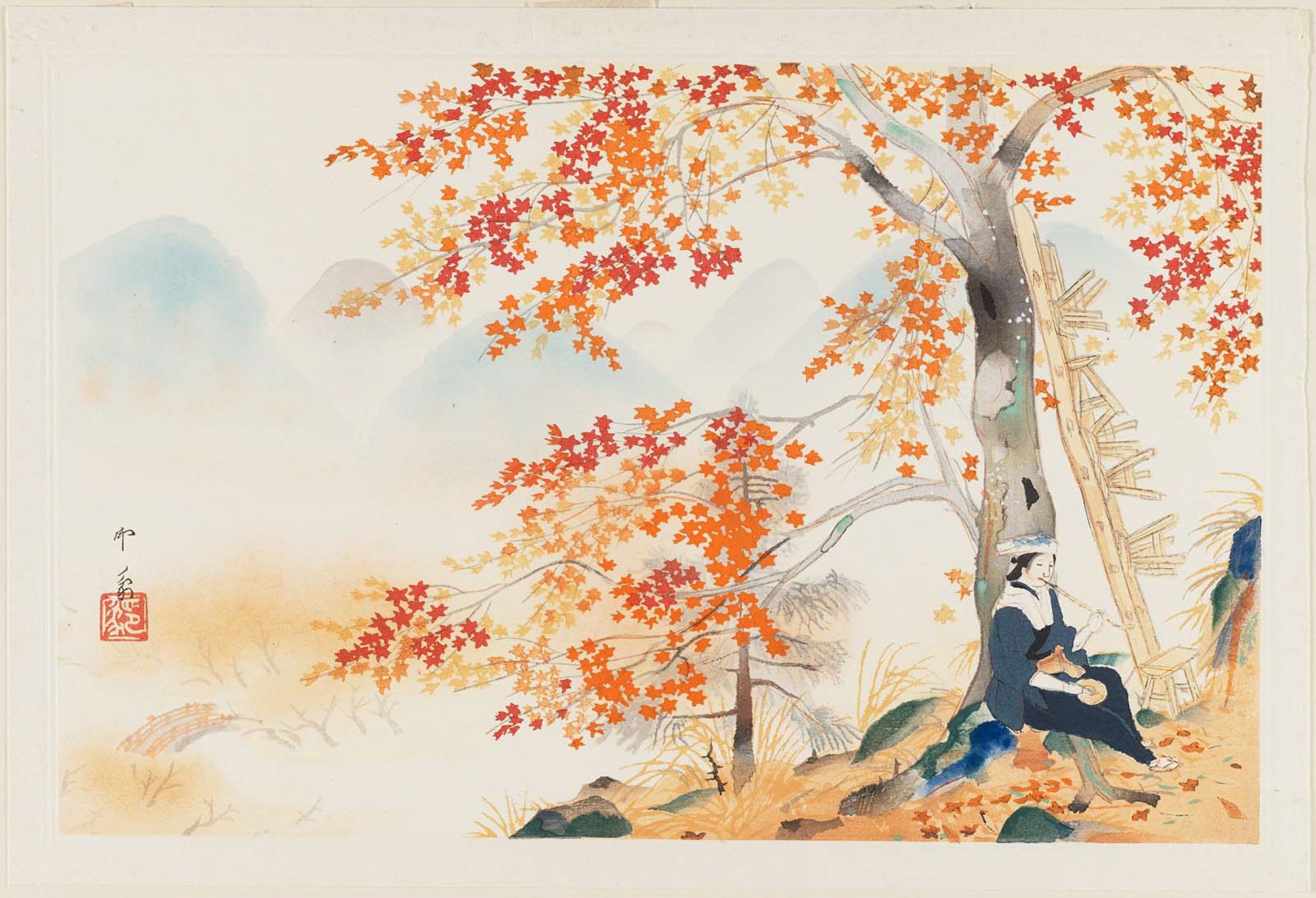
Autumn Maple Leaves at Takao, from the album Eight Views of Kyoto (Kyôto hakkei)
Woodblock print

The Beach at Kaiganji in Sanuki Province (Sanuki Kaiganji no hama), from the series "Collection of Views of Japan II, Kansai Edition (Nihon fukei shu II Kansai hen)"
1934
Color woodblock print; oban

Tea Kettle, section of a sheet from the series "Mirror of Stone Rubbings of Views of the Provinces" (Kohon meihitsu ishizuri kagami)
n.d.
Woodblock print; ishizuri-e, section of harimaze sheet
Featured in Collections
Curated cross-cuts that include this print.
Frequently Asked Questions
Actor Arashi Rikaku II as Sakura Tōgorō was created by Utagawa Kunikazu (歌川国員) in 1856.
Actor Arashi Rikaku II as Sakura Tōgorō depicts landscapes.