
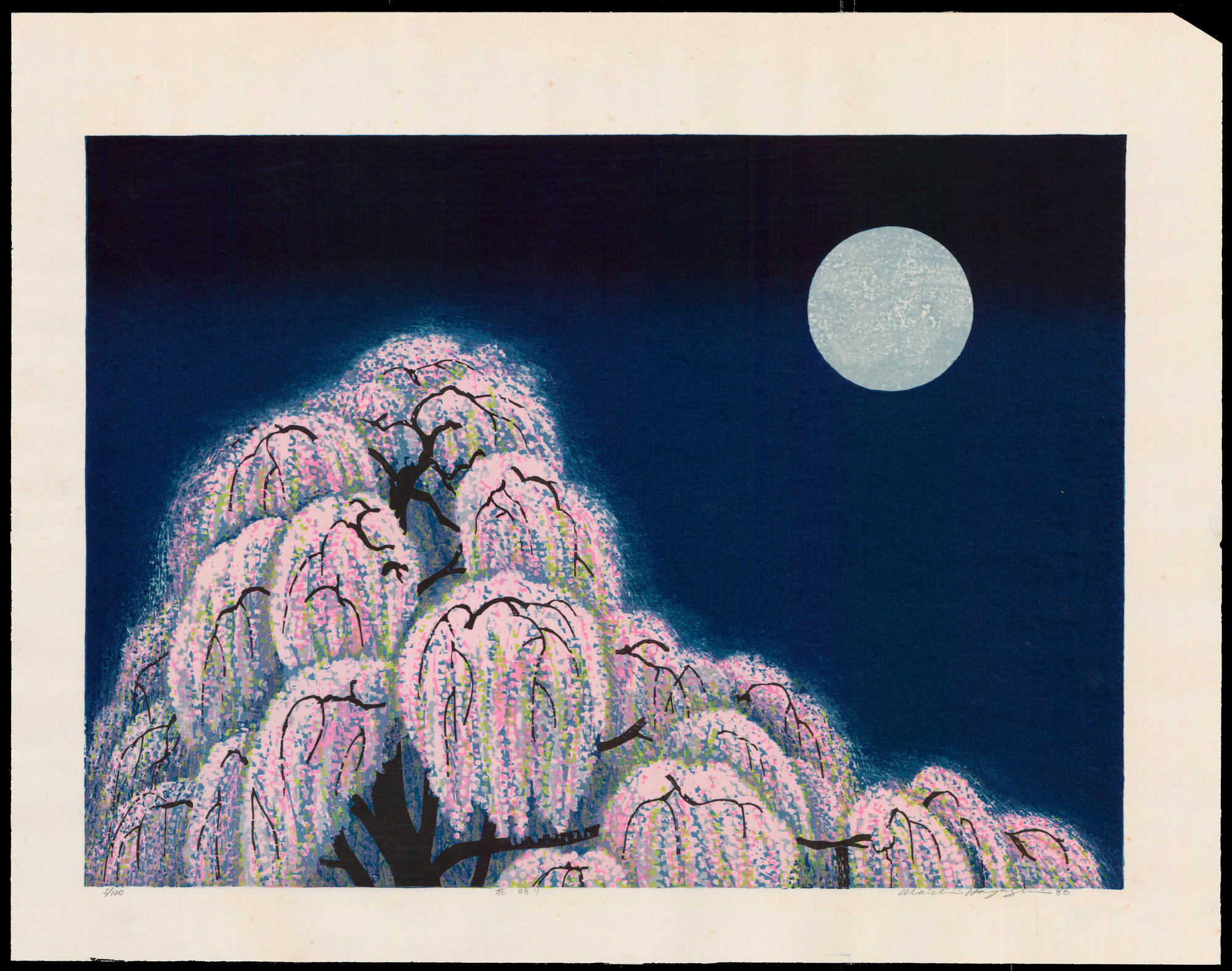
Bright flowers (Full moon and weeping cherry tree in Maruyama park)
- Medium:
- Mokuhanga (Japanese woodblock)
- Image courtesy of
- Saru Gallery
Description
This print depicts the celebrated shidarezakura (weeping cherry tree) of Maruyama Park in Kyoto, set beneath a full moon — a scene that fuses hanami (cherry blossom viewing) with tsukimi (moon viewing) traditions. The 'Bright flowers' designation suggests an emphasis on luminous blossoms, likely achieved through layered impressions and selective coloration that pushes the cherry petals forward against a darker ground. Compositions of this subject typically arrange the cascading branches in a curtain-like sweep across the picture plane, with the moon balanced as a counterweight. Bokashi gradients are well-suited to the sky and the diffuse halo around the moon. The flattened spatial treatment and emphasis on decorative pattern align with the mingei-influenced folk sensibility Hayashi cultivated, while the meisho-e (famous places) lineage connects the work to a centuries-old printmaking tradition reinterpreted through sosaku-hanga independence — designed, carved, and printed by the artist himself rather than under publisher direction.
More Prints by Waichi Hayashi
More Moonlight Prints
![Mount Fuji on a Moonlit Night, Kawai Bridge (Tsukiyo no Fuji [Kawaibashi]), from the series "Selection of Views of the Tokaido (Tokaido fukei senshu)" by Kawase Hasui](https://www.artic.edu/iiif/2/d0960668-1e73-339a-b182-fb995a54bff0/full/843,/0/default.jpg)
Mount Fuji on a Moonlit Night, Kawai Bridge (Tsukiyo no Fuji [Kawaibashi]), from the series "Selection of Views of the Tokaido (Tokaido fukei senshu)"
1947
Color woodblock print; oban

Evening Moon at Nakanoshima, Sapporo (Sapporo Nakanoshima no yuzuki), from the series "Collection of Views of Japan, Eastern Japan Edition (Nihon fukei shu higashi Nihon hen)"
March 1933
Color woodblock print; oban

Matsushima in Moonlight (Tsuki no Matsushima)
1919
Color woodblock print

Kiyozumi Garden in Moonlight
January 1938
Woodblock print, ink and color on paper
Featured in Collections
Curated cross-cuts that include this print.
Frequently Asked Questions
Bright flowers (Full moon and weeping cherry tree in Maruyama park) was created by Waichi Hayashi (林和一).
Bright flowers (Full moon and weeping cherry tree in Maruyama park) depicts moonlight, gardens, and trees.