
Winter Scene on a beach
- Medium:
- Mokuhanga (Japanese woodblock)
- Image courtesy of
- Saru Gallery
Description
Winter Scene on a beach combines two subjects Shoun handled separately elsewhere: snowfall and the coast. Coastal winter prints in the Japanese tradition typically place a low horizon, a strip of grey or indigo sea, and a foreground of windblown sand or snow against pine windbreaks. The compositional interest lies in the contrast between the soft geometry of drifted snow and the harder rhythm of waves. Shoun would likely have used bokashi to grade the sky into a colder, near-white tone, with the sea modeled in flat indigo blocks and small wave caps reserved as unprinted washi. Pine needles and beach grasses provide the linear counterpoint to the broad areas of color. The subject sits within the late-Meiji and Taisho-era fashion for meisho-e of overlooked or unromantic places — not the Tokaido stations of Hiroshige but anonymous stretches of coastline observed in particular weather. Shoun's longevity meant he produced such scenes across multiple decades, with stylistic markers shifting from ukiyo-e flatness toward more atmospheric shin-hanga sensibilities.
More Prints by Yamamoto Shoun


More Snow Scenes Prints
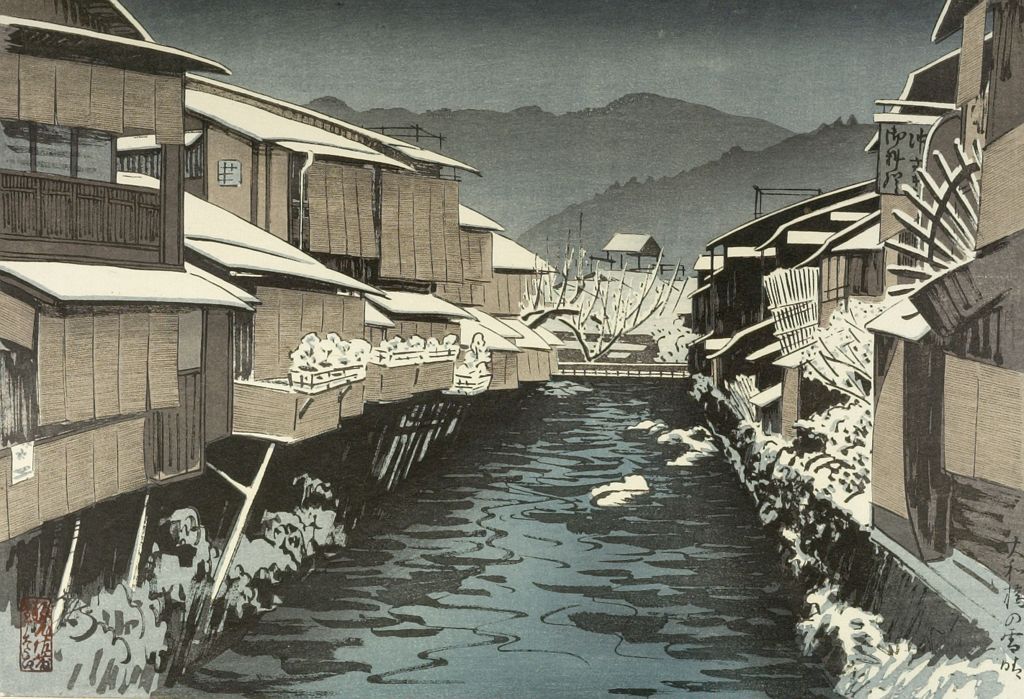
Fair Weather After Snow at Yamato Bridge, Kyoto (Yamato bashi no yukibare), Taishô period, dated 1924
Woodblock print

The Compound of the Tenman Shrine at Kameido in the Snow (Kameido Tenmangu keidai no yuki), from the series "Famous Places in the Eastern Capital (Toto meisho)"
c. 1832/38
Color woodblock print; oban

Miyajima in Snow (Yuki no Miyajima)
Yuki no Miyajima
1929
Color woodblock print; oban
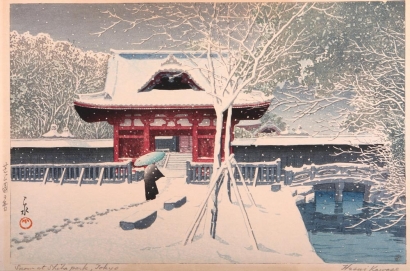
Evening Snow at Shiha Park, Tokyo
1932
Woodblock print
Featured in Collections
Curated cross-cuts that include this print.
Frequently Asked Questions
Winter Scene on a beach was created by Yamamoto Shoun (山本昇雲).
Winter Scene on a beach depicts snow scenes, seascapes, and winter.