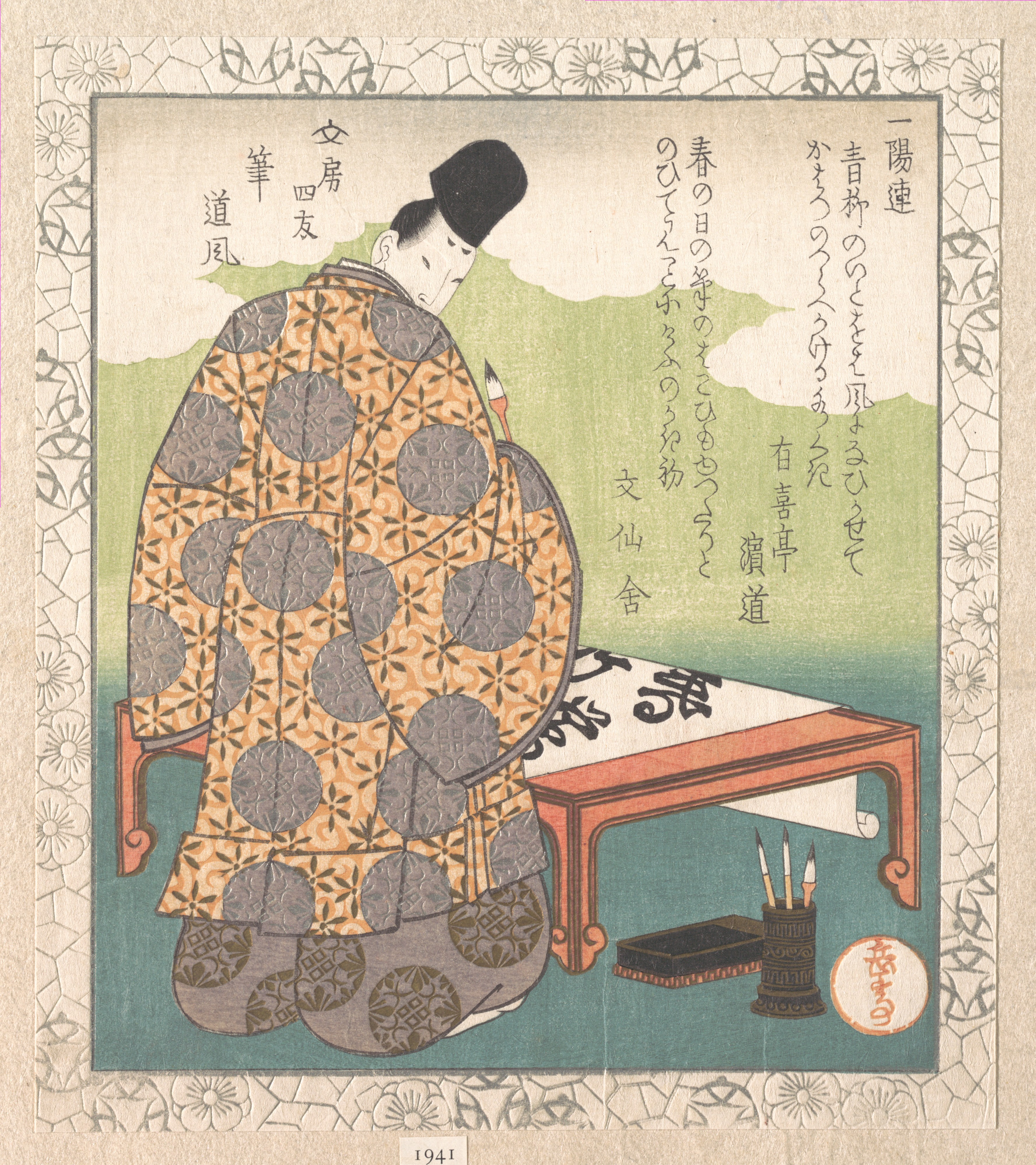
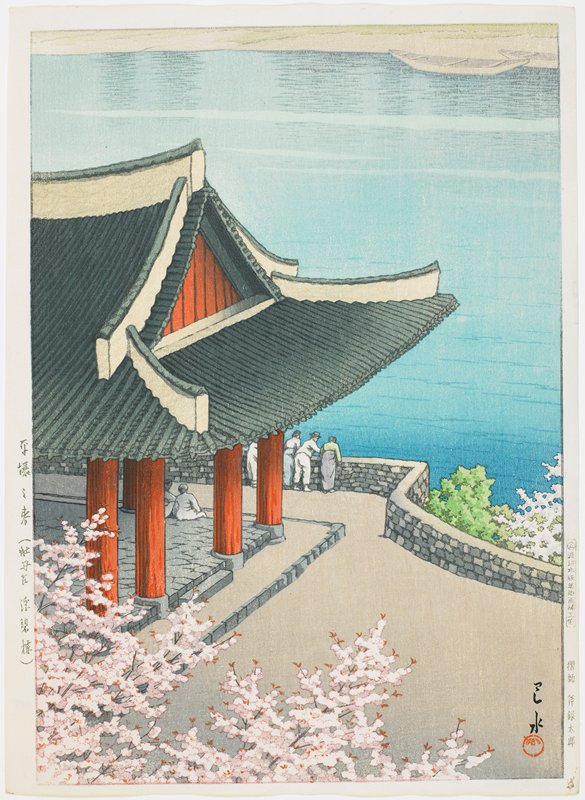
The Heian Court Calligrapher Ono no Tōfū (894–966); “Calligraphy Brush” (Fude), from Four Friends of the Writing Table for the Ichiyō Poetry Circle (Ichiyō-ren Bunbō shiyū) From the Spring Rain Collection (Harusame shū), vol. 1
- Date:
- ca. 1827
- Medium:
- Woodblock print (surimono); ink and color on paper
- Source:
- Metropolitan Museum of Art
Description
Yashima Gakutei designed this surimono in 1817 for the series Four Friends of the Writing Table for the Ichiyō Poetry Circle (Ichiyō-ren Bunbō shiyū), assigning the theme of "Calligraphy Brush" (Fude) to the great Heian court calligrapher Ono no Tōfū (894–966). The print appears in the Spring Rain Collection (Harusame shū), volume 1, preserved at the Metropolitan Museum of Art.
Ono no Tōfū, traditionally counted among the Sanseki (three great brushes) of Heian calligraphy, appears here in courtly attire suitable for a tenth-century aristocrat. Gakutei surrounds him with subtle attributes — paper, possibly a brush, perhaps a small frog, the latter alluding to the famous anecdote in which Tōfū watched a frog repeatedly leap toward a willow branch until succeeding, taking the persistence as a lesson in his own art. The composition unites historical portraiture with a sly literary reference legible to the educated members of the Ichiyō poetry circle.
Gakutei studied in the Hokusai school after early training with Totoya Hokkei, and this surimono shows him fully fluent in the school's design vocabulary. Katsushika Hokusai had popularized literary and historical subjects rendered with crisp drawing and judicious color, and Gakutei applies those principles here, balancing Tōfū's robed figure against an unworked ground while concentrating decorative effort on patterned brocades and trim.
The Ichiyō poetry circle commissioned the entire series of four prints, each pairing a writing-table accessory with an exemplary literary or legendary personage. The surimono format permitted lavish printing techniques — mica grounds, embossing, and metallic pigments — visible in the Metropolitan's impression. Yashima Gakutei's portrait of Ono no Tōfū thus exemplifies how Hokusai school designers served the refined intellectual tastes of Edo's kyōka poetry clubs through historically informed image-making.
More Prints by Yashima Gakutei


More Spring Prints

Frequently Asked Questions
The Heian Court Calligrapher Ono no Tōfū (894–966); “Calligraphy Brush” (Fude), from Four Friends of the Writing Table for the Ichiyō Poetry Circle (Ichiyō-ren Bunbō shiyū) From the Spring Rain Collection (Harusame shū), vol. 1 was created by Yashima Gakutei (八島岳亭) in ca. 1827.
The Heian Court Calligrapher Ono no Tōfū (894–966); “Calligraphy Brush” (Fude), from Four Friends of the Writing Table for the Ichiyō Poetry Circle (Ichiyō-ren Bunbō shiyū) From the Spring Rain Collection (Harusame shū), vol. 1 depicts spring and rain.