
Makura bridge
- Medium:
- Mokuhanga (Japanese woodblock)
- Image courtesy of
- Saru Gallery
Description
Makura-bashi spans the Kita-Jikkengawa canal near the Sumida River in Tokyo's Honjo-Mukojima district, an area central to Fujimaki's documented subject matter. The bridge, whose name translates as "Pillow Bridge," sits within the Shitamachi neighborhoods Fujimaki returned to repeatedly during his short working life. As a sosaku-hanga ("creative print") work, the print would have been designed, carved, and printed by Fujimaki himself, in keeping with the movement's rejection of the traditional ukiyo-e division of labor between designer, carver, and printer. Bridge subjects in 1930s sosaku-hanga typically emphasize structural geometry, the relationship between span and water, and the working-class character of the surrounding district rather than the picturesque vantages of earlier meisho-e. Fujimaki's Shitamachi prints from this period record neighborhoods that would be heavily damaged in the 1945 firebombings, giving surviving impressions documentary as well as artistic value within his small body of work.
More Prints by Fujimaki Yoshio


More Bridges Prints
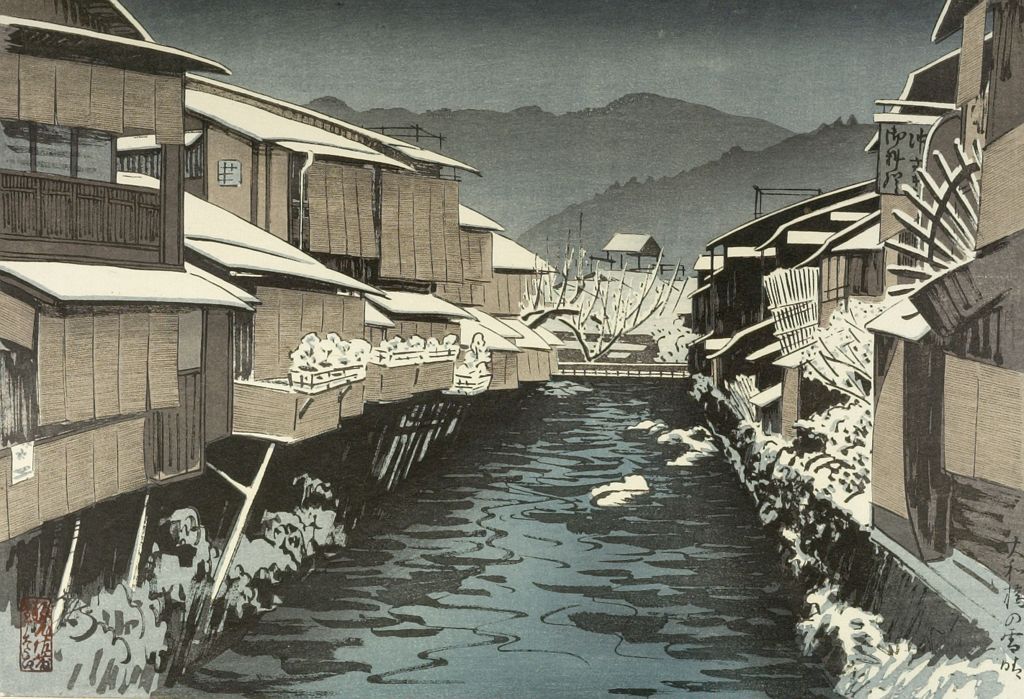
Fair Weather After Snow at Yamato Bridge, Kyoto (Yamato bashi no yukibare), Taishô period, dated 1924
Woodblock print
![Mount Fuji on a Moonlit Night, Kawai Bridge (Tsukiyo no Fuji [Kawaibashi]), from the series "Selection of Views of the Tokaido (Tokaido fukei senshu)" by Kawase Hasui](https://www.artic.edu/iiif/2/d0960668-1e73-339a-b182-fb995a54bff0/full/843,/0/default.jpg)
Mount Fuji on a Moonlit Night, Kawai Bridge (Tsukiyo no Fuji [Kawaibashi]), from the series "Selection of Views of the Tokaido (Tokaido fukei senshu)"
1947
Color woodblock print; oban

Shin Ohashi Bridge (Shin Ohashi), from the series "Twenty View of Tokyo (Tokyu nijukkei)"
1926
Color woodblock print; oban

Sacred Bridge in Nikko (Nikko Shinkyo)
1930
Color woodblock print; oban
Featured in Collections
Curated cross-cuts that include this print.
Frequently Asked Questions
Makura bridge was created by Fujimaki Yoshio (藤牧義夫).
Makura bridge depicts bridges.