Biography
Chizuko Yoshida (吉田千鶴子, 1924–2017) was a Japanese modernist printmaker whose work connected international abstract art movements with the traditions of Japanese woodblock printing. Born on March 20, 1924, in Yokohama, she was neither raised in an artistic family nor destined by birth for the Yoshida printmaking dynasty she would eventually join. Her path to printmaking began at the Sato Girl's High School in Tokyo, where she studied watercolor painting, and continued at the Hongo Art Institute, where she enrolled in 1941 to study design before the war interrupted her education.
After the war, Chizuko studied under the sosaku-hanga printmaker Fumio Kitaoka, and it was while interning at his studio that she first encountered woodblock printing. She also attended the art seminars of Onchi Koshiro, the pioneering abstract printmaker, where she met Hodaka Yoshida, the younger son of the celebrated landscape artist Hiroshi Yoshida. The two married in June 1953, and Chizuko entered the Yoshida family studio in Tokyo --- a household where printmaking was a daily practice passed between generations. Around the time of her marriage, she shifted decisively from painting to woodblock printing as her primary medium, joining the Nihon Hanga Kyokai (Japan Print Association) in 1954.
In 1956, Chizuko co-founded the Joryu Hanga Kyokai (Women's Print Association) with eight other professional female printmakers, including Minami Keiko, Iwami Reika, and Kobayashi Donge. The group mounted its first exhibition in October 1956 at a Tokyo gallery and continued exhibiting together through 1965, creating professional visibility for women artists in a field dominated by men. This organizing work represented a commitment to equity in the art world that ran parallel to her studio practice.
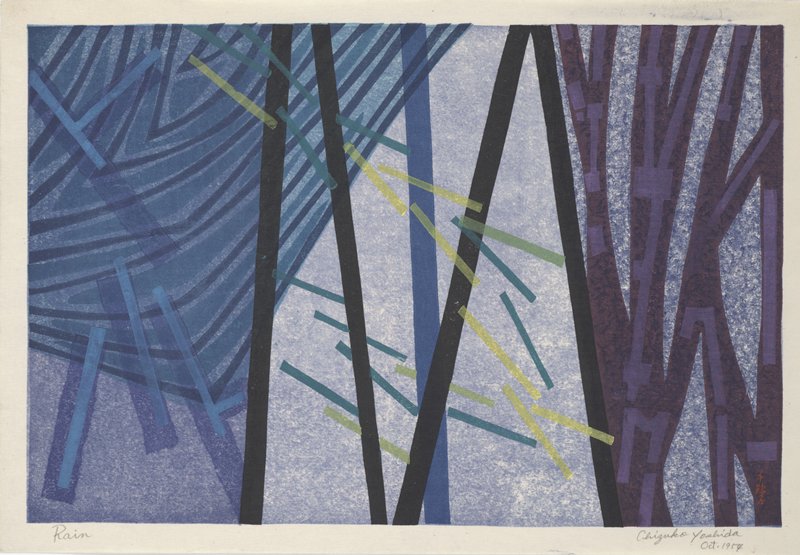
Chizuko's prints ranged from geometric abstraction to nature-inspired compositions --- butterflies, flowers, and organic patterns rendered with a refined Japanese aesthetic sensibility. She drew on the visual language of international movements including abstract expressionism and op art, but filtered these influences through the material qualities of mokuhanga, with its layered water-based pigments and the soft absorption of handmade washi paper. By the early 1960s, her work grew larger in scale and incorporated Japanese calligraphic elements and embossed surfaces that added physical depth to the printed image.
She continued working for over six decades, a testament to both her personal dedication and the Yoshida tradition of lifelong artistic practice. Her daughter Ayomi Yoshida, born in 1958, became a printmaker known for modernist woodblock prints and large-scale woodblock-chip installations, carrying the family's printmaking tradition into the next generation. Chizuko died on April 1, 2017, at the age of ninety-three, having built a body of work that established her as an important figure in postwar Japanese printmaking independent of the famous family name she carried.
Key Facts
- Active Period
- 1924–2017
- Nationality
- 🇯🇵Japan
- Movements
- Contemporary MokuhangaSōsaku-hanga
- Works Indexed
- 30
Frequently Asked Questions
Chizuko Yoshida (吉田千鶴子, 1924–2017) was a Japanese modernist printmaker whose work connected international abstract art movements with the traditions of Japanese woodblock printing. Born on March 20, 1924, in Yokohama, she was neither raised in an artistic family nor destined by birth for the Yoshida printmaking dynasty she would eventually join. Her path to printmaking began at the Sato Girl's High School in Tokyo, where she studied watercolor painting, and continued at the Hongo Art Institute, where she enrolled in 1941 to study design before the war interrupted her education.
Chizuko Yoshida was active from 1924 to 2017. They were associated with the Contemporary Mokuhanga and Sōsaku-hanga movements.
Chizuko Yoshida's work was shaped by the Contemporary Mokuhanga and Sōsaku-hanga traditions in Japanese woodblock printmaking. Contemporary Mokuhanga: Contemporary mokuhanga (literally "wood-block print") encompasses artists working from approximately 1970 to the present who continue or reinvent traditional Japanese woodblock printing techniques. Sōsaku-hanga: ## What is sōsaku-hanga? Sōsaku-hanga (創作版画, "creative prints") was a twentieth-century Japanese print movement defined by a single commitment: the artist must design, carve, and print every work alone.
Chizuko Yoshida's prints frequently feature abstract, insects, music, landscapes, rain, seascapes.
Original prints by Chizuko Yoshida can be found in collections including Art Institute of Chicago, Minneapolis Institute of Art, wbp, Harvard Art Museum.
Woodblock Prints by Chizuko Yoshida (30)
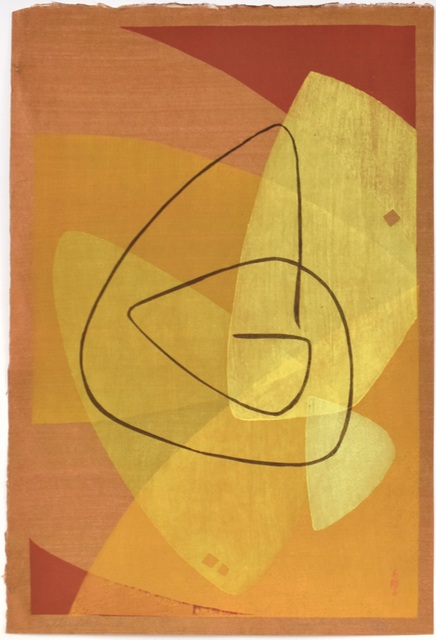
Butterfly A
1953
Woodblock print
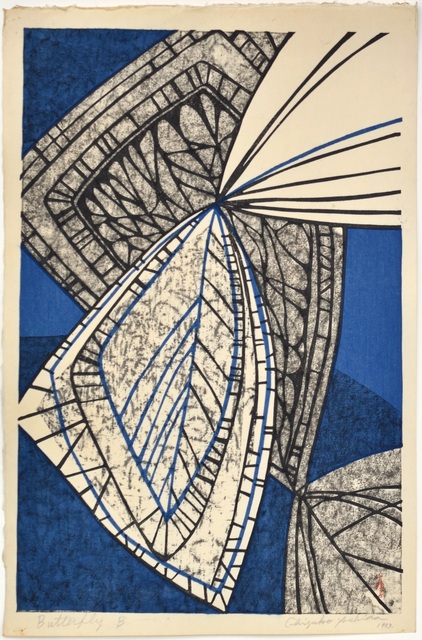
Butterfly B
1953
Woodblock print

Tenryuji Garden (Tenryuji teien)
1953
Color woodblock print

Muro
1953
Color woodblock print
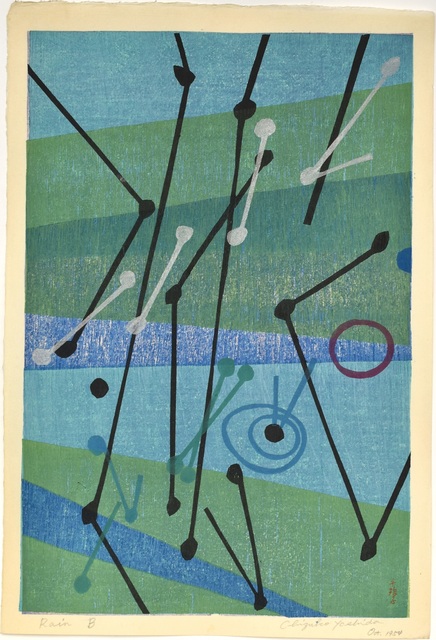
Rain B
1954
Woodblock print
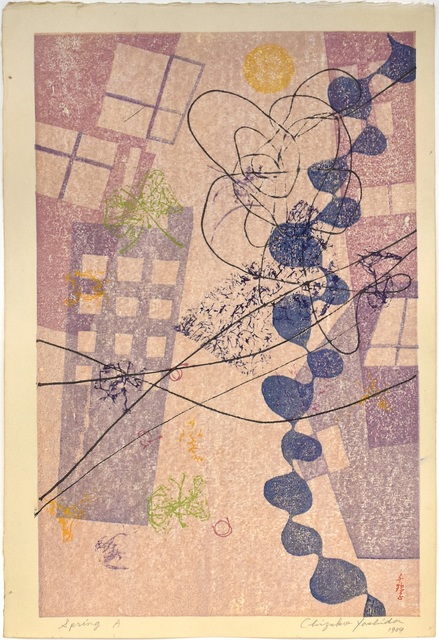
Spring A
1954
Woodblock print
Rain
October 1954
Woodblock print, ink and color on paper

Jazz
1954
Woodblock print, ink and color on paper
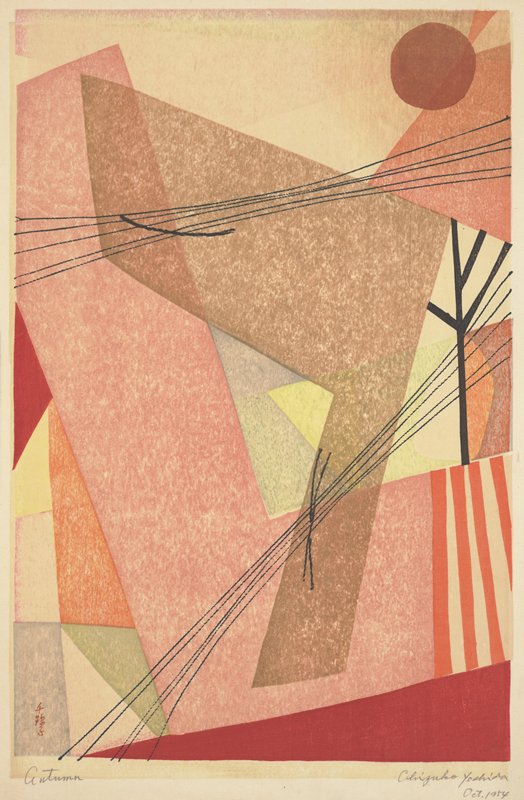
Autumn
October 1954
Woodblock print, ink and color on paper

Requiem (Chinkon) No. 2
1956
Color relief print

Impression of an Arab
1958
Color woodblock print; edition 44/50

Night in the Desert (Sabaku no yoru)
1959
Color woodblock print; edition 3/50

Anticipation (Uchinarumono)
1961
Color woodblock print; artist’s proof
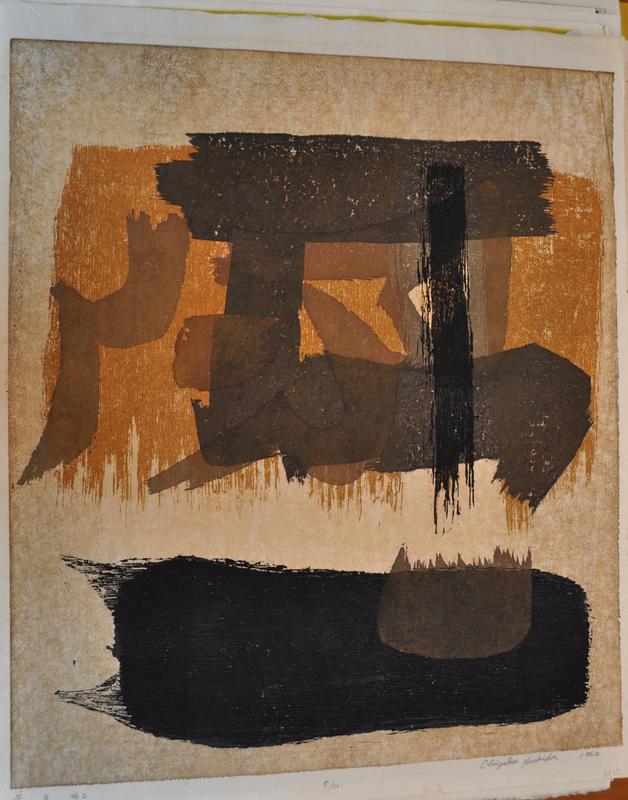
Passed Days
1962
Woodblock print, ink and color on paper

Sign (Kizashi) (artist’s proof)
1970
Color woodblock print with embossing
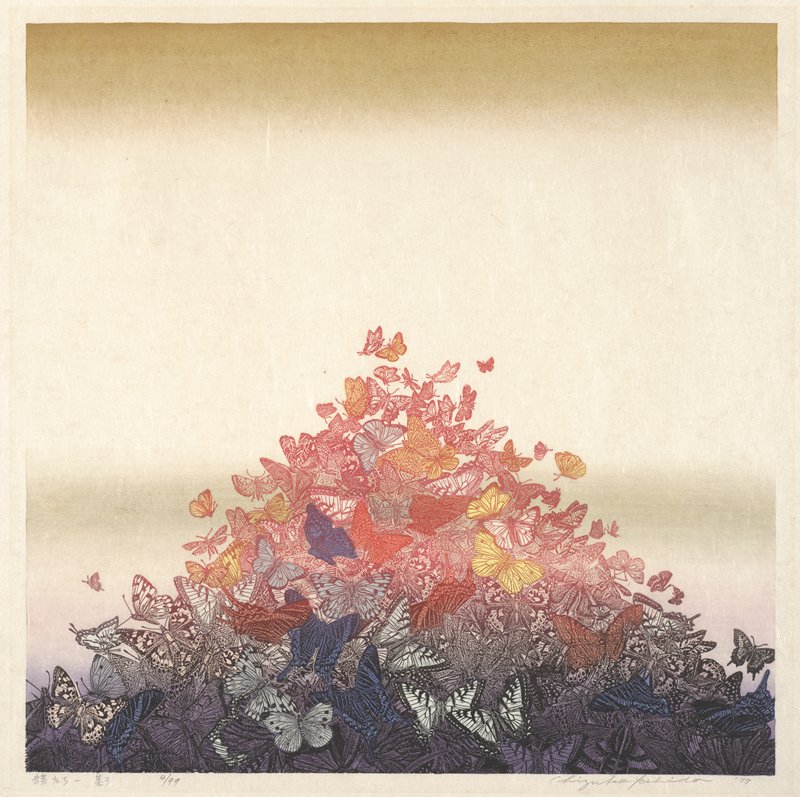
Butterflies—Swarming
1977
Woodblock print, ink and color on paper
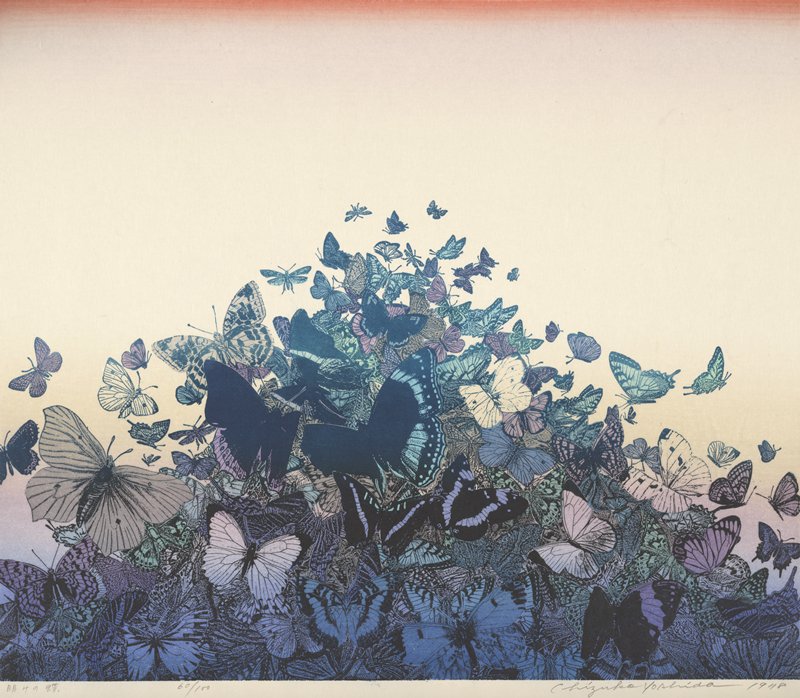
Butterflies at Dawn
1978
Woodblock print, ink and color on paper

Valley of Butterflies (Tanima no cho)
1979
Photoetching and color woodblock print; artist’s proof
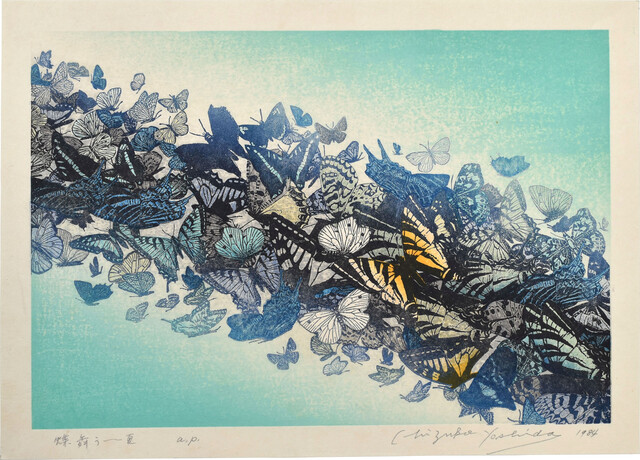
Butterfly Dance - Summer
1984
Zinc plate and woodblock print
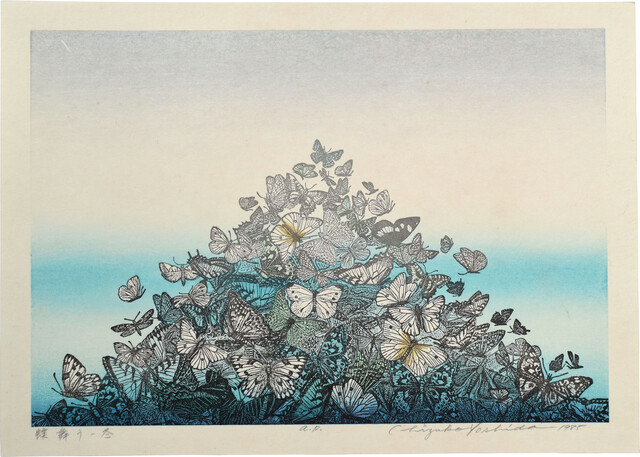
Butterfly Dance - Winter
1985
Zinc plate and woodblock print
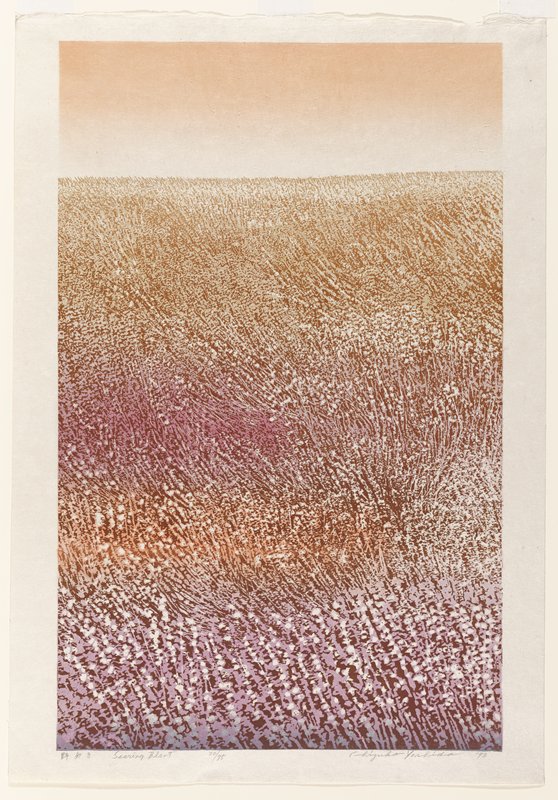
Searing Blast
1993
Woodblock print, ink and color on paper

Cool Breeze (Sofu)
1993
Photoetching and color woodblock print

Ice Floe, Utoro (Utoro ryūhyō)
1995
Photoetching and color woodblock print; artist’s proof

Drift Ice B
1995
Color woodblock print