Biography
Hiratsuka Un'ichi (1895-1997) was one of the leading figures and teachers of the sosaku-hanga (creative print) movement in Japan. Born in Matsue, Shimane Prefecture, he studied Western-style painting under Okada Saburōsuke before turning to printmaking, and trained in traditional woodblock carving under the master carver Igami Bonkotsu — an unusually rigorous grounding in cutting technique for an artist of his generation. The sosaku-hanga movement, whose origins are often traced to Yamamoto Kanae's 1904 print 'Fisherman,' held that artists should design, carve, and print their own works, in contrast to the collaborative division of labour of the ukiyo-e and shin-hanga traditions — a principle Hiratsuka championed throughout his life.
Throughout his extraordinarily long and prolific career, Hiratsuka created a vast body of work, predominantly bold black-and-white woodcuts characterised by strong contrasts and dynamic compositions. His subjects ranged from Buddhist temples and Shinto shrines to modern cityscapes, rendered with a distinctively powerful cutting technique. An active member of the Nihon Sosaku-Hanga Kyokai (Japan Creative Print Association), he taught woodblock-cutting to a rising generation of printmakers, most notably Shiko Munakata, whom he instructed in wood carving from 1928.
In 1962, Hiratsuka moved to Washington, D.C., where he continued to create prints and remained artistically active well into his old age before eventually returning to Japan. He received numerous honours, becoming in 1970 the first print artist to receive the Order of Cultural Merit and, in 1977, the first artist awarded the Order of the Sacred Treasure. His longevity — he lived to 102 — made him a living link between the pre-war origins of sosaku-hanga and its postwar international recognition.
Key Facts
- Active Period
- 1895–1997
- Nationality
- 🇯🇵Japan
- Movement
- Sōsaku-hanga
- Works Indexed
- 299
Frequently Asked Questions
Hiratsuka Un'ichi (1895-1997) was one of the leading figures and teachers of the sosaku-hanga (creative print) movement in Japan. Born in Matsue, Shimane Prefecture, he studied Western-style painting under Okada Saburōsuke before turning to printmaking, and trained in traditional woodblock carving under the master carver Igami Bonkotsu — an unusually rigorous grounding in cutting technique for an artist of his generation. The sosaku-hanga movement, whose origins are often traced to Yamamoto Kanae's 1904 print 'Fisherman,' held that artists should design, carve, and print their own works, in contrast to the collaborative division of labour of the ukiyo-e and shin-hanga traditions — a principle Hiratsuka championed throughout his life.
Hiratsuka Un'ichi was active from 1895 to 1997. They were associated with the Sōsaku-hanga movement.
Hiratsuka Un'ichi's work was shaped by the Sōsaku-hanga tradition in Japanese woodblock printmaking. Sōsaku-hanga: ## What is sōsaku-hanga? Sōsaku-hanga (創作版画, "creative prints") was a twentieth-century Japanese print movement defined by a single commitment: the artist must design, carve, and print every work alone.
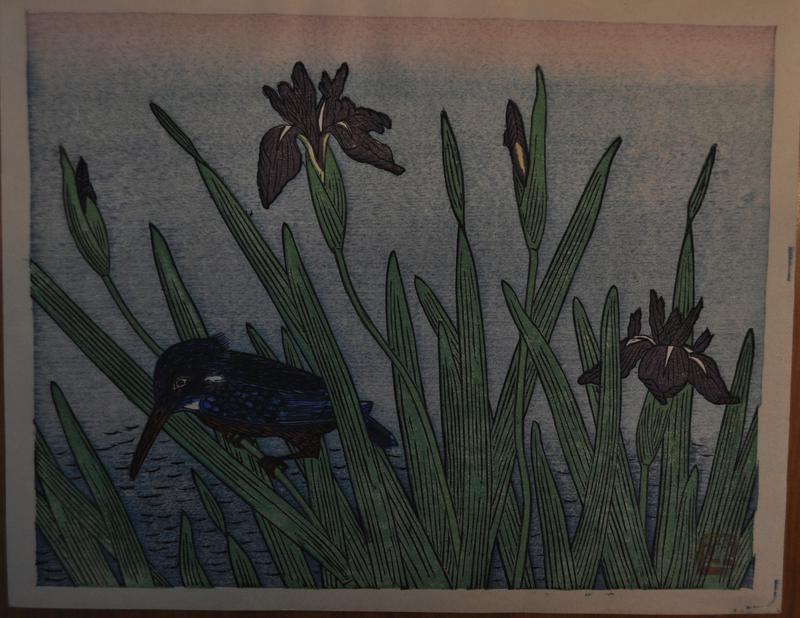
Hiratsuka Un'ichi's prints frequently feature landscapes, temples & shrines, architecture, birds & flowers, rivers & lakes, urban scenes.
Original prints by Hiratsuka Un'ichi can be found in collections including Art Institute of Chicago, Minneapolis Institute of Art, Honolulu Museum of Art, Harvard Art Museums.
Series by Hiratsuka Un'ichi
Recollections of Tokyo
2 prints
of One Hundred Views of New Japan
1 print
Scenes After the Tokyo Earthquake
1 print
One Hundred Views of New Tokyo (Shin Tokyo hyakkei)
1 print
Prints of the Shinjuku Imperial Garden (Shinjuku Gyoen hanga)
1 print
Scenes After theTokyo Earthquake
1 print
Mantai Suriutsuchi No Uchi
1 print
Ten Views of Nara
2 prints
Woodblock Prints by Hiratsuka Un'ichi (299)

Bird on Desk (Kijo kotori)
1928
Woodcut print

Hiratsuka Shrine, Tokyo
1933
Woodblock print

Akasaka Palace, from the series Recollections of Tokyo
1929
Color woodblock print
Rain on the Tama River
1929
Woodblock print, ink and color on paper

Great Eastern Gate, Seoul, Korea
1934
Woodblock print

Mount Amagi Imperial Forest, Izu
1935
Color woodblock print

Rosette Quarter Panels
1930s
Woodblock print

Site of the Capital City of Ancient Paekche, Korea
1935
Color woodblock print

Sukiya Bridge, from the series Recollections of Tokyo
1930
Color woodblock print

Rosette-X in Center, from roof tile
1930s
Woodblock print

Mount Aso in Kyushu
1935
Color woodblock print

Crane Pulling Cart, from roof tile
1930s
Woodblock print

3/4 Rosette with Fleur de Lis from Center
1930s
Woodblock print

Partial Rosette Segment from a Roof Tile and Peony from a Roof Tile
1930s
Woodblock prints

Rosette-like Segment of Tile, from roof tile
1932
Woodblock print

Nichiren Shonin, from the series Mantai Suriutsuchi No Uchi
1937
Woodblock print

Mt. Uchikongo Falls (banbak-do) Korea
1939
Woodblock print

Horse Pulling Carriage with Drive, from roof tile
1935
Woodblock print

Horse and Rider, from roof tile
1935
Woodblock print

Soyangsa Temple in Inner Diamond Mountain (Nae Keum Kang), Korea
1940
Woodblock print

Grand Bridge of Matsue in Shimane
1941
Color woodblock print

Sutra Depository at Iwayaji Temple, Aichi Prefecture
1940
Woodblock print

Saint Nichiren
1937
Woodblock print

Kokubun-ji Temple at Hida, Gifu Prefecture
1942
Color woodblock print