
Fisherwomen
by Asai Chu
- Medium:
- Oil on canvas
Description
Fisherwomen, by Asai Chu, is a coastal-labor canvas that extends the artist's Meiji yoga (Western-style) program from the agricultural fields of his earlier Kotaba and Hachioji paintings to the shore and tidal flats of Japan. Asai had absorbed the Barbizon-school commitment to working figures within a unified atmospheric landscape during his late 1870s training under Antonio Fontanesi at the Kobu Bijutsu Gakko (Technical Fine Art School), and he had spent the 1880s and 1890s applying that program to the rural countryside as a co-founder of the Meiji Bijutsukai (Meiji Art Society) and leader of the second wave of Japanese Western-style painters. In Fisherwomen, that same approach is turned on the women of a coastal fishing community — figures bent to their work along the shoreline, treated as integrated, dignified labor rather than as picturesque incident. The handling is tonal and unified, with cool water grays, warm sand tones, and the muted darks of fishing dress organized into a single atmospheric envelope. The painting is preserved in the Chiba Prefectural Museum of Art and reproduced through Wikimedia Commons (https://commons.wikimedia.org/wiki/File:Fisherwomen_by_Asai_Chu_(Chiba_Prefectural_Museum_of_Art).jpg). For students of Meiji yoga, Fisherwomen is significant as evidence of how Asai's Barbizon-derived program was capacious enough to take in the maritime working life of the Japanese coast, alongside its better-known agricultural subjects. It is one of several Asai canvases preserved in regional Japanese museums that together let viewers trace his interest in the coastal communities of the Boso peninsula and surrounding shores. The work also reinforces the continuity between his pre-French and post-French periods: whether at Kotaba, Hachioji, Grez-sur-Loing, or a Japanese fishing shore, Asai treats working figures with the same tonal restraint and the same insistence that ordinary labor is a fit subject for serious oil painting in the Meiji yoga tradition.
More Prints by Asai Chu


More Landscapes Prints

Lake Kugushi in Wakasa Province (Wakasa Kugushiko), from the series Souvenirs of Travel I (Tabi miyage dai isshu)"
Wakasa Kugushiko
1920
Color woodblock print; oban
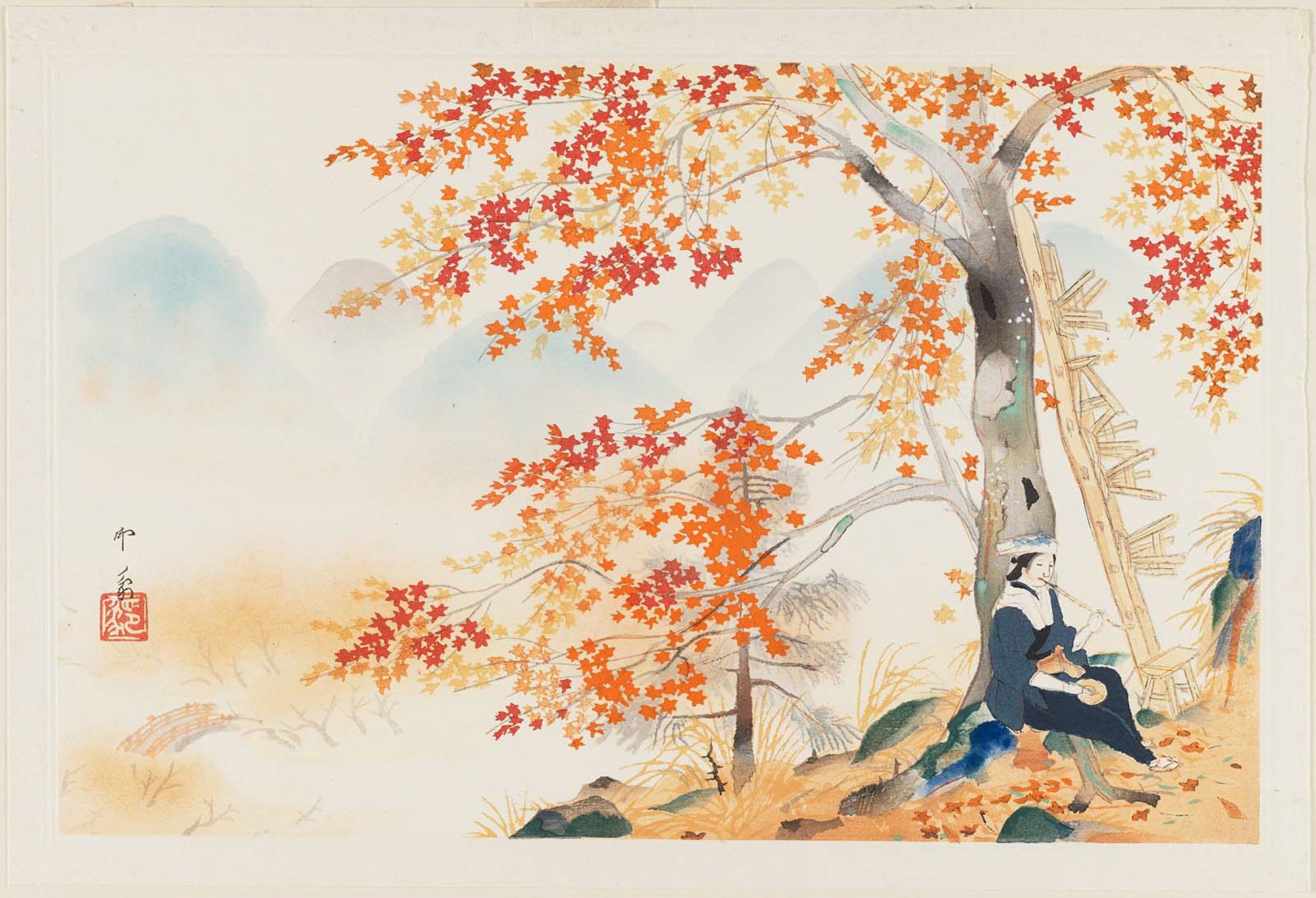
Autumn Maple Leaves at Takao, from the album Eight Views of Kyoto (Kyôto hakkei)
Woodblock print

The Beach at Kaiganji in Sanuki Province (Sanuki Kaiganji no hama), from the series "Collection of Views of Japan II, Kansai Edition (Nihon fukei shu II Kansai hen)"
1934
Color woodblock print; oban

Tea Kettle, section of a sheet from the series "Mirror of Stone Rubbings of Views of the Provinces" (Kohon meihitsu ishizuri kagami)
n.d.
Woodblock print; ishizuri-e, section of harimaze sheet
Featured in Collections
Curated cross-cuts that include this print.
Frequently Asked Questions
Fisherwomen was created by Asai Chu (浅井忠).
Fisherwomen depicts landscapes.