
Peasants Going Home
by Asai Chu
- Date:
- 1887
- Medium:
- Oil on canvas
Description
Peasants Going Home, painted by Asai Chu in 1887, is one of the most widely reproduced canvases of the artist's pre-French period and a foundational statement of how Meiji yoga (Western-style) painting could absorb Japanese agrarian life into the visual idiom of the Barbizon school. By 1887 Asai had been working in oils for roughly a decade, having received his formative training under Antonio Fontanesi at the Kobu Bijutsu Gakko (Technical Fine Art School) in Tokyo in the late 1870s. The painting depicts farm laborers walking home at the end of the working day along a path through cultivated land, their figures dark against a glowing sunset sky and the softened greens and ochres of fields. The compositional motif — peasants returning at evening, set within a broad atmospheric landscape — is recognizably indebted to French rural painters of the Barbizon generation, especially Jean-Francois Millet, whose vision of agricultural dignity Fontanesi had transmitted to his Tokyo students. Asai, however, locates the scene unmistakably in Japan, through the cut of farmhand garments, the form of carrying tools, and the contours of the surrounding terrain. The painting is preserved in the Hiroshima Museum of Art and reproduced through Wikimedia Commons (https://commons.wikimedia.org/wiki/File:Peasants_Going_Home_by_Asai_Chu_(Hiroshima_Museum_of_Art).jpg). For students of Meiji yoga, Peasants Going Home of 1887 is something close to a manifesto. It appears within a year of the formative meetings that would lead to the Meiji Bijutsukai (Meiji Art Society) — co-founded by Asai — and it shows the second wave of Japanese Western-style painters making a deliberate case that the agrarian everyday of their own country could carry the moral and pictorial weight that Millet and his peers had given to the French countryside. As one of Asai's most quoted pre-1907 works, it remains essential to any account of how Fontanesi's Barbizon inheritance was naturalized into a specifically Japanese yoga tradition.
More Prints by Asai Chu


More Landscapes Prints

Lake Kugushi in Wakasa Province (Wakasa Kugushiko), from the series Souvenirs of Travel I (Tabi miyage dai isshu)"
Wakasa Kugushiko
1920
Color woodblock print; oban
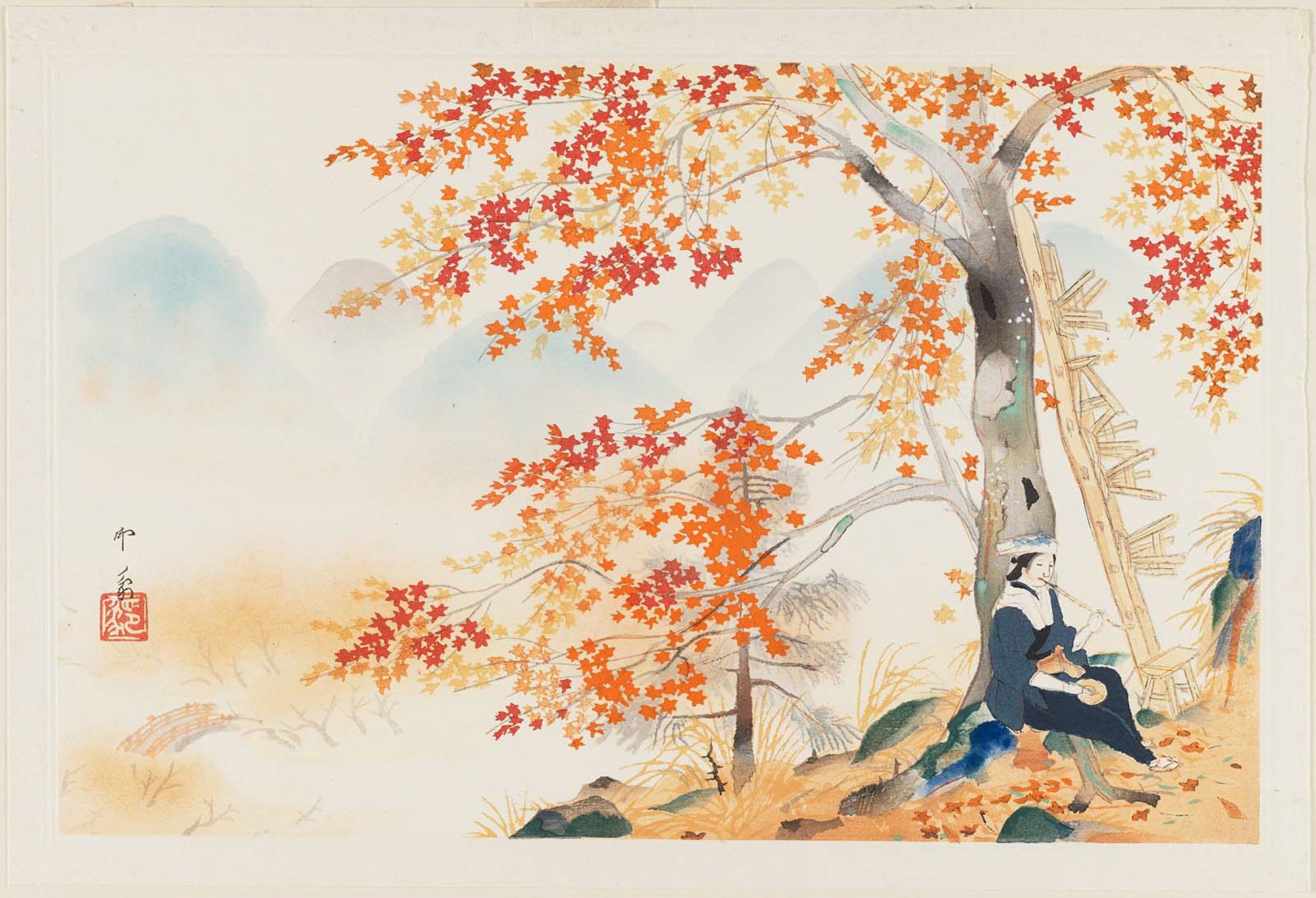
Autumn Maple Leaves at Takao, from the album Eight Views of Kyoto (Kyôto hakkei)
Woodblock print

The Beach at Kaiganji in Sanuki Province (Sanuki Kaiganji no hama), from the series "Collection of Views of Japan II, Kansai Edition (Nihon fukei shu II Kansai hen)"
1934
Color woodblock print; oban

Tea Kettle, section of a sheet from the series "Mirror of Stone Rubbings of Views of the Provinces" (Kohon meihitsu ishizuri kagami)
n.d.
Woodblock print; ishizuri-e, section of harimaze sheet
Featured in Collections
Curated cross-cuts that include this print.
Frequently Asked Questions
Peasants Going Home was created by Asai Chu (浅井忠) in 1887.
Peasants Going Home depicts landscapes.