
Spring Ridge
by Asai Chu
- Date:
- 1888
- Medium:
- Oil on canvas
- Source:
- Wikimedia Commons
Description
Spring Ridge, painted by Asai Chu in 1888, is an early but already characteristic example of how the artist used Meiji yoga (Western-style) plein-air practice to register the look of Japanese cultivated land in early spring. The canvas dates from the year of the founding of the Meiji Bijutsukai (Meiji Art Society), in which Asai was a leading co-founder, and it reflects the program of sober, naturalistic painting that society was organized to defend. Antonio Fontanesi's Tokyo studio at the Kobu Bijutsu Gakko (Technical Fine Art School) in the late 1870s had taught Asai to read the agricultural landscape through a Barbizon-school lens: muted tonal palette, broad brush handling, and a willingness to subordinate detail to the larger atmospheric envelope of the scene. In Spring Ridge those lessons are visible in the calibrated greens and warm ochres of new growth on a sloping field, in the loose handling of furrows and ridges, and in the modest scale of any human or built incident. The picture is preserved through Wikimedia Commons under a file recording an early Asai vegetable-field motif (https://commons.wikimedia.org/wiki/File:Asai_chu_vegetable.jpg). For historians of Meiji yoga, Spring Ridge is important as a marker of where Asai stood in the late 1880s: a decade after Fontanesi's departure from Tokyo, he was producing fully convincing Japanese rural landscapes in the Barbizon manner well before his own French residence at Grez-sur-Loing in 1900-1902. The painting also exemplifies a crucial argument of the Meiji Bijutsukai generation — that the unspectacular Japanese countryside, observed under ordinary seasonal light, was a legitimate and serious subject for oil painting. Within his pre-1907 catalogue, Spring Ridge belongs with the village views of Kotaba and the Hachioji studies as evidence of Asai's ability to treat the agricultural landscape of central Japan as a Barbizon-school subject of equal dignity to anything in the Ile-de-France.
More Prints by Asai Chu


More Landscapes Prints

Lake Kugushi in Wakasa Province (Wakasa Kugushiko), from the series Souvenirs of Travel I (Tabi miyage dai isshu)"
Wakasa Kugushiko
1920
Color woodblock print; oban
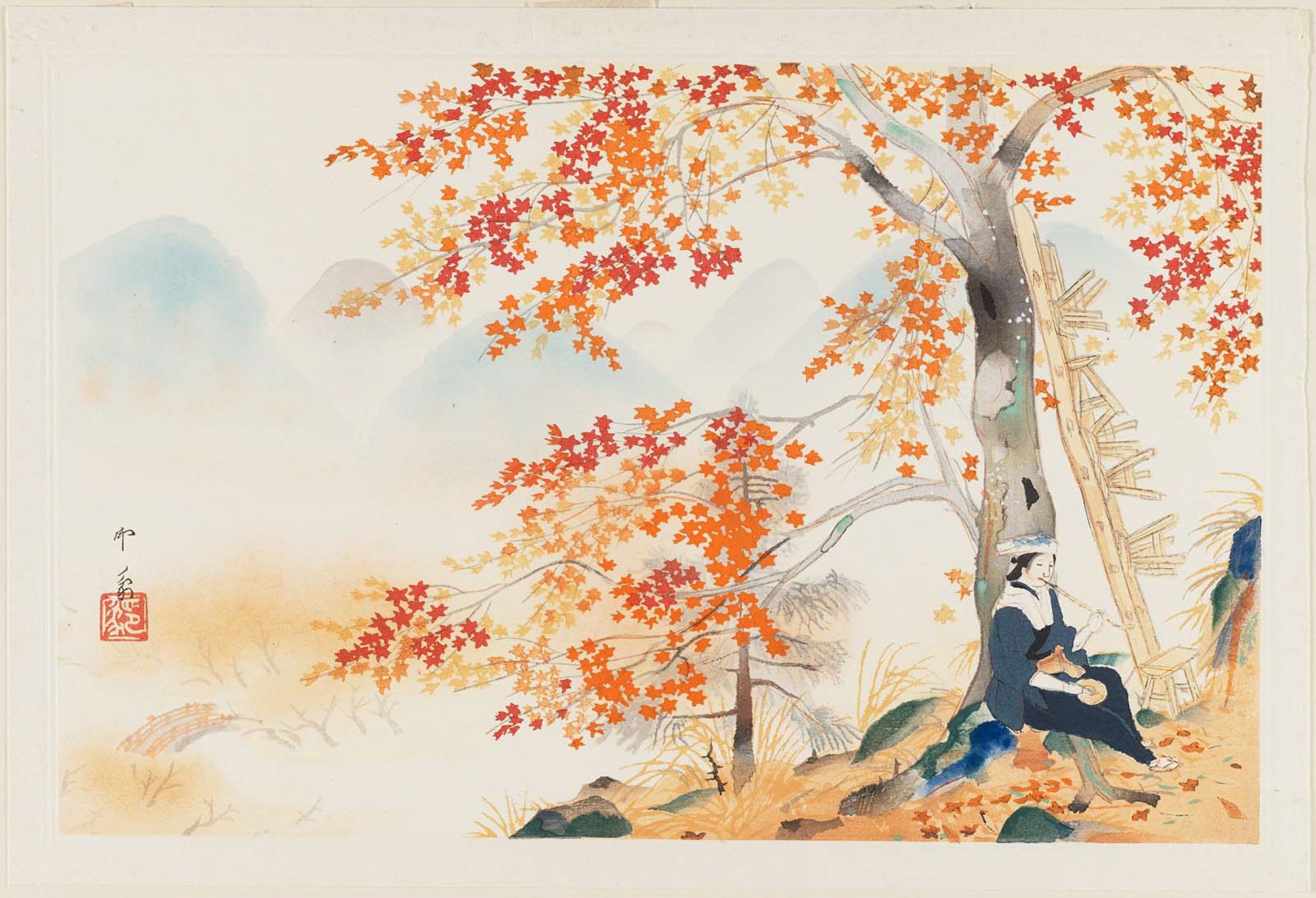
Autumn Maple Leaves at Takao, from the album Eight Views of Kyoto (Kyôto hakkei)
Woodblock print

The Beach at Kaiganji in Sanuki Province (Sanuki Kaiganji no hama), from the series "Collection of Views of Japan II, Kansai Edition (Nihon fukei shu II Kansai hen)"
1934
Color woodblock print; oban

Tea Kettle, section of a sheet from the series "Mirror of Stone Rubbings of Views of the Provinces" (Kohon meihitsu ishizuri kagami)
n.d.
Woodblock print; ishizuri-e, section of harimaze sheet
Featured in Collections
Curated cross-cuts that include this print.
Frequently Asked Questions
Spring Ridge was created by Asai Chu (浅井忠) in 1888.
Spring Ridge depicts landscapes.