
Straw-Thatched Roof
by Asai Chu
- Medium:
- Oil on canvas
Description
Straw-Thatched Roof, by Asai Chu, is a close-range architectural study in which the artist concentrates his Meiji yoga (Western-style) sensibility on a single defining element of the Japanese rural village — the heavy, gracefully sloping thatched roof of a traditional farmhouse. As a leading co-founder of the Meiji Bijutsukai (Meiji Art Society) and a central figure of the second wave of Japanese Western-style painters, Asai had spent decades arguing, in canvas after canvas, that the unspectacular fabric of the Japanese countryside could sustain serious oil painting. Thatched roofs appear as a recurrent motif across his pre-1907 catalogue, from the village views of Kotaba and Hachioji to the broader harvest landscapes; in this picture, the roof is given pride of place, treated as a tonal mass in its own right. The handling is broad and atmospheric, with warm thatch browns and cooler shadow grays organized into a unified envelope of late nineteenth-century Japanese light, in keeping with the Barbizon-school discipline that Asai had absorbed under Antonio Fontanesi at the Kobu Bijutsu Gakko (Technical Fine Art School) in the late 1870s. The painting is preserved in the Chiba Prefectural Museum of Art and reproduced through Wikimedia Commons (https://commons.wikimedia.org/wiki/File:Straw-Thatched_Roof_by_Asai_Chu_(Chiba_Prefectural_Museum_of_Art).jpg). For students of Meiji yoga, Straw-Thatched Roof is a small but valuable document. It shows Asai narrowing his characteristic village motif to a single architectural focus, in the manner of a Fontanesi-era plein-air study, and treating the most ordinary form of rural shelter as a worthy subject for sustained oil-painting attention. Within his pre-1907 catalogue and alongside the Chiba Kotaba Village canvas in the same collection, the work confirms how regional Japanese museums preserve a distributed but coherent record of Asai's lifelong commitment to the Japanese village as a central subject of Meiji Western-style painting.
More Prints by Asai Chu


More Landscapes Prints

Lake Kugushi in Wakasa Province (Wakasa Kugushiko), from the series Souvenirs of Travel I (Tabi miyage dai isshu)"
Wakasa Kugushiko
1920
Color woodblock print; oban
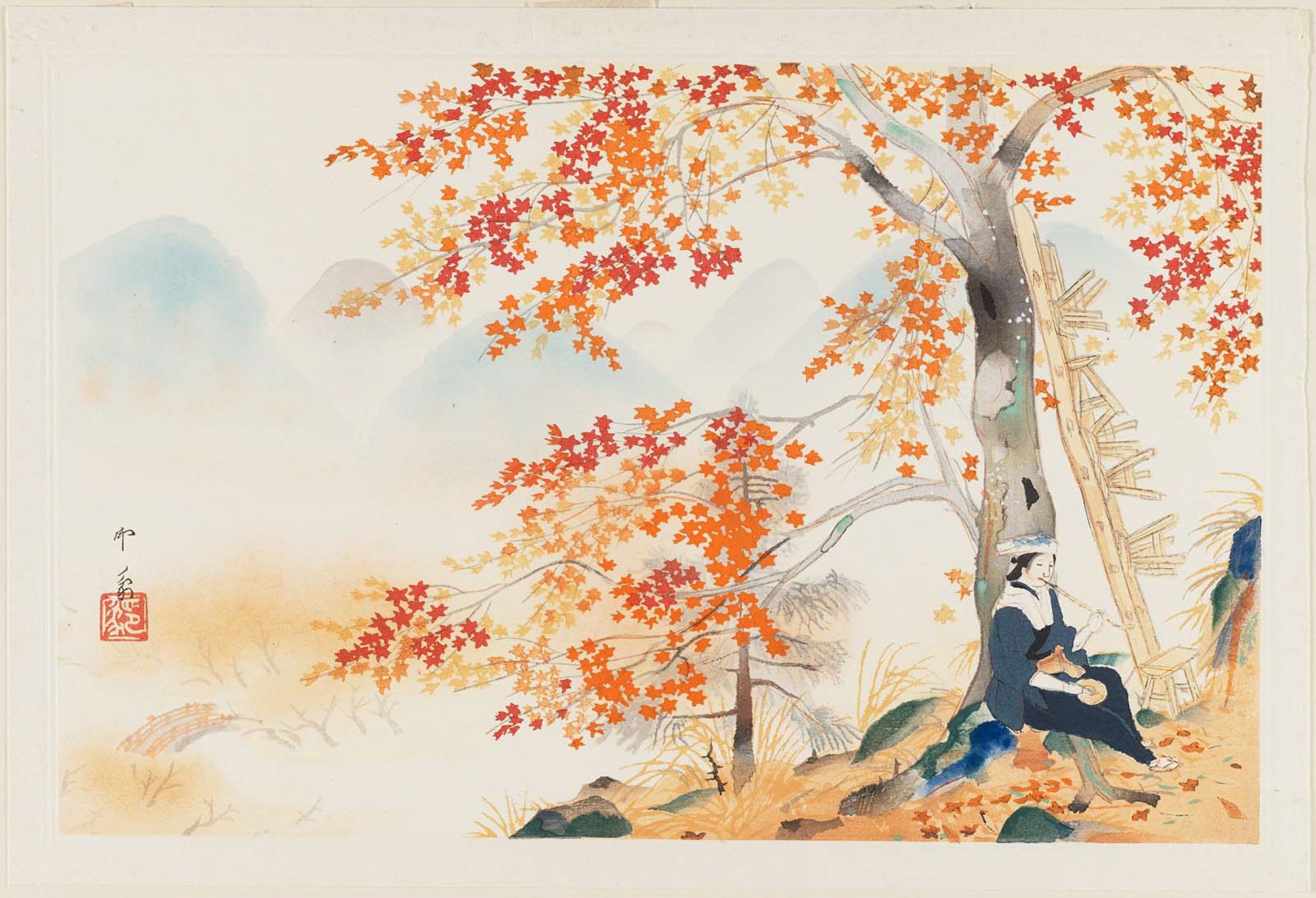
Autumn Maple Leaves at Takao, from the album Eight Views of Kyoto (Kyôto hakkei)
Woodblock print

The Beach at Kaiganji in Sanuki Province (Sanuki Kaiganji no hama), from the series "Collection of Views of Japan II, Kansai Edition (Nihon fukei shu II Kansai hen)"
1934
Color woodblock print; oban

Tea Kettle, section of a sheet from the series "Mirror of Stone Rubbings of Views of the Provinces" (Kohon meihitsu ishizuri kagami)
n.d.
Woodblock print; ishizuri-e, section of harimaze sheet
Featured in Collections
Curated cross-cuts that include this print.
Frequently Asked Questions
Straw-Thatched Roof was created by Asai Chu (浅井忠).
Straw-Thatched Roof depicts landscapes.