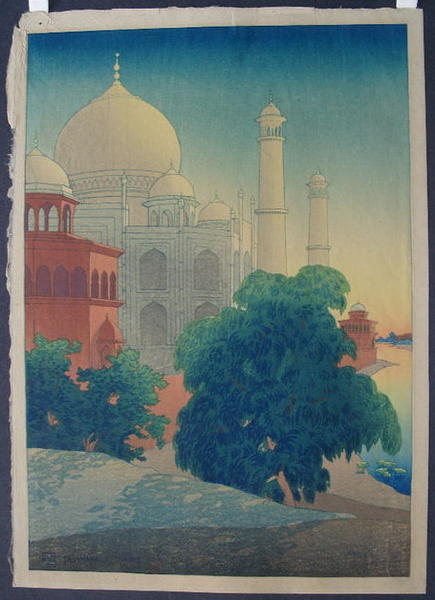
Taj Mahal Sunset
- Date:
- 1919
- Medium:
- Woodblock print
- Format:
- Oban
- Source:
- Japanese Art Open Database
Description
Taj Mahal Sunset, created in 1919, captures the mausoleum at the opposite end of the day from its dawn counterpart, when the setting sun floods the western sky with warm color and the marble surfaces take on deep amber and rose tones. The Yamuna River, flowing past the Taj Mahal's northern face, reflects this warm light, and the surrounding gardens darken as shadows lengthen across the formal Mughal pathways.
This oban woodblock print required a palette dominated by warm pigments: the oranges, reds, and golds of a tropical sunset layered over the white ground of the marble structure. Bartlett's 1919 printing date, three years after his Indian journey, suggests a work refined through extended consideration of color relationships and compositional balance. The Taj Mahal's bilateral symmetry provides a stable architectural framework against which the dynamic, asymmetrical drama of the sunset plays out, creating a tension between the building's eternal permanence and the fleeting spectacle of the sky.
More Prints by Charles W. Bartlett

More Rivers & Lakes Prints

Lake Chuzenji, Nikko (Nikko Chuzenjiko)
Nikko Chuzenjiko
1930
Color woodblock print; oban

Lake Kugushi in Wakasa Province (Wakasa Kugushiko), from the series Souvenirs of Travel I (Tabi miyage dai isshu)"
Wakasa Kugushiko
1920
Color woodblock print; oban

Gosai Canal in Niigata (Niigata Gosaibori), from the series "Souvenirs of Travel, Second Series (Tabi miyage dai nishu)"
Niigata Gosaibori
1921
Color woodblock print; oban

The Hori River at Obama (Obama Horikawa), from the series "Souvenirs of Travel, First Series (Tabi miyage dai isshu)"
Obama Horikawa
1920
Color woodblock print; oban
Featured in Collections
Curated cross-cuts that include this print.
Frequently Asked Questions
Taj Mahal Sunset was created by Charles W. Bartlett in 1919.
Taj Mahal Sunset depicts rivers & lakes, night scenes, and architecture.