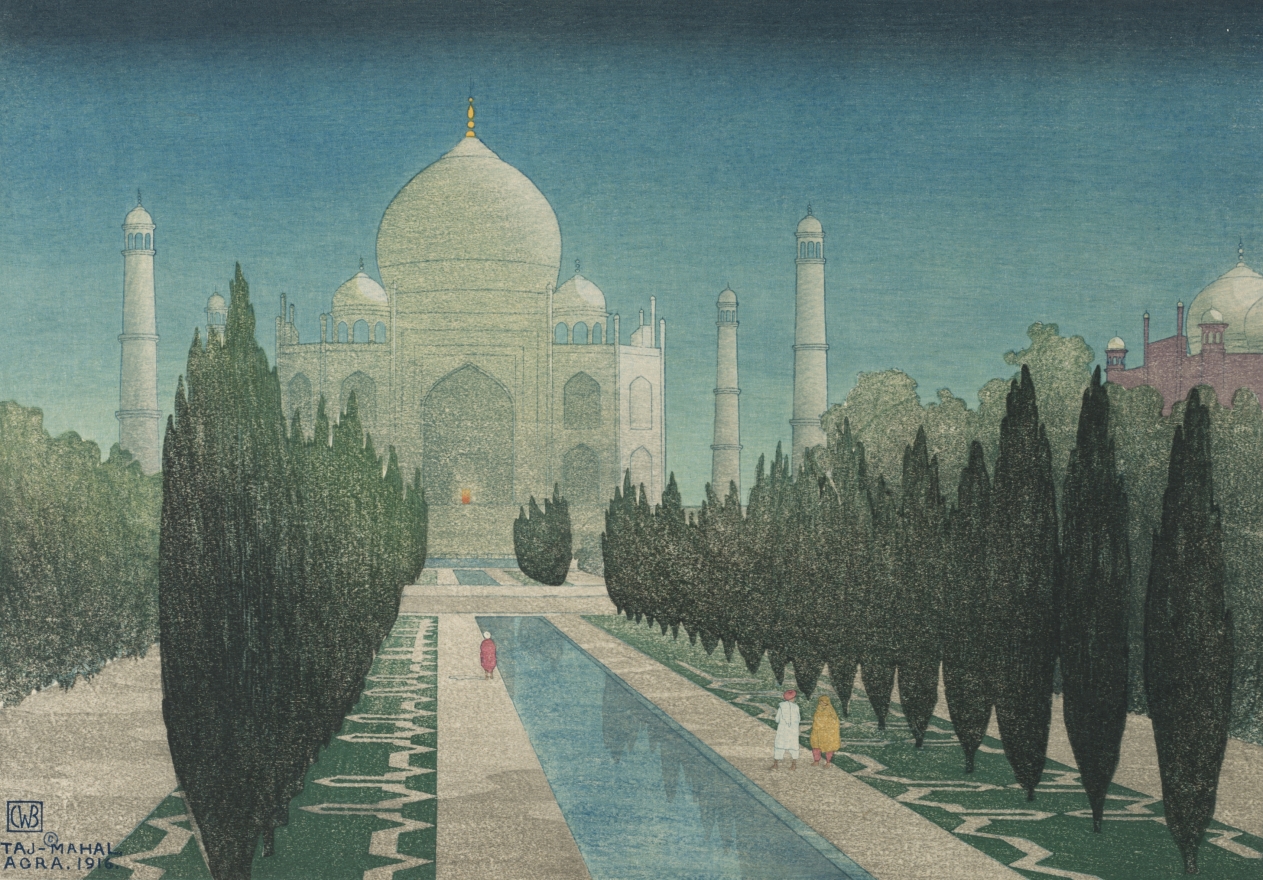
Taj Mahal, Twilight
- Date:
- 1916
- Medium:
- Woodblock print, ink and color on Japan paper
- Format:
- Oban
- Dimensions:
- 25.2 × 36.8 cm
- Source:
- Cleveland Museum of Art
Description
Taj Mahal, Twilight, created in 1916, places the mausoleum in the brief interval between sunset and darkness, when the sky retains a deep luminous blue and the first stars become visible. This liminal moment transforms the Taj Mahal into a ghostly presence, its white marble holding the last ambient light while the surrounding landscape sinks into shadow.
Bartlett printed this oban-format work in ink and color on Japan paper, a material whose absorbent, fibrous surface enhances the soft tonal transitions essential to depicting twilight. The paper's natural warmth modifies the cool blue pigments of the dusky sky, preventing the palette from becoming harsh or cold. Bartlett's multiple treatments of the Taj Mahal at different times of day, dawn, twilight, moonlight, and sunset, together constitute a sustained study of how a single architectural subject is continuously transformed by the passage of natural light, an investigation that connects to both Monet's serial practice and the Japanese tradition of meisho-e.
More Prints by Charles W. Bartlett

More Night Scenes Prints
Evening in East Africa
Woodblock print

Evening Shower at Teradomari (Teradomari no yau), from the series "Souvenirs of Travel, Second Series (Tabi miyage dai nishu)"
Teradomari no yau
1921
Color woodblock print; oban
![Mount Fuji on a Moonlit Night, Kawai Bridge (Tsukiyo no Fuji [Kawaibashi]), from the series "Selection of Views of the Tokaido (Tokaido fukei senshu)" by Kawase Hasui](https://www.artic.edu/iiif/2/d0960668-1e73-339a-b182-fb995a54bff0/full/843,/0/default.jpg)
Mount Fuji on a Moonlit Night, Kawai Bridge (Tsukiyo no Fuji [Kawaibashi]), from the series "Selection of Views of the Tokaido (Tokaido fukei senshu)"
1947
Color woodblock print; oban

Evening Moon at Nakanoshima, Sapporo (Sapporo Nakanoshima no yuzuki), from the series "Collection of Views of Japan, Eastern Japan Edition (Nihon fukei shu higashi Nihon hen)"
March 1933
Color woodblock print; oban
Featured in Collections
Curated cross-cuts that include this print.
Frequently Asked Questions
Taj Mahal, Twilight was created by Charles W. Bartlett in 1916.
Taj Mahal, Twilight depicts night scenes.
Taj Mahal, Twilight measures 25.2 × 36.8 cm (Oban format).