
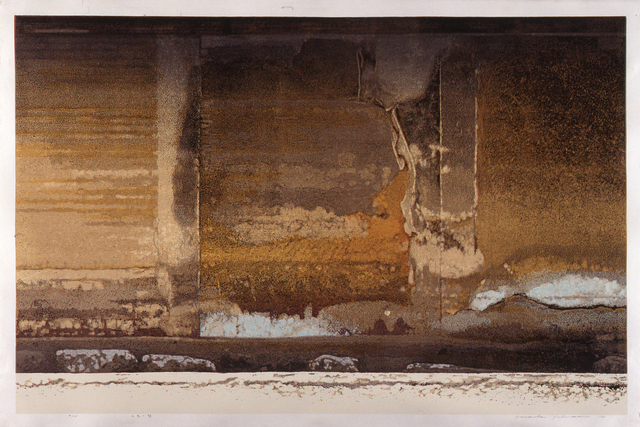
Landscape M-A
- Date:
- 1972
- Medium:
- Zinc photoetching and woodblock print, ink and color on paper
- Source:
- Art Institute of Chicago
Description
Landscape M-A, dated 1972, is a woodblock print by Hodaka Yoshida (1926-1995) held in the collection of the Art Institute of Chicago, an institution that holds one of the most significant North American collections of Yoshida family prints. By the early 1970s Hodaka had fully established himself as one of the leading second-generation figures of the sosaku-hanga movement, the postwar Japanese tradition in which the artist alone designs, carves, and prints each block as a self-expressive act rather than the collaborative shin-hanga method his father Hiroshi Yoshida had practiced. The 'M-A' designation reflects Hodaka's habit of titling works with letter-and-number codes, a strategy borrowed from European abstraction that signaled his rejection of literary or scenic narrative in favor of pure formal investigation. The Landscape series occupies a distinctive position in his output: the title gestures toward the genre most closely associated with the Yoshida family name, yet the image itself disassembles landscape into geometric blocks, photographic transfers, and layered color fields, asserting that a print of land could exist without horizon, foliage, or recognizable place. This dialogue between inherited subject and reinvented method is what makes Hodaka so important to the Yoshida lineage. Collectors and scholars approaching the family chronologically often turn to works like Landscape M-A to see how Hodaka simultaneously honored and overturned his father's legacy. The Art Institute of Chicago's holdings of his prints from this period, including this 1972 sheet, document a mature artist confidently working in an idiom entirely his own while remaining unmistakably part of one of the most influential Japanese printmaking families of the twentieth century.
More Prints by Hodaka Yoshida

Featured in Collections
Curated cross-cuts that include this print.
Frequently Asked Questions
Landscape M-A was created by Hodaka Yoshida (吉田穂高) in 1972.