
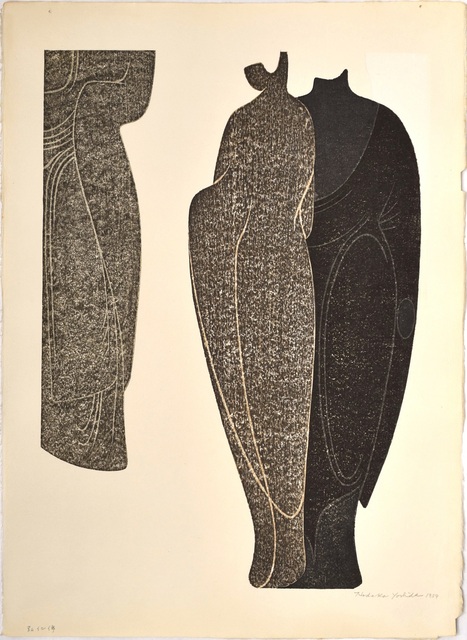
Stones and a Man, A, Shôwa period, dated 1956
- Source:
- ukiyo-e.org
Description
Stones and a Man, A, dated 1956 in the Showa period, is an early woodblock print by Hodaka Yoshida (1926-1995) held by the Harvard Art Museums and documented through the ukiyo-e.org image archive. The mid-1950s mark the decisive moment in Hodaka's career: he had begun printmaking only a few years earlier, having initially worked as an oil painter, and by 1956 he was producing the experimental, semi-abstract prints that would define his contribution to the sosaku-hanga (creative print) movement. The pairing of 'stones' and 'a man' in the title is characteristic of his early work, which often introduced isolated human figures into rugged, almost primordial settings - bones, rocks, fossils, archaic terrain - in a way that recalled both prehistoric cave imagery and the existential figuration that international modernists like Henry Moore and Marino Marini had made widely visible in the postwar decade. Within the Yoshida family chronology this print is doubly valuable: it represents one of Hodaka's earliest mature efforts and it stakes out a deliberate distance from the shin-hanga workshop practice that had made his father Hiroshi Yoshida famous. By personally carving and printing every block, Hodaka asserted that the second Yoshida generation would belong to the creative-print movement rather than the collaborative shin-hanga tradition. Harvard's preservation of this 1956 impression gives scholars a primary document for that transition, and its appearance in the ukiyo-e.org archive ensures that this critical formative phase of the Yoshida family's postwar history remains accessible and visible to collectors and researchers worldwide.
More Prints by Hodaka Yoshida

Featured in Collections
Curated cross-cuts that include this print.
Frequently Asked Questions
Stones and a Man, A, Shôwa period, dated 1956 was created by Hodaka Yoshida (吉田穂高).