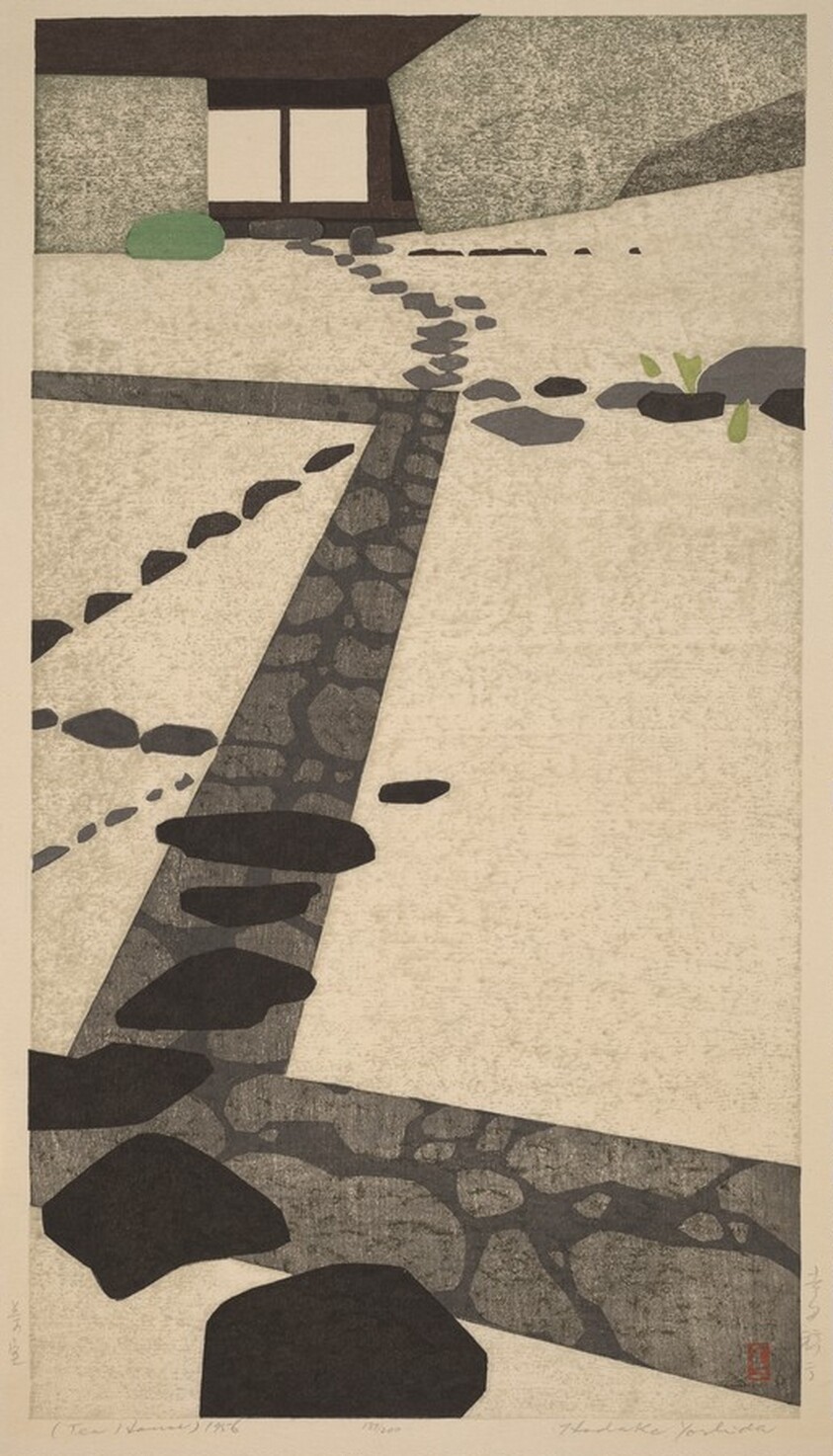
Teahouse
- Medium:
- 6-color woodcut
- Source:
- National Gallery of Art
Description
Teahouse, produced by Hodaka Yoshida in 1956, belongs to the mid-1950s phase of the artist's career when traditional Japanese subjects were still being admitted into his developing abstract vocabulary, but with steadily increasing distance from any conventional depiction. The composition is organized around an implied structure — a teahouse rendered as a simplified configuration of dark vertical and horizontal members set against a textured ground — with carved striations and modulated inking suggesting timber, paper screens, and the surrounding garden or street without resolving into illusionistic view. There is no figure, no specific roof line, no identifying signage; the teahouse functions as a totemic architectural emblem, registered through tonal weight rather than topographic accuracy. The treatment marks a deliberate departure from the picturesque tea-room and village imagery that flowed through the prewar shin-hanga and early Yoshida-studio output, in which his father Hiroshi Yoshida and others had perfected an atmospheric naturalism. By contrast, Hodaka — second son of Hiroshi and the painter Fujio Yoshida, half-brother to Toshi Yoshida — was already aligning his practice with the international postwar abstract turn, treating the teahouse as the kind of archetypal subject that European and American contemporaries were finding in vernacular architecture. The work was produced within the sosaku-hanga (creative print) tradition, in which the artist personally designed, carved, and printed each impression so that every chisel mark and ink layer would carry individual authorship. The National Gallery of Art, which holds this impression in its collection of modern Japanese prints (https://www.nga.gov/collection/art-object-page.46990.html), preserves Teahouse as part of an important institutional holding of postwar Japanese printmaking. For students of the postwar Japanese print, the 1956 work is a particularly useful demonstration of how Hodaka could approach a culturally laden Japanese subject without lapsing into either nostalgia or strict depiction, allowing the carved surface itself to do the iconographic work.
More Prints by Hodaka Yoshida

Featured in Collections
Curated cross-cuts that include this print.
Frequently Asked Questions
Teahouse was created by Hodaka Yoshida (吉田穂高).