
Abumi Promontory (Abumisaki)
Abumisaki
by Kawase Hasui
- Date:
- 1950
- Medium:
- Color woodblock print
- Format:
- Oban
- Dimensions:
- 24.1 × 36.6 cm
- Publisher:
- Watanabe Shozaburo
- Edition:
- Published by Watanabe Shozaburo
- Source:
- Art Institute of Chicago
Description
A two-masted sailboat with pale, paneled sails dominates the foreground, crossing calm blue water whose surface is patterned with light ripples and reflected sunlight; a smaller white-sailed boat appears at left in the middle distance. To the right, a rocky, tree-topped promontory rises from the water, crowned by a small building with a dark tiled roof. The sky is pale blue with horizontal bands of thin white cloud; this color woodblock print, "Abumi Promontory (Abumisaki)," was made by Kawase Hasui in 1950.
More Prints by Kawase Hasui


More Landscapes Prints

Lake Kugushi in Wakasa Province (Wakasa Kugushiko), from the series Souvenirs of Travel I (Tabi miyage dai isshu)"
Wakasa Kugushiko
1920
Color woodblock print; oban
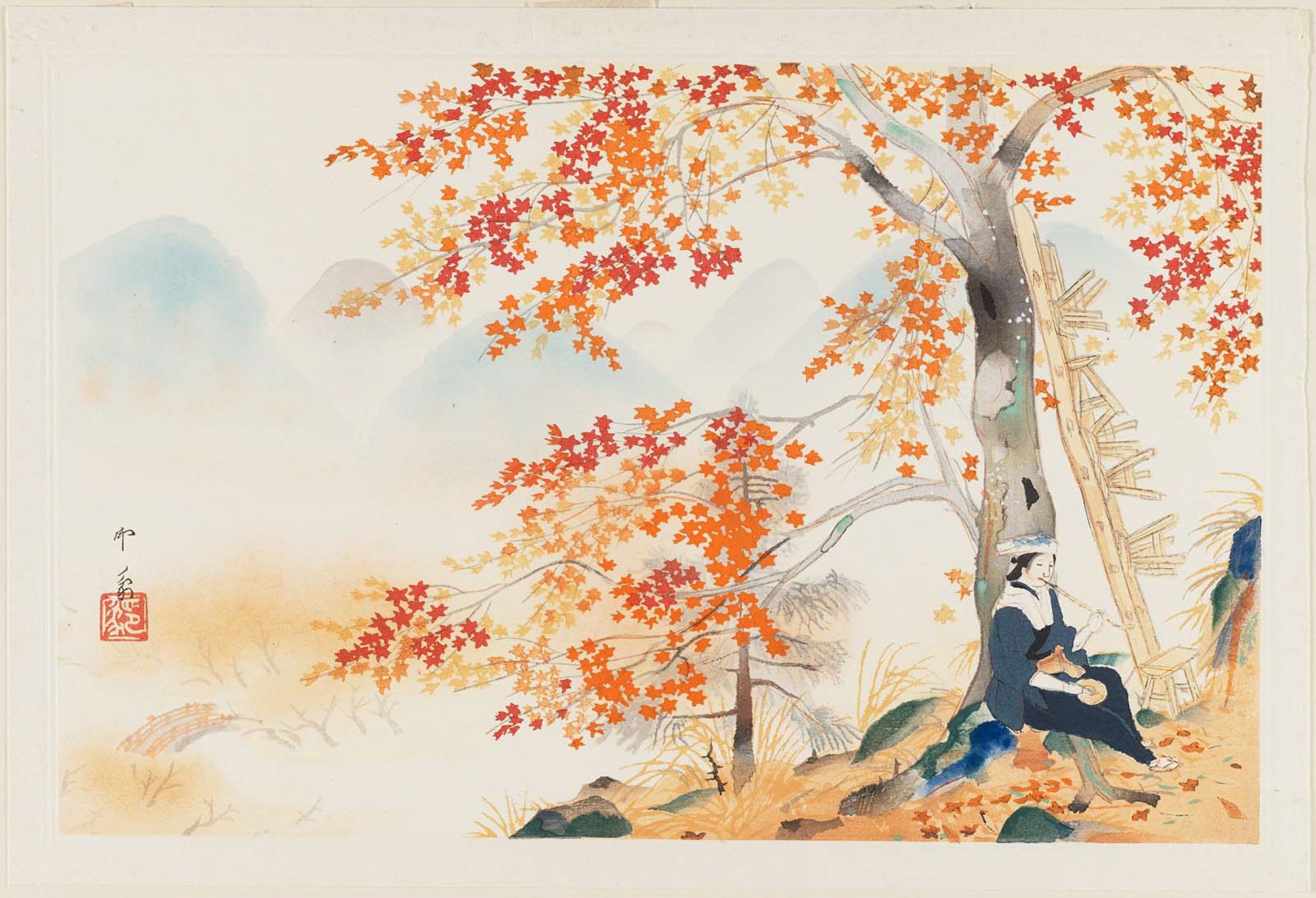
Autumn Maple Leaves at Takao, from the album Eight Views of Kyoto (Kyôto hakkei)
Woodblock print

The Beach at Kaiganji in Sanuki Province (Sanuki Kaiganji no hama), from the series "Collection of Views of Japan II, Kansai Edition (Nihon fukei shu II Kansai hen)"
1934
Color woodblock print; oban

Tea Kettle, section of a sheet from the series "Mirror of Stone Rubbings of Views of the Provinces" (Kohon meihitsu ishizuri kagami)
n.d.
Woodblock print; ishizuri-e, section of harimaze sheet
Featured in Collections
Curated cross-cuts that include this print.
Frequently Asked Questions
Abumi Promontory (Abumisaki) (Abumisaki) was created by Kawase Hasui (川瀬巴水) in 1950.
Abumi Promontory (Abumisaki) uses Bokashi, Nishiki-e, and Moku-hanga, on color woodblock print.
Abumi Promontory (Abumisaki) was published by Watanabe Shozaburo (1950).
Abumi Promontory (Abumisaki) depicts landscapes and seascapes.
Abumi Promontory (Abumisaki) measures 24.1 × 36.6 cm (Oban format).