
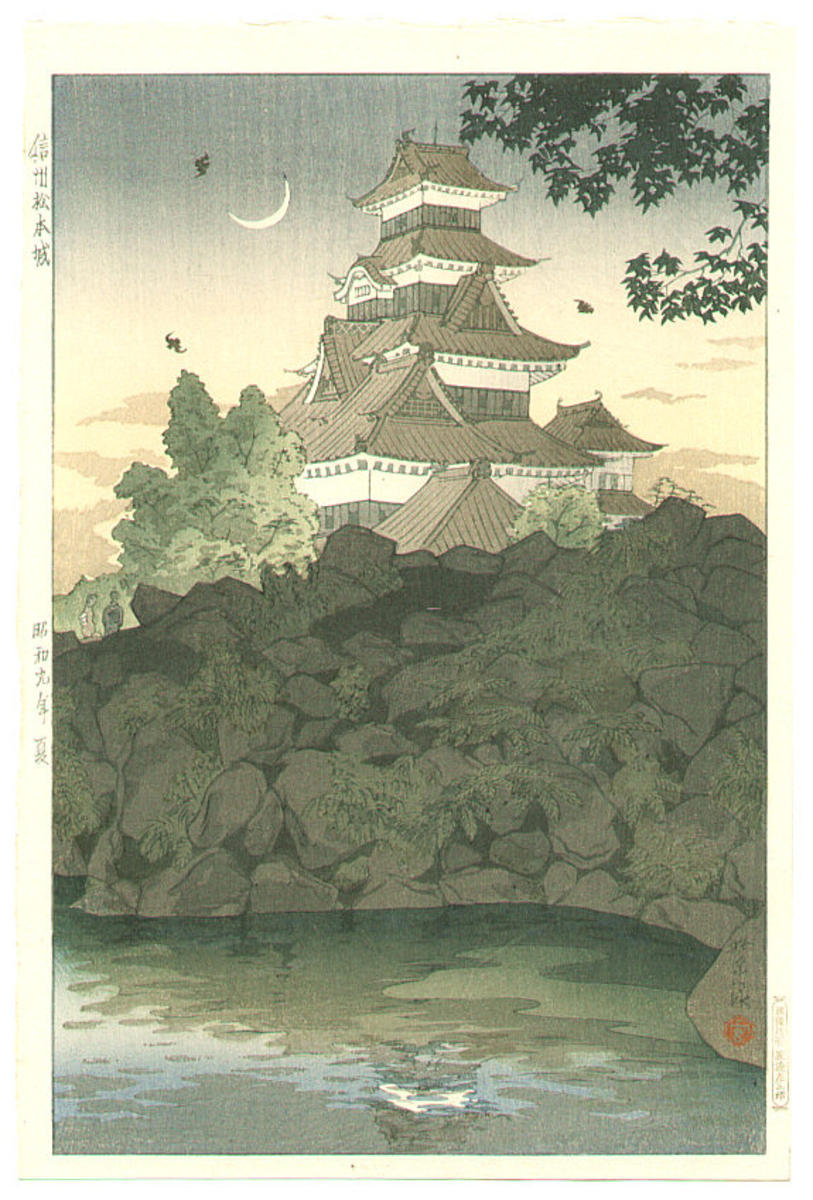
Hakuho Castle, Ueno, Iga (Iga Ueno Hakuhojo)
Iga Ueno Hakuhojo
by Kawase Hasui
- Date:
- 1951
- Medium:
- Color woodblock print
- Format:
- Oban
- Dimensions:
- 36.5 × 24.2 cm
- Publisher:
- Watanabe Shozaburo
- Edition:
- Published by Watanabe Shozaburo
- Source:
- Art Institute of Chicago
Description
Hakuho Castle at Ueno in Iga Province, published in 1951, depicts the reconstructed white castle keep at Ueno in present-day Mie Prefecture — a castle whose original three-story tower, destroyed in a storm in 1612 before completion, was finally rebuilt in concrete in 1935 using the original planned dimensions. The castle, nicknamed Hakuho-jo (White Phoenix Castle) for the white plaster walls of the intended but long-delayed keep, is notable for the tallest stone defensive walls (ingui) of any surviving Japanese castle — a sheer 30-meter drop. Hasui's 1951 composition likely emphasizes the dramatic verticality of the white walls and keep against the sky.
More Prints by Kawase Hasui

More Castles Prints


Featured in Collections
Curated cross-cuts that include this print.
Frequently Asked Questions
Hakuho Castle, Ueno, Iga (Iga Ueno Hakuhojo) (Iga Ueno Hakuhojo) was created by Kawase Hasui (川瀬巴水) in 1951.
Hakuho Castle, Ueno, Iga (Iga Ueno Hakuhojo) uses Moku-hanga, Nishiki-e, and Bokashi, on color woodblock print.
Hakuho Castle, Ueno, Iga (Iga Ueno Hakuhojo) was published by Watanabe Shozaburo (1951).
Hakuho Castle, Ueno, Iga (Iga Ueno Hakuhojo) depicts castles and urban scenes, set at Tokyo, Ueno.
Hakuho Castle, Ueno, Iga (Iga Ueno Hakuhojo) measures 36.5 × 24.2 cm (Oban format).