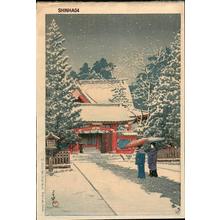
Shato no Yuki Hie Jinja
by Kawase Hasui
- Medium:
- Woodblock print
- Source:
- Japanese Art Open Database
- Image courtesy of
- Japanese Art Open Database
Description
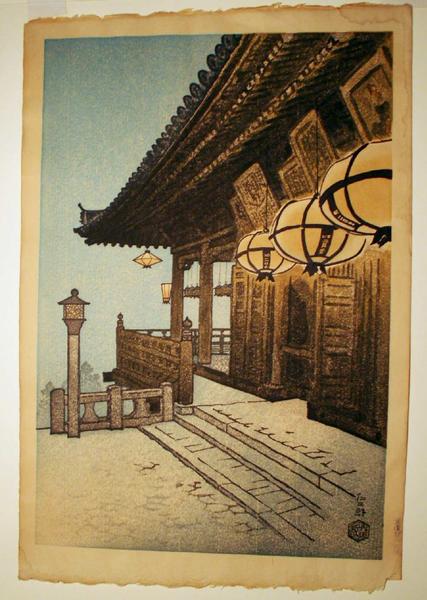
Hie Jinja in Akasaka, Tokyo, has served as one of the capital's principal Shinto shrines since the Edo period, when it functioned as the guardian shrine of Edo Castle. Its wooded precinct, ninety-six-step stone stairway, and successive torii rising from the Akasaka hillside provided Hasui with a subject combining formal architecture with dense urban greenery. 'Shato no yuki'—snow at the shrine precincts—places the composition in winter, when fresh accumulation covers the flat torii caps, the stone paving of the forecourt, and the rooflines of the shrine buildings. The hanging lanterns along the approach would glow warmly against the cooler gray-white of the snow and overcast sky, a thermal contrast in color temperature that Hasui handled through careful warm-to-cool tonal transitions. The structured geometry of the torii, steps, and shrine gate under snow gave this composition a more architectural character than Hasui's open landscape prints, with diagonal perspective lines reinforcing spatial depth.
More Prints by Kawase Hasui

More Temples & Shrines Prints

Fushimi Inari Temple
伏見稲荷
Woodblock print

The Compound of the Tenman Shrine at Kameido in the Snow (Kameido Tenmangu keidai no yuki), from the series "Famous Places in the Eastern Capital (Toto meisho)"
c. 1832/38
Color woodblock print; oban
Temple with lanterns
Woodblock print

A Section of the Byodo Temple at Uji (Uji Byodoin no ichibu), from the series "Souvenirs of Travel, Second Series (Tabi miyage dai nishu)"
Uji Byodoin no ichibu
1921
Color woodblock print; oban
Featured in Collections
Curated cross-cuts that include this print.
Frequently Asked Questions
Shato no Yuki Hie Jinja was created by Kawase Hasui (川瀬巴水).
Shato no Yuki Hie Jinja depicts temples & shrines.