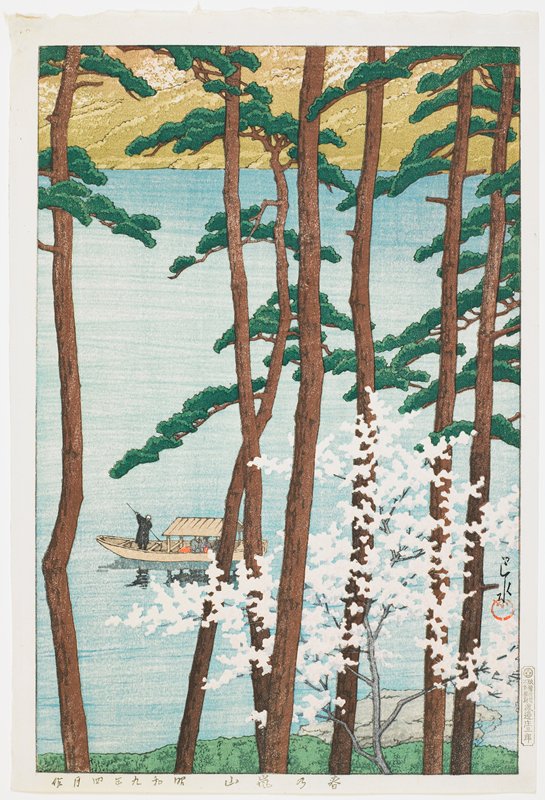
Spring in Arashiyama
by Kawase Hasui
- Date:
- April 1934
- Medium:
- Woodblock print, ink and color on paper
- Format:
- Oban
- Dimensions:
- 36.2 × 24 cm
- Publisher:
- Watanabe Shozaburo
- Edition:
- Published by Watanabe Shozaburo
- Source:
- Minneapolis Institute of Art
Description
Arashiyama in spring — the western Kyoto mountain district where the Oi River winds between bamboo groves and cherry-blossom-covered slopes — is one of the most celebrated spring landscapes in Japan. This April 1934 print shows Arashiyama in peak bloom, the mountain reflected in the river's wide surface below the famous Togetsu Bridge. The spring palette of pale cherry pink against the mountain's still-bare trees and the river's reflective surface made this one of Hasui's most chromatic compositions.
More Prints by Kawase Hasui

More Spring Prints

Featured in Collections
Curated cross-cuts that include this print.
Frequently Asked Questions
Spring in Arashiyama was created by Kawase Hasui (川瀬巴水) in April 1934.
Spring in Arashiyama uses Bokashi, on woodblock print, ink and color on paper.
Spring in Arashiyama was published by Watanabe Shozaburo (April 1934).
Spring in Arashiyama depicts spring, set at Arashiyama.
Spring in Arashiyama measures 36.2 × 24 cm (Oban format).