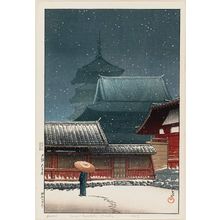
Tennô-ji Temple in Osaka (Ôsaka Tennô-ji), from the series Souvenirs of Travel III (Tabi miyage dai sanshû)
by Kawase Hasui
- Medium:
- Woodblock print
- Source:
- Museum of Fine Arts Boston
- Image courtesy of
- Museum of Fine Arts Boston
Description
From the Tabi miyage dai sanshū (Souvenirs of Travel, Third Series), this ōban-format shin-hanga print depicts Tennō-ji, the ancient Buddhist temple founded by Prince Shōtoku in 593 CE and located in the Tennōji ward of Osaka. The Tabi miyage series documented scenic and historic sites across Japan as Hasui traveled and sketched from direct observation, bringing the approach of the meisho-e tradition into the collaborative shin-hanga framework. The composition probably employs the low, close-in vantage points and strong architectural framing characteristic of Hasui's temple scenes, with stone lanterns or a wooden gate anchoring the foreground and the sky rendered in the smooth bokashi gradations Watanabe's printing team executed with consistent technical precision. Multiple printings of Tabi miyage sheets were produced throughout the series' life to meet sustained collector demand.
More Prints by Kawase Hasui
More Temples & Shrines Prints

Fushimi Inari Temple
伏見稲荷
Woodblock print

The Compound of the Tenman Shrine at Kameido in the Snow (Kameido Tenmangu keidai no yuki), from the series "Famous Places in the Eastern Capital (Toto meisho)"
c. 1832/38
Color woodblock print; oban
Temple with lanterns
Woodblock print

A Section of the Byodo Temple at Uji (Uji Byodoin no ichibu), from the series "Souvenirs of Travel, Second Series (Tabi miyage dai nishu)"
Uji Byodoin no ichibu
1921
Color woodblock print; oban
Featured in Collections
Curated cross-cuts that include this print.
Frequently Asked Questions
Tennô-ji Temple in Osaka (Ôsaka Tennô-ji), from the series Souvenirs of Travel III (Tabi miyage dai sanshû) was created by Kawase Hasui (川瀬巴水).
Tennô-ji Temple in Osaka (Ôsaka Tennô-ji), from the series Souvenirs of Travel III (Tabi miyage dai sanshû) depicts temples & shrines.