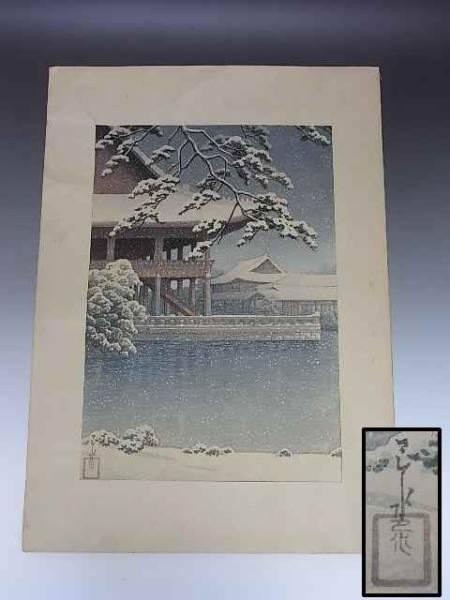
The Kyonghoiru Pavilion, Seoul — 京城 慶会楼
by Kawase Hasui
- Medium:
- Woodblock print
- Source:
- Japanese Art Open Database
- Image courtesy of
- Japanese Art Open Database
Description
Kawase Hasui's view of the Gyeonghoeru Pavilion in Seoul—titled with the Japanese colonial place name 京城 (Keijō) and the Korean 慶会楼—depicts the royal banquet pavilion of Gyeongbokgung Palace, constructed in 1412 and rebuilt in 1867. The Gyeonghoeru is a large ceremonial hall built on an artificial island within a rectangular pond in the western portion of the palace grounds, its multi-story timber superstructure supported by forty-eight stone columns. Hasui visited Korea during the period of Japanese colonial administration and produced a small series of prints documenting Korean architectural landmarks. The pavilion's reflection in the surrounding pond—its stone-column base and tiered wooden eaves doubled in the water's surface—provided Hasui with a compositional device central to his landscape practice. The print extends the meisho-e tradition of documentary landscape beyond the Japanese archipelago, treating Korean palace architecture with the same formal attentiveness applied to Japanese subjects, recording the site's monumental form during a period of significant political and cultural transformation on the Korean peninsula.
More Prints by Kawase Hasui

More Animals Prints

Snake Charmers (Hebizukai)
Hebizukai
1932
Color woodblock print; oban

Hoshifuri Pine at Zen'yoji Temple in Edogawa (Edogawa-ku Zen'yoji Hoshifuri matsu), from the series "One Hundred Views of Great Tokyo in the Showa Era (Showa dai Tokyo fukei hyaku zue hanga)"
1935
Color woodblock print; oban

Drawing for Rabbit and Boy
1964
Acrylic paint and oil pastel with oiled charcoal and ink over an ink and graphite underdrawing on paper

Rabbit and Boy
1964
Color lithograph with relief block and hand coloring; edition 35/36
Featured in Collections
Curated cross-cuts that include this print.
Frequently Asked Questions
The Kyonghoiru Pavilion, Seoul — 京城 慶会楼 was created by Kawase Hasui (川瀬巴水).
The Kyonghoiru Pavilion, Seoul — 京城 慶会楼 depicts animals.