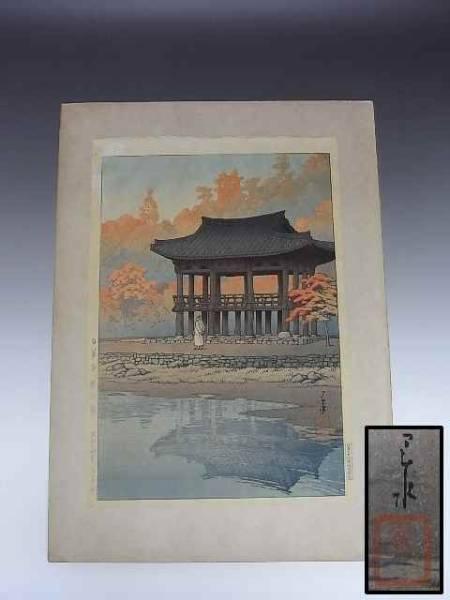
The Sanggeru Pavilion, the Pegyangsa Temple, Korea — 白羊寺
by Kawase Hasui
- Medium:
- Woodblock print
- Source:
- Japanese Art Open Database
- Image courtesy of
- Japanese Art Open Database
Description
A raised, open-sided pavilion with a dark tiled hip roof stands on a stone platform beside a still pond that mirrors its reflection, with a stone pagoda partly visible behind it among trees rendered in orange and rust autumn foliage against a pale blue sky. A single robed figure in white stands near the pavilion's base on a paved stone terrace edged with a low stone wall. The print is bordered by a wide cream mat, with the artist's red seal and signature mounted separately at lower right; woodblock print, Kawase Hasui, "The Sanggeru Pavilion, the Pegyangsa Temple, Korea — 白羊寺," year unknown.
More Prints by Kawase Hasui

More Animals Prints

Snake Charmers (Hebizukai)
Hebizukai
1932
Color woodblock print; oban

Hoshifuri Pine at Zen'yoji Temple in Edogawa (Edogawa-ku Zen'yoji Hoshifuri matsu), from the series "One Hundred Views of Great Tokyo in the Showa Era (Showa dai Tokyo fukei hyaku zue hanga)"
1935
Color woodblock print; oban

Drawing for Rabbit and Boy
1964
Acrylic paint and oil pastel with oiled charcoal and ink over an ink and graphite underdrawing on paper

Rabbit and Boy
1964
Color lithograph with relief block and hand coloring; edition 35/36
Featured in Collections
Curated cross-cuts that include this print.
Frequently Asked Questions
The Sanggeru Pavilion, the Pegyangsa Temple, Korea — 白羊寺 was created by Kawase Hasui (川瀬巴水).
The Sanggeru Pavilion, the Pegyangsa Temple, Korea — 白羊寺 depicts animals.