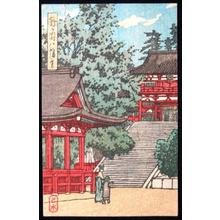
Tsurugaoka Hachimangu Shrine — 鶴ヶ岡八幡宮
by Kawase Hasui
- Medium:
- Woodblock print
- Source:
- Japanese Art Open Database
- Image courtesy of
- Japanese Art Open Database
Description
Tsurugaoka Hachimangū, established at its present Kamakura site by Minamoto no Yoritomo in 1180, is the most significant Shinto shrine in the former military capital and a defining landmark of the Kantō region. A long approach avenue (Wakamiya Ōji) lined with cherry trees leads from the sea toward the shrine complex, with the Genpei Pond in the foreground divided by a causeway. Hasui's composition likely depicts the shrine under a seasonal condition that amplifies its spatial drama—cherry blossom crowding the approach, or the bare winter branches of the boulevard trees against a pale sky. The torii gate, the stone stairway ascending to the upper shrine, or the main hall against the forested hillside behind would provide architectural structure while bokashi sky treatment creates atmospheric recession. The print belongs to the broad category of Kamakura scenic views Hasui produced across his career, connecting to the tradition of pilgrimage imagery associated with the region's religious sites.
More Prints by Kawase Hasui
More Temples & Shrines Prints
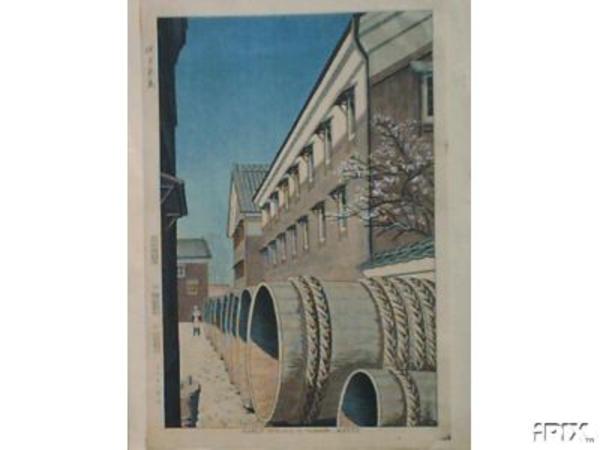
Fushimi Inari Temple
伏見稲荷
Woodblock print

The Compound of the Tenman Shrine at Kameido in the Snow (Kameido Tenmangu keidai no yuki), from the series "Famous Places in the Eastern Capital (Toto meisho)"
c. 1832/38
Color woodblock print; oban
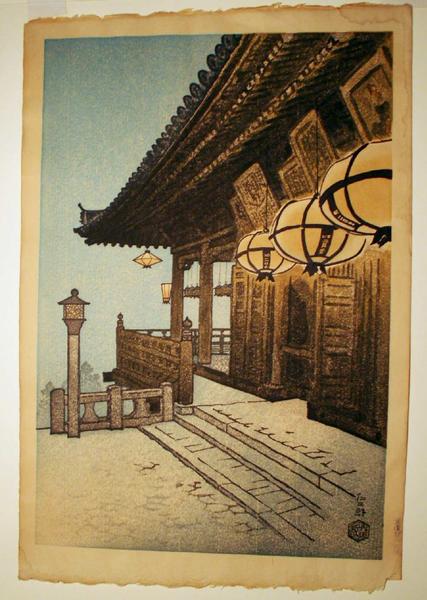
Temple with lanterns
Woodblock print

A Section of the Byodo Temple at Uji (Uji Byodoin no ichibu), from the series "Souvenirs of Travel, Second Series (Tabi miyage dai nishu)"
Uji Byodoin no ichibu
1921
Color woodblock print; oban
Featured in Collections
Curated cross-cuts that include this print.
Frequently Asked Questions
Tsurugaoka Hachimangu Shrine — 鶴ヶ岡八幡宮 was created by Kawase Hasui (川瀬巴水).
Tsurugaoka Hachimangu Shrine — 鶴ヶ岡八幡宮 depicts temples & shrines.